
The fastest way to judge Last Epoch items is to check them in a fixed order: confirm the equipment type and requirements, evaluate the base and its implicits, inspect the affixes and their tiers, then decide whether crafting can turn the item into a real upgrade. Color alone is not enough. A purple Exalted item may contain a valuable tier 6 or tier 7 affix, but the wrong base or several irrelevant modifiers can still make it worse than a well-crafted Rare.
Ordinary Affix Shard upgrades stop at tier 5, while tier 6 and tier 7 affixes normally come from Exalted drops. That is a limit of standard shard crafting rather than every item-development system: special rune interactions can move high tiers between affixes or reach tier 8. Unique and Set equipment, ordinary Idols, Heretical Idols, and corrupted items also follow different rules. Identify the applicable system before planning an upgrade.
Read Every Item in Four Passes
Use the same four-pass inspection whenever an item drops. This keeps one impressive stat or a bright rarity color from distracting you from a weak overall piece.
- Check the slot, class, and level requirement. An item has no immediate value to the character if it cannot be equipped. Class-specific helmets, body armor, and relics are common reasons an otherwise attractive item does not fit.
- Read the base and implicit modifiers. The item subtype determines its inherent stats. These are part of the base rather than ordinary prefixes or suffixes, so two items for the same slot can begin with very different strengths.
- Count useful affixes and note their tiers. Ordinary equipment can have up to two prefixes and two suffixes. Judge how many of those modifiers advance the same offensive, defensive, or resource goal.
- Check what crafting can still accomplish. Standard Affix Shard upgrades reach tier 5. Exalted drops normally supply tier 6 or tier 7 affixes, so preserve useful high-tier modifiers; special rune workflows have their own rules rather than extending the ordinary shard-upgrade button.
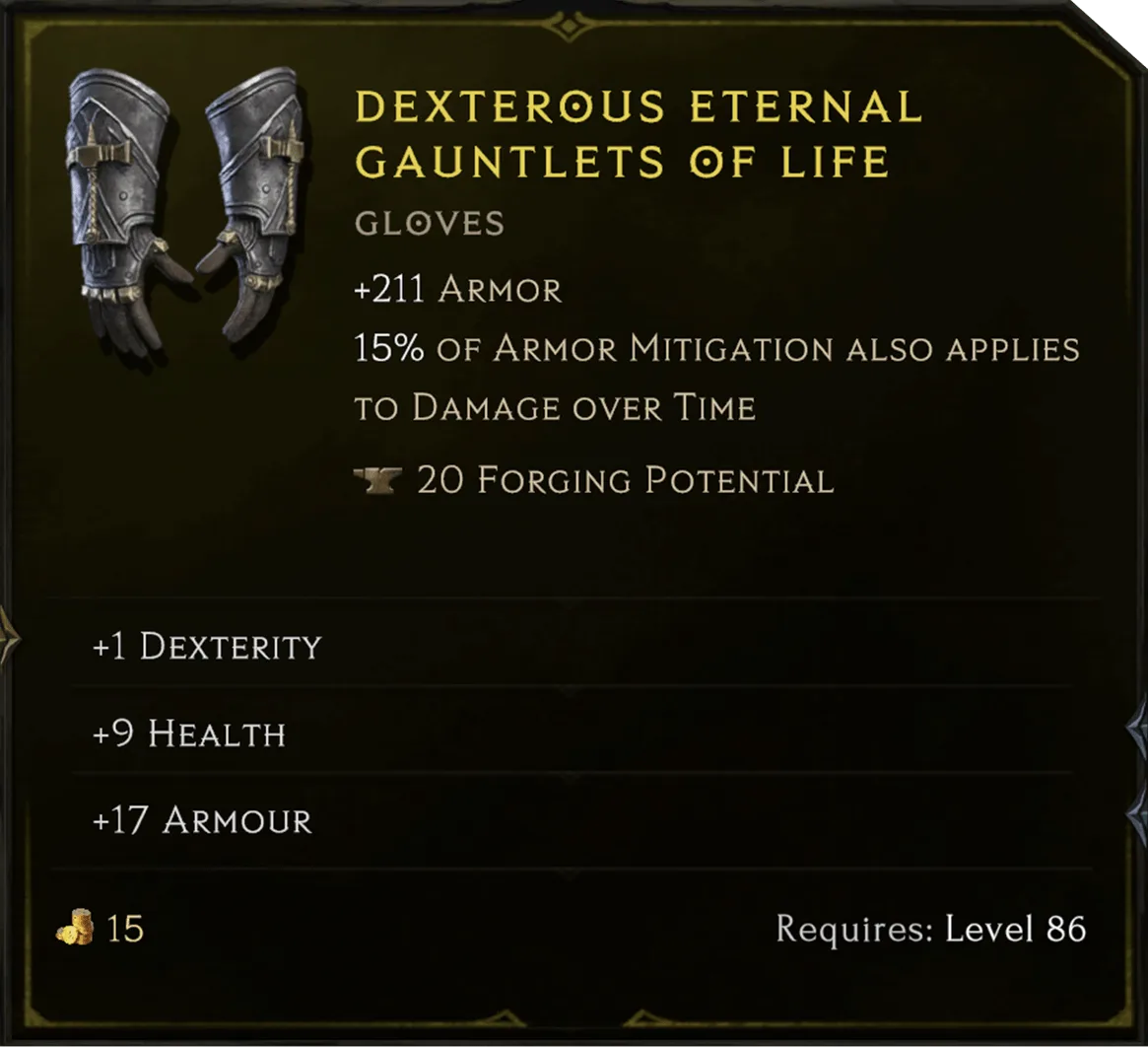
The tooltip separates base information, inherent effects, affixes, and requirements.
An item is a strong candidate when all four passes point in the same direction: the correct slot, a useful base, relevant affixes, and a realistic crafting path. If the base is wrong or the required high-tier affix is absent, extra crafting usually cannot solve the fundamental problem.
Last Epoch Item Rarities at a Glance
Rarity describes the modifiers or special properties currently present on an item. Because crafting can add or improve affixes on ordinary equipment, its rarity can change as the affix count changes.
| Rarity | Color | What it means | Crafting implication |
|---|---|---|---|
| Common | White | The item has no affixes. | It begins with only its base and implicit modifiers. |
| Magic | Blue | The item has one or two affixes. | Empty affix positions leave room for additional ordinary modifiers. |
| Rare | Yellow | The item has three or four affixes, with no more than two prefixes and two suffixes. | Judge both the existing modifiers and whether further changes are worthwhile. |
| Exalted | Purple | The item has an Exalted high-tier affix, normally tier 6 or tier 7 on drops. | Standard shard upgrades cannot create those tiers. Special rune interactions are a separate route; otherwise ordinary affixes still follow the familiar Forge workflow. |
| Unique | Orange | The item has named stats or effects unavailable as ordinary affixes. | It cannot be modified through normal Forge crafting. Some Uniques have Legendary Potential, but that is a separate progression system. |
| Set | Green | The item belongs to a named set whose bonuses depend on equipped pieces. | Read its current state and specific crafting eligibility; ordinary sets and Reforged Set equipment should not be treated as the same upgrade path. |
| Legendary | Red | The item combines a Unique with affixes from an Exalted item. | It is the result of a separate Legendary creation process, not a normal rarity upgrade in the Forge. |
Rarity therefore answers only part of the question. Magic and Rare items may be useful because their base and affixes fit your character. Exalted items deserve attention because tier 6 and tier 7 modifiers are unavailable through ordinary shard upgrades, but the presence of one such modifier does not guarantee that the rest of the item is usable.
Start with the Base and Its Implicits
Every equipment item has inherent modifiers called implicits. Each subtype consistently provides the same kinds of implicits, while their values can roll within a range. This makes the base itself part of the build decision rather than an empty container for affixes.
For example, Arcane Boots emphasize movement and a Ward-related implicit, while Archive Wand provides spell damage and spell mana-cost reduction. These bases solve different problems before ordinary affixes are considered. Read the values and level requirement on the current tooltip, since an old base-stat table is not a substitute for the item in front of you.
Use this sequence when comparing bases:
- Identify the implicit stats that every item of that subtype supplies.
- Compare the actual rolls when an implicit has a range.
- Decide whether those stats support the character's damage, defense, movement, or resource plan.
- Check class and level requirements before spending crafting materials.
- Prefer the better base when two items have similarly useful affixes.
Implicit modifiers apply globally. Increased Physical Damage on a weapon implicit has the same global effect as the same type of modifier from an affix on a ring or from a passive node. The position of the modifier does not make it local to that item.
The practical lesson is simple: do not evaluate only the colored lines added by affixes. A strong collection of affixes on an unsuitable base can leave you with the wrong implicit package, while a good base can make a modest-looking item worth developing.
Affixes, Tiers, and Roll Ranges
Affixes are modifiers added on top of an item's implicits. They can appear when the item drops or be added and improved later with Affix Shards. An item can hold no more than two prefixes and two suffixes, for a normal maximum of four affixes.
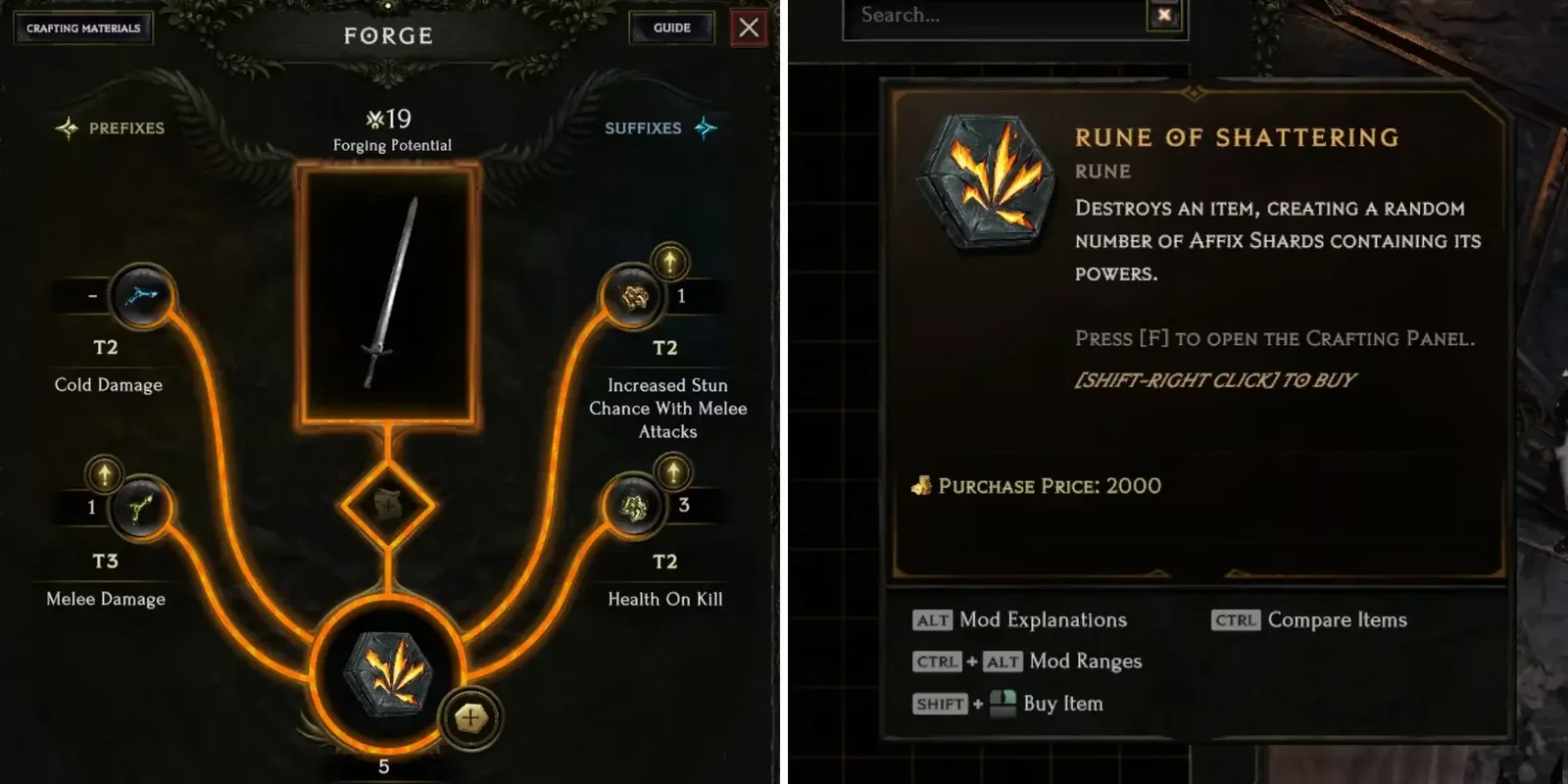
Prefixes and suffixes appear on opposite sides of the Forge panel, with each affix tier shown beneath its icon.
Tier 1 is the lowest ordinary affix tier, and standard Affix Shard upgrades reach tier 5. Exalted drops normally provide tier 6 or tier 7 modifiers. Do not treat tier 7 as the highest result of every current system: a special Rune of Evolution workflow can produce tier 8. Each tier also has its own value range, so distinguish improving the tier from rerolling a value within that tier.
That creates two separate questions when reading an affix:
- Is this the right modifier? A high tier does not help if its effect is unrelated to the character's skills or defenses.
- How strong is its roll within the tier? Two affixes at the same tier can show different values because each tier has a range.
A Rune of Refinement can reroll an affix's value within its existing tier. It does not convert an unwanted modifier into a different one, and rerolling within a tier should not be confused with raising the tier itself.
Like implicits, stats granted by affixes are global. Increased Physical Damage on a ring, a weapon implicit, and a passive node contributes to the same global modifier. This matters when comparing equipment because you should evaluate the final stat package rather than assuming a weapon affix receives special treatment solely from its location.
When you find an Exalted item, identify exactly which affix has the high tier. Then judge whether the base and the remaining modifiers support it. The purple color signals high-tier value, not automatic compatibility with every build.
Use a Keep-or-Skip Evaluation Workflow
A reliable item decision is based on the result you can reach, not merely the item as it dropped. Work through these steps before putting a piece in the stash or spending materials on it.
- Define the job of the slot. Decide whether you need damage, survivability, movement, resource support, or a specific combination. This gives every modifier a clear purpose.
- Reject incompatible requirements. Check the class and level restrictions first. There is no reason to plan an immediate upgrade around an item the character cannot equip.
- Grade the base. Compare the implicit package with other bases available for that slot. A useful affix cannot replace an important implicit that the base never supplies.
- Mark the affixes as required, useful, or irrelevant. Required modifiers enable the intended setup, useful ones support it, and irrelevant ones occupy space without helping.
- Protect high-tier value. If the item contains an Exalted affix you need, treat that modifier as a central reason to keep the item. Ordinary shard upgrades cannot rebuild its tier later.
- Count the prefix and suffix positions. Remember that an item is limited to two of each. A free affix position is useful only if it is on the side needed by the desired modifier.
- Compare the attainable item. Consider what supported crafting actions can change, then compare that likely result with the item already equipped.
This process also gives you sensible criteria for deciding what loot deserves attention without turning item evaluation into a rarity-only rule. The best candidate is usually the item that needs the fewest changes to become useful while preserving the hardest-to-replace stats.
Craft Only After the Item Passes the Evaluation Check
Crafting is most effective when the item already has the correct foundation. Affix Shards can add new affixes or increase the tier of existing ones. Runes modify items in other ways, including removing an undesired affix or rerolling affix values within their ranges. Glyphs are used alongside an Affix Shard or Rune to modify the effect of a craft.
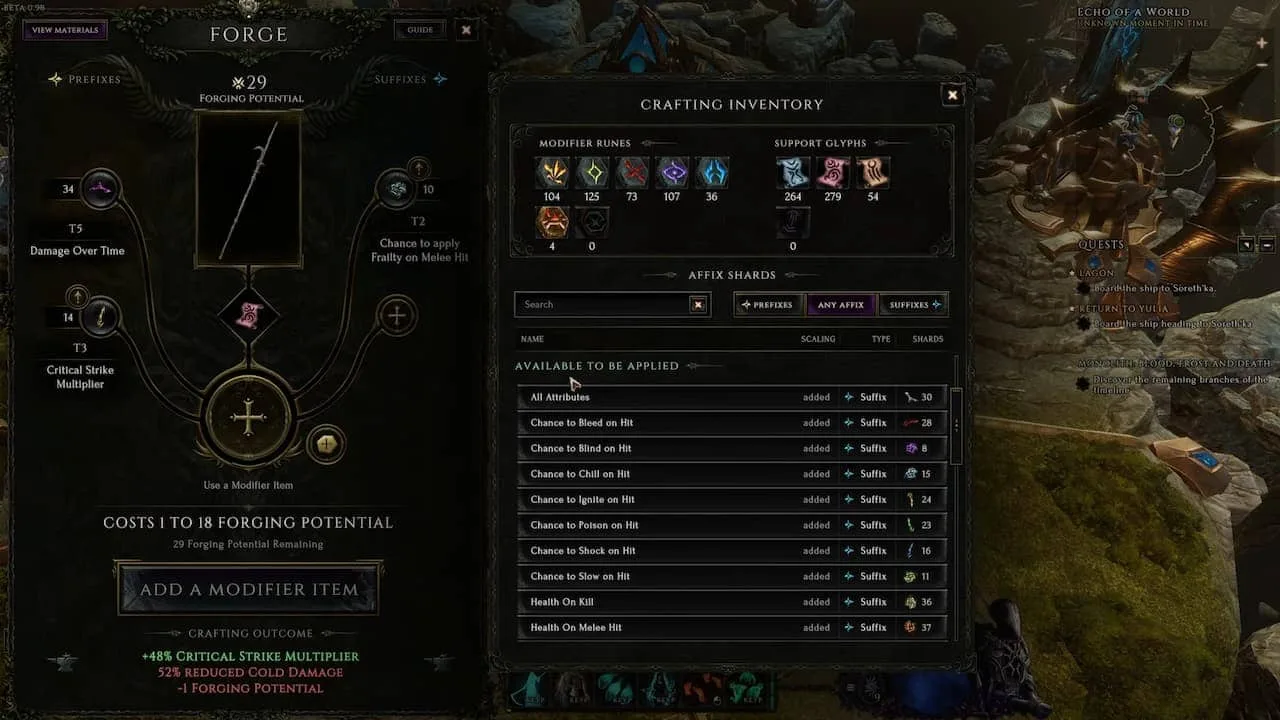
The Forge screen combines the item, crafting controls, and material inventory in one view.
Use this decision order before opening the Forge:
- Confirm that the item is eligible for the intended craft. Ordinary equipment, Reforged Sets, uniques, and special Idols do not share every operation.
- Verify that its base and implicit modifiers are worth keeping.
- Identify the exact affix you want to add or improve.
- Check whether the item already contains a tier 6 or tier 7 modifier that must be preserved.
- Choose a shard, rune, or glyph for a specific supported outcome rather than crafting simply because the item has a high rarity.
Eligible unwanted ordinary equipment can be shattered in the Forge to recover Affix Shards. Do not assume every non-Unique object is a valid target: check the operation and item state in the Forge. Consider shattering only after deciding that the item itself is not a useful base, upgrade, or Exalted candidate.
Unique items cannot be modified through ordinary Forge crafting. Their named properties may create effects unavailable on lower-rarity items, and some can participate in Legendary creation through Legendary Potential. Evaluate that special function separately instead of applying the Magic, Rare, or Exalted crafting workflow to them.
Special rune workflows are separate from shard upgrades
A high-tier rune craft is not the same operation as repeatedly adding a shard. One late Warpath gearing route begins with a Leonine Greathelm carrying a tier 7 Exalted modifier and tier 1 Reduced Channel Cost. Rune of Havoc can redistribute affix tiers so that Reduced Channel Cost becomes tier 7, after which Rune of Evolution can raise it to tier 8.
That example does not make a desired result automatic. Havoc changes the tier arrangement instead of letting you select a guaranteed destination; examine the entire result before continuing. Preserve a functional helmet before investing in this late upgrade. The important distinction is that shard upgrades have one ceiling while named runes may have specific exceptions, eligibility requirements, and costs.
Equipment Slots and Requirements Still Matter
Equippable gear includes helmets, amulets, weapons, body armor, offhands, two ring positions, belts, gloves, boots, and relics. The slot determines what can be equipped, while the item's class and level requirements can further restrict the character that uses it.
Some examples show why requirements belong at the beginning of the evaluation:
| Item | Type and restriction | Listed base profile | Immediate evaluation question |
|---|---|---|---|
| Adept Helm | Mage Helmet | Early Mage armor base | Does the character meet the current class and level requirements? |
| Ancestral Crown | Primalist Helmet | Armor and Endurance-oriented implicits | Does the Primalist benefit from this defensive package? |
| Argent Crest | Sentinel Relic | Cold and Lightning Resistance implicits | Are both resistance types useful enough to justify the base? |
| Archive Wand | Wand | Spell damage and spell mana-cost reduction | Does the skill setup value both spell damage and mana efficiency? |
These examples are base comparisons, not universal rankings. A lower-level base can be appropriate during progression, while a high-level base can still be wrong for the character's actual stat plan.
Idols Follow Different Rules
Idols are equipment with a separate inventory area on the right side of the normal inventory. Quest progression expands that area up to 20 slots. The relevant decision is not only whether an Idol has useful stats, but also whether its dimensions fit the available grid.
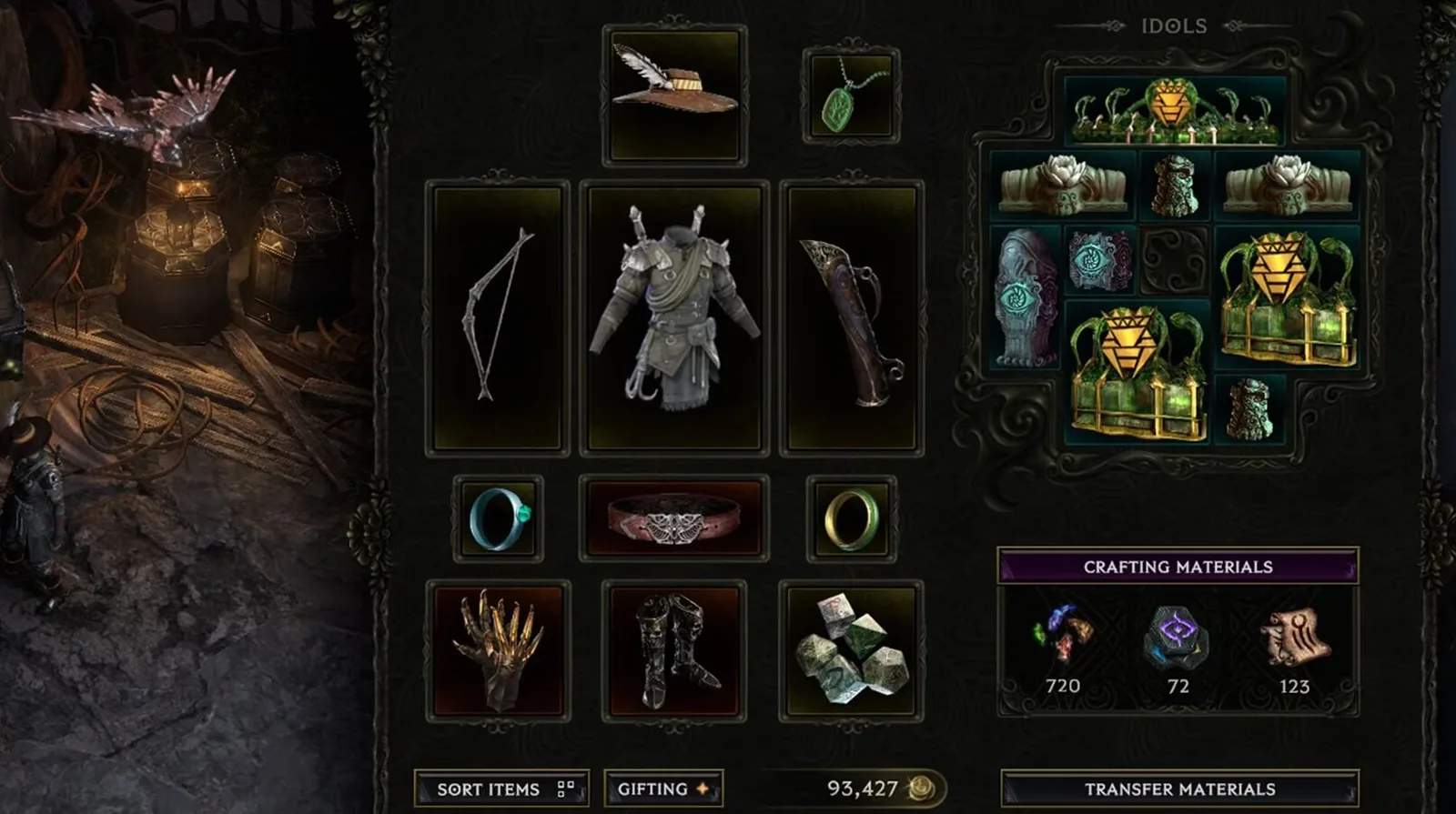
The Idol Grid uses different shapes and sizes alongside the character’s equipment slots.
Idol sizes range from 1 × 1 to shapes including 2 × 2, 1 × 4, and 4 × 1. Larger sizes provide more of each stat, and many Idol stats are restricted to particular sizes. Most Idols are limited to a specific base class, and class-specific Idols have their own possible affixes.
An ordinary Idol drops with one prefix and one suffix. Standard Affix Shard crafting does not let you tune those two modifiers, so check the class restriction, dimensions, prefix, suffix, and grid fit before keeping it. An Idol Altar changes the grid’s shape or properties; it does not make every Idol compatible with ordinary shard crafting.
Special Idol systems add other development paths. The Woven Enchanter can turn eligible class-specific Idols into Heretical Idols, preserving their ordinary modifiers and adding enchanted affixes plus Weaver’s Touch. Equipped kills can spend that resource to develop the enchantments, and re-enchantment replaces the old enchanted result. Omen Idols are a different family that drop already corrupted. A corrupted state is final and prevents further modification.
These distinctions matter when planning an upgrade. “Cannot use ordinary shard crafting” does not mean “cannot change through any game system.” Identify the Idol’s family, remaining Weaver’s Touch, and corrupted state before deciding whether it can still develop. Finish any eligible development before accepting an irreversible corruption result.
Avoid the Most Common Item Evaluation Mistakes
- Choosing by color alone. Purple confirms at least one tier 6 or tier 7 affix, but it does not confirm a useful base or a coherent modifier package.
- Reading affixes before implicits. The base establishes permanent inherent stats that ordinary affix choices do not replace.
- Expecting a normal shard upgrade to create an Exalted tier. Standard shard upgrades stop at tier 5. Special high-tier rune workflows have separate requirements and should not be confused with that ordinary operation.
- Ignoring prefix and suffix limits. Four affixes do not mean four interchangeable positions. The normal limit is two prefixes and two suffixes.
- Treating the roll and tier as the same thing. An affix has both a tier and a value within that tier's range.
- Applying the normal Forge plan to Uniques or Sets. Their special effects and restrictions require a different decision path.
- Treating every Idol as the same finished object. Ordinary prefixes and suffixes cannot be tuned with shards, but Heretical enchantments develop through Weaver’s Touch. A corrupted Idol is already final.
- Keeping every high-level base. A demanding level requirement does not prove that the implicit package supports the character.
- Discarding a Magic item automatically. A good base with one or two relevant affixes may offer a clearer crafting direction than a Rare filled with unrelated modifiers.
A Repeatable Gearing Routine
When sorting a full inventory, inspect bases first and rarity second. Separate items with useful implicit packages, then identify which of them contain relevant affixes. Give special attention to useful Exalted drops because ordinary shard upgrades cannot recreate their tiers. Finally, compare what supported crafting can produce with the equipment already worn.
The routine can be reduced to five checks:
- Can the character equip it?
- Does the base provide the right implicits?
- Are the affixes relevant, correctly positioned, and strong enough?
- Does it contain high-tier value that the intended crafting operation can preserve?
- Can the remaining crafting options produce a genuine upgrade?
If the answer breaks down at the base or required-affix stage, skip the item or consider shattering it if it is eligible. If the foundation is correct, craft toward a defined result. This makes Last Epoch items easier to compare because every decision follows the same hierarchy: requirements, base, implicits, affixes, tiers, then crafting.