
Last Epoch uniques are equipment with special stats or effects that ordinary affixes cannot provide. The right unique can enable a build, accelerate a new character, or solve a specific defensive problem, but the orange name alone does not make every drop valuable. Judge each item by what its effect does for your build, the quality of its rolls, its Legendary Potential, and what you give up by replacing your current gear.
For a fast decision, read the unique effect first. Keep the item if it changes a skill you use, supplies an unusually useful leveling effect, fills an important defensive or utility need, or has strong Legendary Potential. If none of those conditions applies, compare its ordinary stats with the item already in that slot before spending stash space on it.
What makes a unique item different
Magic, rare, and exalted equipment are largely defined by normal affixes. A unique can provide effects outside that normal affix pool, including new interactions between skills, alternate ways to scale an existing mechanic, or entirely new mechanics. This is why some uniques are useful even when their raw damage, armor, or resistance numbers appear modest.
Uniques cannot be modified through ordinary crafting. Some can instead drop with Legendary Potential, an additional property used when creating Legendary items. Legendary Potential can make an otherwise ordinary copy much more valuable, but it should not distract you from the item's actual purpose. A high-potential unique that does nothing for your build is still not an automatic upgrade.
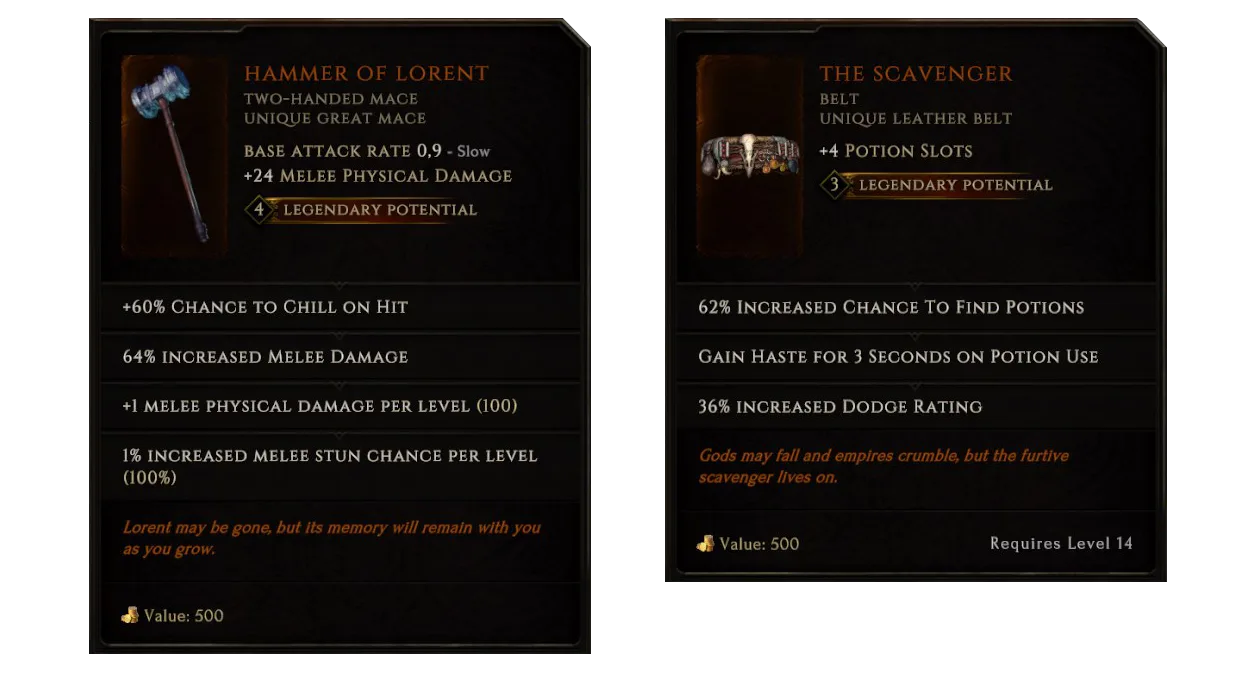
Unique item tooltips make special effects and Legendary Potential visible at a glance.
When inspecting a unique, separate its information into four parts:
- Base and slot: Check the weapon type or armor slot and whether equipping it displaces an important implicit or affix package.
- Unique effect: Identify the skill, ailment, defense, resource, minion, or movement mechanic the item changes.
- Roll ranges: Compare the actual values on this copy rather than judging every copy by the same standard.
- Extra potential: Note Legendary Potential, but evaluate it after confirming that the underlying item is useful.
This order prevents a common mistake: keeping an item only because it is rare while overlooking a severe mismatch with the character that would wear it.
A practical keep-or-pass checklist
Use this sequence whenever a unique drops:
- Read the complete effect. Do not stop at the largest number. Trigger conditions, restrictions, and drawbacks can determine whether the item works at all.
- Match it to an active mechanic. A modifier for melee hits, spellcasting, a named skill, minions, ailments, or potion use needs a build that can actually activate and scale it.
- Check the required slot. Gloves, amulets, body armor, and weapons can carry valuable ordinary affixes. The unique must justify losing those alternatives.
- Inspect every variable roll. Two copies of the same unique can differ enough that one is attractive and the other is not.
- Check Legendary Potential. A unique with two or more Legendary Potential deserves careful inspection even when you do not need it immediately. Very rare items can be notable with even one.
- Consider another character. A weak fit for the current build may be an excellent leveling item or the foundation of a different build.
- Make one clear decision. Equip it, reserve it for another character, keep it as a promising Legendary base, or leave it behind.
A build-enabling effect should normally receive more weight than a small numerical improvement. If an item converts a skill, adds a new trigger, or changes how a resource works, test the entire interaction on paper before comparing damage numbers. Conversely, a broadly useful defensive unique may be worthwhile without changing your rotation at all.
Choosing uniques for leveling
Leveling uniques are valuable because they solve immediate campaign problems: movement, early damage, sustain, crowd control, or defenses. Their usefulness usually comes from a strong effect available at a low level, not from being permanent endgame equipment.
Movement and campaign speed
Arboreal Circuit is a leveling ring whose most useful campaign stat is Movement Speed. Its Illusory Tree effect can distract enemies, and its minion armor can help a minion character. Check the movement roll and current level requirement on the copy you own instead of assuming every version has an identical maximum.
Mourningfrost can also help with campaign movement, but read its current tooltip and drawbacks before combining it with other speed items. Judge the actual equipped setup rather than adding maximum rolls from an old guide. Movement uniques are useful when damage is already sufficient and travel time is the main bottleneck; they are less useful when they make the next boss harder to survive.
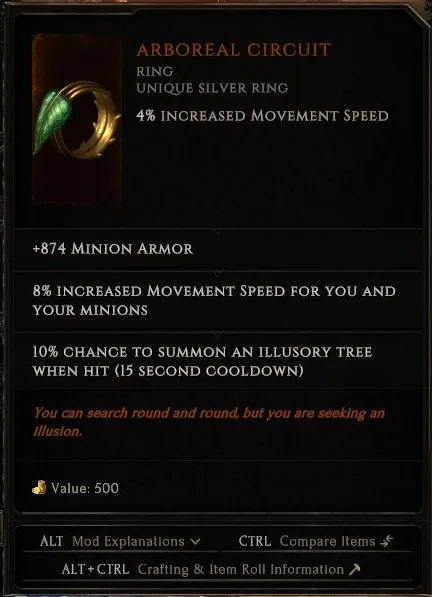
Movement speed is not the only consideration. If faster gear leaves your resistances, sustain, or damage too weak for comfortable progress, replace one piece instead of forcing the full combination. A leveling unique succeeds when it reduces the time and friction needed to advance, not when it produces the largest isolated movement number.
Early damage and sustain
Firestarter's Torch is an early-clearing option when you meet its current level requirement. Its chance to inflict Spreading Flames supplies fire damage over time that spreads to nearby enemies, making it especially useful for early clearing on characters that hit enemies. Its damage affixes further support that effect.
Taste of Blood offers Bleed chance alongside added damage; compare the current roll and required level on your own item. Most of its Bleed chance applies on melee hit, so it is a targeted choice for melee characters rather than a universal leveling weapon.
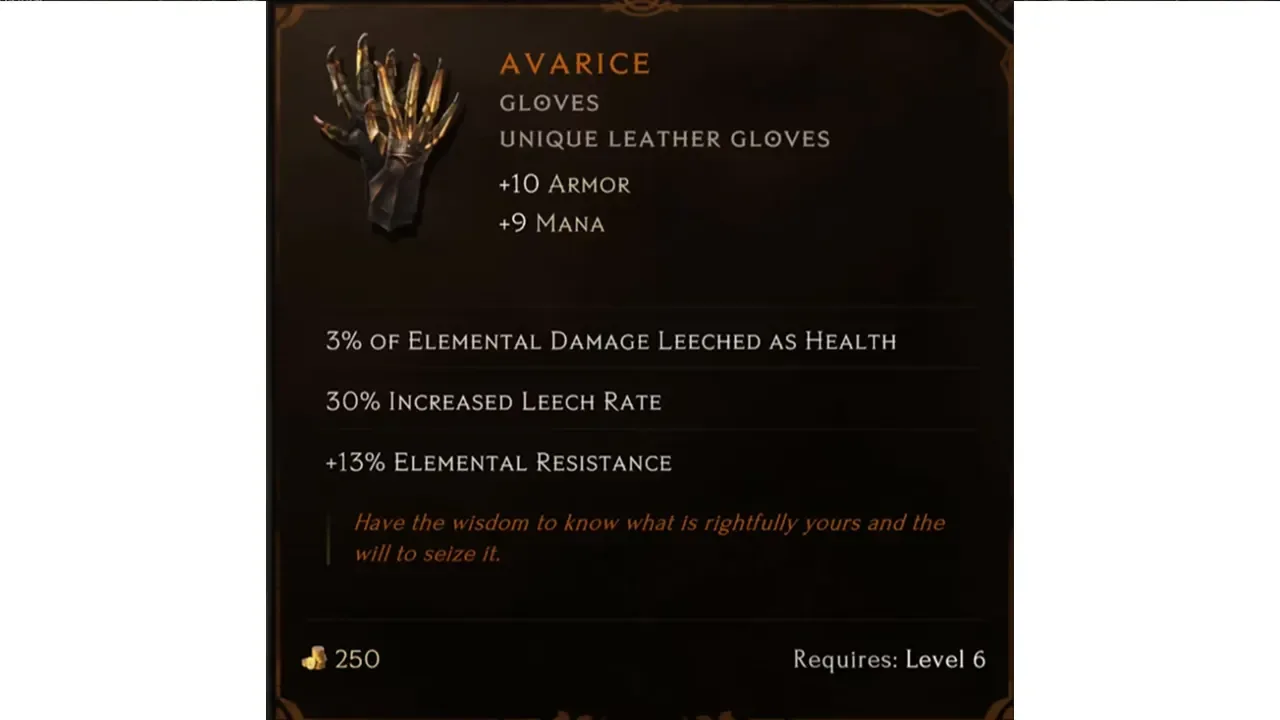
Avarice comes from the early Erza's Ledger side quest when you give the ledger to Elder Erza. Giving it to Artem instead provides the alternative quest reward, Gambler's Fallacy. The gloves provide several resistances and elemental leech, making them broadly useful and especially attractive to characters dealing fire, cold, or lightning damage.
Bleeding Heart can provide exceptional leech for a melee or throwing attack character, but frequent spellcasting creates a serious drawback because its self-inflicted Bleeds can become dangerous. This is a good example of why a powerful line on a unique cannot be judged separately from the rest of its effect.
Other leveling drops still require the same build check. Vipertail supports characters that hit and can benefit from poison. Dreamthorn supplies substantial added melee damage for its level and can carry a Void melee character farther than many early weapons. Tome of Elements combines leech with elemental ailments, while Torch of the Pontifex emphasizes Ignite for single-target damage. The correct choice depends on what your character actually scales.
Evaluating endgame uniques
Endgame evaluation is less forgiving because each equipment slot competes with stronger ordinary affixes, exalted affixes, and specialized defenses. A unique should either provide an effect that the build cannot obtain elsewhere or deliver enough combined value to justify that opportunity cost.
Use the following comparison instead of asking whether an item is generally considered good:
| Check | What to compare | Reason it matters |
|---|---|---|
| Build function | The unique effect against your skill and damage plan | An inactive effect contributes nothing |
| Defensive cost | Lost health, resistance, armor, endurance, or other defenses | A damage gain can still weaken the full build |
| Roll quality | Every variable value on the dropped copy | Some uniques change sharply with their rolls |
| Slot pressure | The unique against other desirable items in the same slot | Strong gloves or amulets may carry a high replacement cost |
| Legendary Potential | The potential on this exact copy | It can raise the item's long-term ceiling |
| Rarity and replacement | How difficult another usable copy is to obtain | Rare copies deserve more cautious handling |
Some items illustrate different reasons to keep a drop. Ravenous Void offers broad defense but competes with valuable glove affixes and requires a way to remove Mimic Feast. Herald of the Scurry is highly specialized: it is a priority for a Squirrel build, but that narrow purpose makes it far less important to unrelated characters. Aurora's Time Glass offers a powerful survival effect and endurance, while a copy with Legendary Potential is especially uncommon.
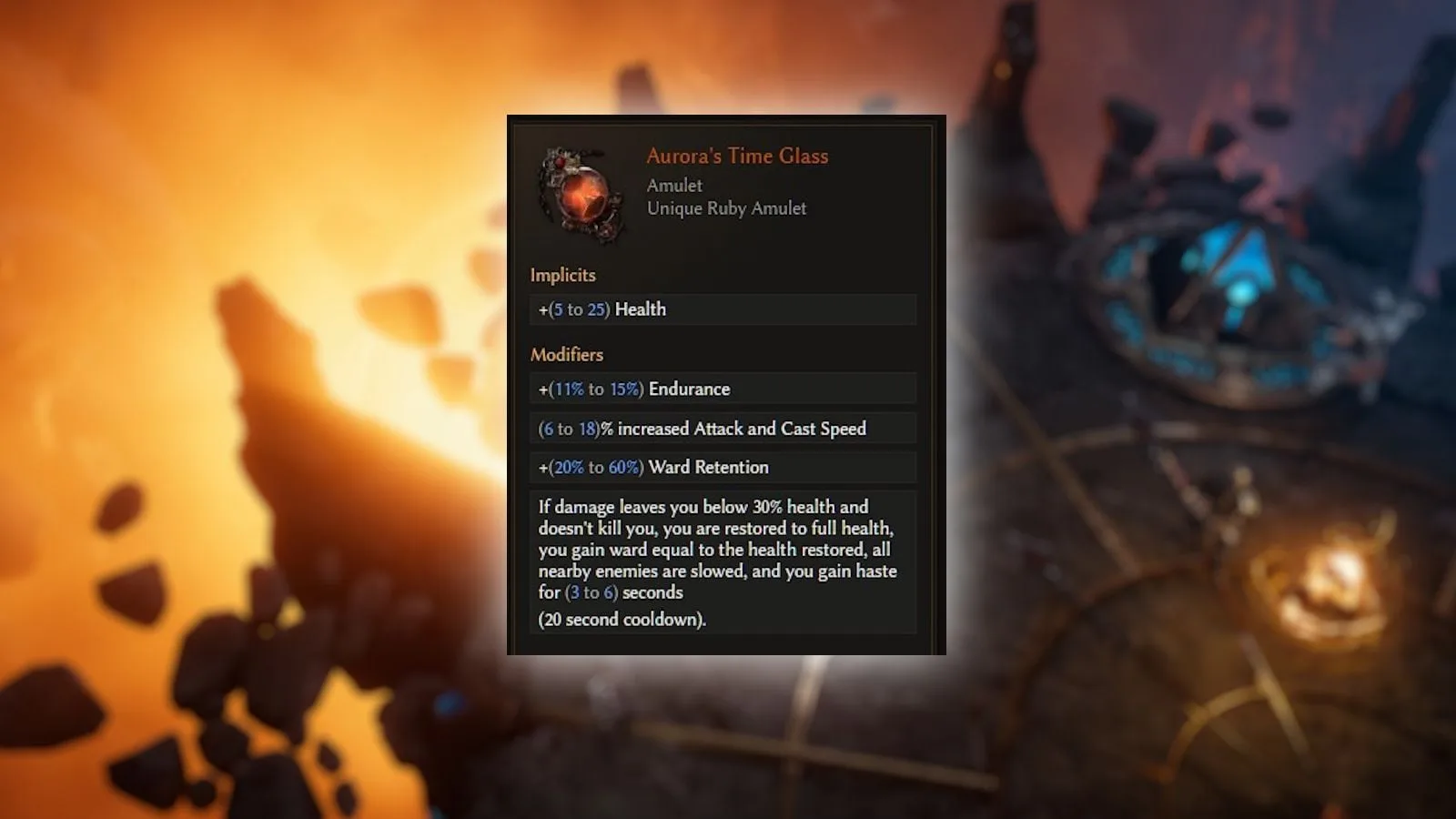
Aurora's Time Glass shows how a unique effect and Legendary Potential influence endgame value.
The lesson is not to collect a fixed list of supposedly mandatory items. It is to recognize the type of value each unique offers. A universally useful leveling item, a rare defensive option, and a build-defining helmet should not be judged by the same standard.
How to compare duplicate copies
Do not automatically discard the second copy of a unique. Place the two tooltips side by side and compare them in this order:
- Compare the roll that controls the item's defining effect.
- Compare any defensive or utility rolls that would be difficult to replace elsewhere.
- Check whether the item has variant effects or other properties that make the copies function differently.
- Compare Legendary Potential only after the functional rolls.
- Keep the copy that best fits its intended build, not merely the one with the largest total of unrelated numbers.
For a leveling item such as Arboreal Circuit, Movement Speed is the most important roll because campaign speed is its main job. For an endgame item with several independently rolled defenses, a balanced group of useful rolls may matter more than one maximum value. For a build-enabling unique, the roll tied to the enabling mechanic usually deserves priority.
If both copies are useful in different ways, label or separate them by purpose: one for immediate use and one as a future Legendary base. This is more reliable than filling a stash tab with unreviewed duplicates.
Handling a useful unique with no Legendary Potential
A zero-potential unique is not automatically worthless. It may still be the best available item for leveling or the only copy you have of a build-enabling effect. Equip it if it solves the present problem, and replace it only when a stronger copy or a better slot option appears.
Some endgame Nemesis encounters may also let you exchange one of your own unique items that has neither Legendary Potential nor Weaver's Will. That interaction can transform the item into a Legendary or enhance it with Legendary Potential. This gives selected zero-potential items another possible route instead of leaving them permanently unchanged.
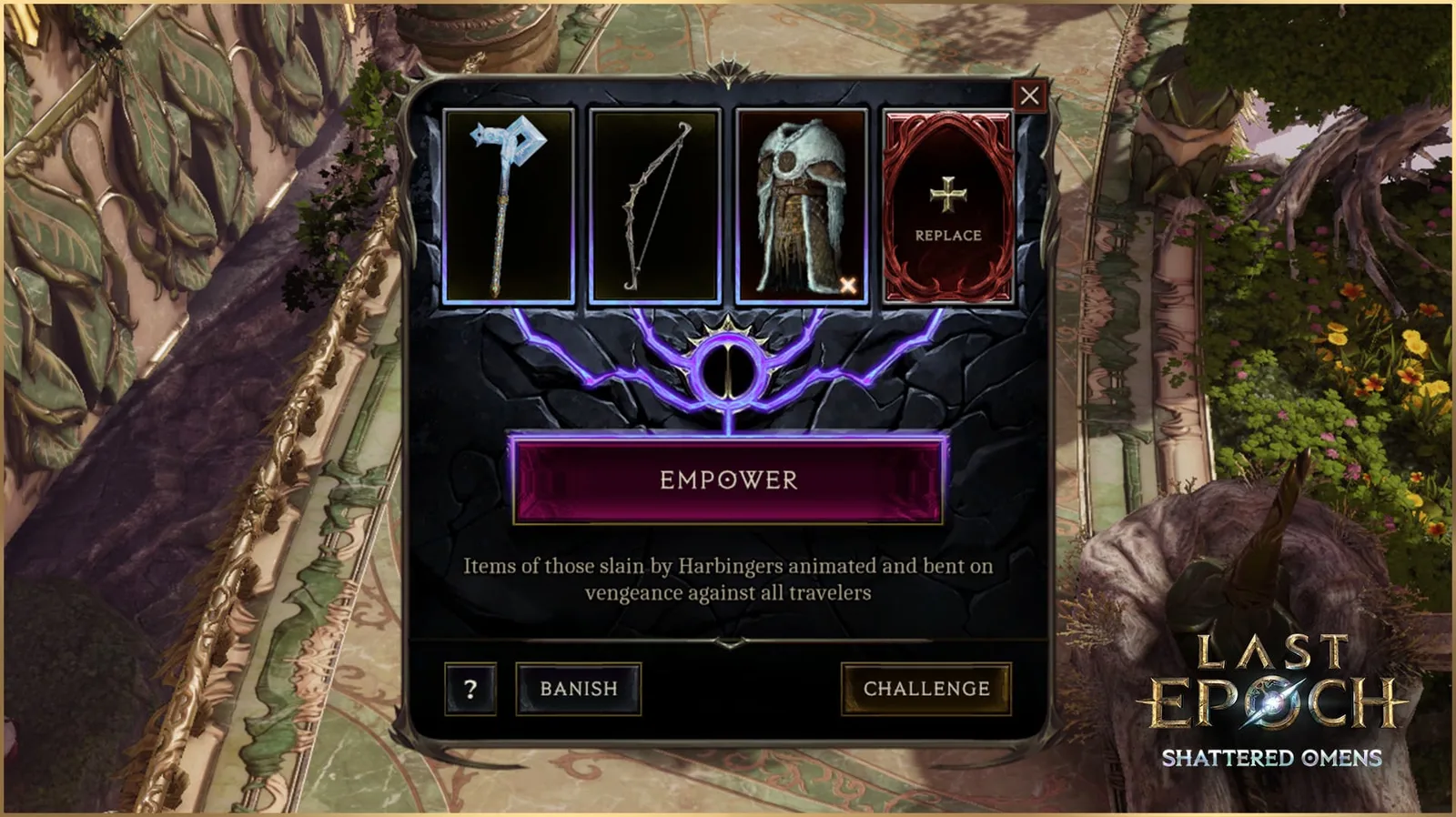
The Nemesis interface separates Empower from Challenge and Banish.
At a Nemesis, the three choices have different consequences:
- Banish removes the current Nemesis without a fight and replaces its reward set in the next encounter.
- Challenge begins the fight and awards the displayed items if you win, after which a new Nemesis and reward set can appear.
- Empower begins the fight but allows the Nemesis to escape through a rift when defeated. Meeting it again presents empowered rewards, which can gain affixes, higher affix tiers, Forging Potential, or other upgrades. A Nemesis and its items can be empowered twice before you must Challenge or Banish.
Use this system selectively. Reserve the exchange opportunity for an item whose unique effect and rolls already justify further investment. Enhancement cannot turn an irrelevant effect into one that fits your build.
Common mistakes when judging uniques
- Treating rarity as proof of power: A rare drop can still be wrong for the current build or badly rolled.
- Ignoring the drawback: Restrictions, self-damage, trigger costs, or lost defenses can outweigh an attractive benefit.
- Looking only at damage: Movement, sustain, crowd control, and defense can improve real progression more than another damage modifier.
- Equipping by item name alone: The values on the specific copy matter, especially when important stats roll independently.
- Overvaluing Legendary Potential: Potential raises the ceiling of a useful item; it does not repair a fundamental build mismatch.
- Discarding all zero-potential copies: The base unique may still be immediately useful, and selected items may have another enhancement route through Nemesis encounters.
- Assuming an unlisted unique is bad: The value of many uniques is highly situational, so no short list can represent every viable build.
The most dependable rule is simple: keep a unique when you can name the job it performs. If you cannot identify the skill interaction, leveling benefit, defensive purpose, or future use that justifies the slot, it is probably safe to pass on that copy.