Last Epoch Legendary Potential determines how many affixes an eligible unique receives when you combine it with an exalted item in the Eternity Cache. The unique needs at least one Legendary Potential, and the exalted donor needs exactly four unsealed affixes of a compatible equipment type. Complete Temporal Sanctum, defeat Julra, and use the Cache to make the combined item.
At Tier 2 or higher, you can choose one donor affix to guarantee its transfer. Any remaining transfers are random. That makes a one-LP unique capable of receiving a specific important affix without requiring a four-LP drop. Prepare the donor before the run, check the dungeon tier's unique-level restriction, and keep corrupted items out of the process.
Read LP separately from Forging Potential
Legendary Potential, usually shortened to LP, belongs to the unique used as the base. It can range up to four, and each point corresponds to one affix transferred from the donor. The unique's existing properties remain part of the resulting item; the donor supplies additional affixes rather than replacing the unique's identity.
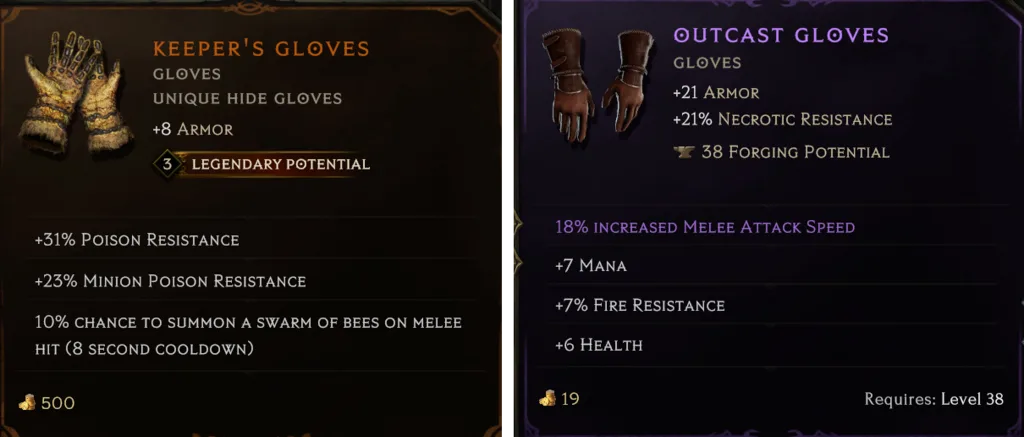
Forging Potential is a separate resource used for ordinary crafting. It does not replace LP, and an exalted item with zero Forging Potential can still qualify for Legendary crafting. That distinction lets you spend the donor's crafting potential improving its affixes before taking it to the Cache.
| Unique's LP | Affixes transferred | Tier 2 or higher selection |
|---|---|---|
| 1 | One | Choose the one affix you need |
| 2 | Two | Choose one; the remaining transfer is random |
| 3 | Three | Choose one; the remaining transfers are random |
| 4 | Four | All four unsealed donor affixes transfer |
LP is not a general item-quality score. A powerful unique with one useful added affix can be more relevant to your build than an unrelated unique with more LP. Decide which item's effect you need first, then assess the additional affixes. Starting with the largest LP number can lead you toward an item that does not solve your actual equipment problem.
A unique without LP cannot enter this ordinary Cache combination. Do not assume a full donor, a higher dungeon tier, or extra Forging Potential creates the missing LP. Qualify the base before spending time finishing a donor specifically for it.
Qualify both materials before crafting
Choose a unique with at least one LP and an exalted item of the same compatible equipment type. A shield donor belongs with a shield unique; a useful affix on an unrelated item type does not make that item an eligible substitute. Confirm compatibility in the Cache rather than trying to infer it solely from matching damage statistics.
The donor must have exactly four unsealed affixes. A sealed affix can exist in addition, but it is ignored for the Legendary transfer. The useful affix therefore needs to occupy one of the four eligible slots if you want to select or randomly receive it.
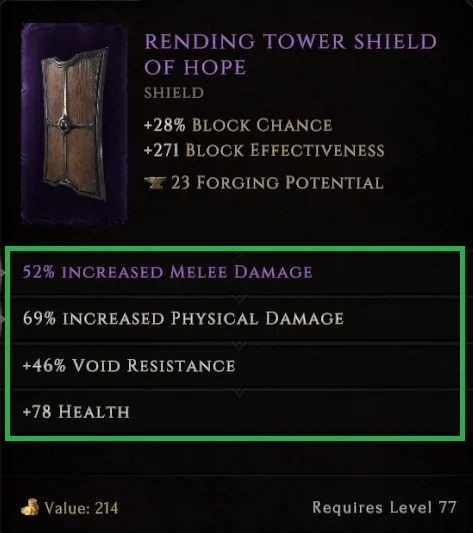
Use this material check before the dungeon:
- Identify the unique you intend to equip after crafting.
- Confirm that its tooltip actually shows LP.
- Choose a compatible exalted donor.
- Count all four unsealed affixes separately from any sealed affix.
- Decide which eligible affix matters most.
- Check that the resulting class and level requirements will suit the character.
- Verify that neither material is corrupted.
Corrupted items cannot be used to create Legendary items. If the planned route includes both a Legendary craft and item corruption, the corruption decision cannot come first on materials you still need for the Cache. Treat a Corrupt label as an eligibility problem, not as a sign that the item is an especially strong donor.
Class-specific affixes can affect the resulting Legendary's usability. A unique that appears broadly usable before crafting may become class-specific after a class affix transfers. Read those affixes carefully when preparing equipment for an alt, and do not select a skill bonus for a class that cannot use the finished result.
Finish the donor around your chosen outcome
A good donor is not merely purple. It contains the affix that provides the intended improvement, plus other eligible affixes that are acceptable if the unique has more than one LP. Decide what success looks like before spending crafting materials: more health, a relevant damage improvement, recovery, or a supported skill bonus.
Improve the donor's eligible affixes while its Forging Potential allows. Having zero potential left does not disqualify it, so keeping unused potential solely for the Legendary combination is unnecessary. However, ordinary crafting still has its own risks and constraints; confirm that a change preserves the affix you intend to transfer.
Do not remove affixes until only the desired one remains. The four-unsealed-affix rule still applies even when the unique has one LP. A donor with a single excellent affix and empty slots is unfinished rather than a way to force the transfer.
A sealed fifth affix is also not a backup transfer candidate. If the best modifier is sealed, selecting a different ordinary affix will not move that sealed one with it. Compare the four actual eligible affixes, not the donor's total visible power as an equipped item.
For a two-LP or three-LP attempt, strengthen the remaining affix pool. The guaranteed selection protects one outcome, but it does not let you pick every transfer. A donor with one perfect affix and three irrelevant ones may be reasonable for a specific one-LP plan while being less attractive when you are sacrificing a valuable higher-LP base.
Choose the Temporal Sanctum tier deliberately
Higher Temporal Sanctum tiers let you use higher-level uniques. Tier 1 accepts uniques up to a level requirement of 50, Tier 2 up to 65, and Tier 3 up to 75. Tier 4 removes the unique-level restriction. Check the unique's requirement rather than the character's level or the donor's affix tier when planning the run.
| Sanctum tier | Maximum unique level requirement | Guaranteed donor-affix choice |
|---|---|---|
| Tier 1 | 50 | Unavailable |
| Tier 2 | 65 | One affix |
| Tier 3 | 75 | One affix |
| Tier 4 | No restriction | One affix |
Even when Tier 1 accepts your unique, Tier 2 or higher can be preferable if guaranteeing one affix is central to your plan. The choice involves dungeon difficulty as well as crafting control. Do not sacrifice a key to a harder run that you cannot yet complete simply because the selection is attractive.
If your unique requires a higher tier than you can safely finish, keep both materials and improve the character first. An otherwise excellent donor does not lower the unique's entry restriction. A lower-tier learning run can help you understand Julra before using the higher tier required by your intended item.
You can only make one Legendary per dungeon run. If you have several prepared pairs, prioritize the one that fixes the clearest problem. Multiple pairs in the stash do not turn a single completed run into unlimited Cache uses.
Use the Eternity Cache in order
Defeat Chronomancer Julra and enter the room containing the Eternity Cache. Stash access is available in that room, so you can retrieve prepared materials there. Preparation still matters: access to your stash saves carrying space, but it does not make an incompatible donor or missing LP acceptable.
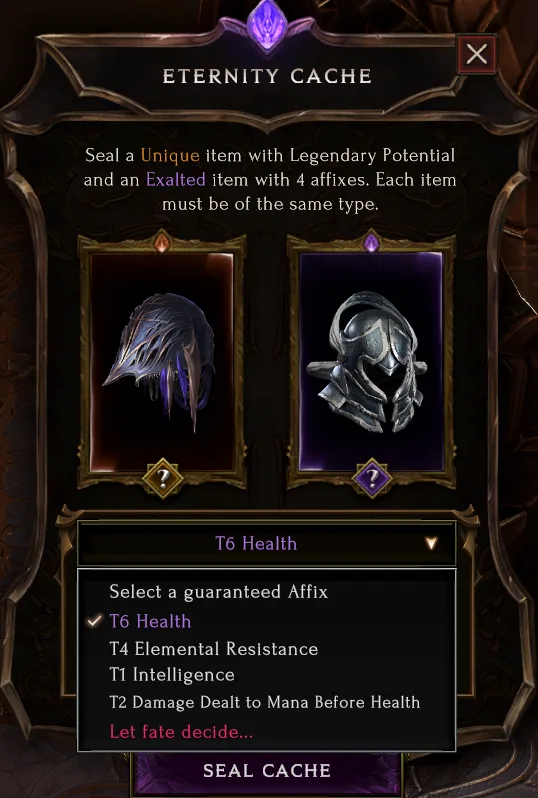
The practical sequence is:
- In the Divine Era, place the eligible unique and exalted donor in the Cache.
- At Tier 2 or higher, select the donor affix you want guaranteed.
- Recheck the items and the selected affix before committing.
- Use Temporal Shift to move into the Ruined Era.
- Retrieve the Legendary result and inspect its requirements and transferred affixes.
Choose the guaranteed affix according to your planned replacement. If the unique is intended to fix a defensive gap, a large offensive number can be less valuable than the defensive affix you prepared. If the item enables a specific skill setup, ensure the selected modifier belongs to that setup rather than another character's eventual build.
The remaining transfers come from the same donor. Two LP does not mean you can supply two different exalted items and take the best affix from each. Build the whole donor around the attempt before starting the run.
The final Legendary's level requirement can be higher than that of the original unique, depending on the affixes transferred. Inspect the result before moving it to a leveling character. Successful crafting and immediate equipability are two separate outcomes.
Farm LP without assuming every bonus applies
The amount of LP a unique drops with is influenced mainly by the level of the area where it drops, with corruption providing a smaller increase. Increased item rarity and character level do not themselves raise the LP roll. Do not choose a farming strategy merely because it increases ordinary rarity if your specific goal is a better LP version.
Uniques also differ in how readily they receive LP. Powerful or highly scalable items can be difficult to find with even one LP, while simpler leveling items often receive more. A high equip-level requirement alone is not a complete explanation of an item's LP behavior.
For Circle of Fortune, distinguish finding the unique from improving the potential on unique rewards. A lens that changes the rarity weighting of Unique and Set items serves a different goal from one that improves average LP. The relevant choices depend on whether you are missing the item entirely or looking for an improved version of one you already have.
Do not turn a displayed database probability into a fixed number of runs until a drop. The area and other stated conditions matter, and even a properly eligible farm can produce a long sequence without the version you want. Keep a workable unique equipped while collecting a better crafting base rather than making every upgrade wait for a rare high-LP outcome.
Decide when a modest craft is enough
Use a one-LP item when one selected affix would already create a meaningful upgrade. At Tier 2 or higher, that plan has a clear outcome: the selected eligible affix transfers. You can therefore build a practical improvement around a specific donor without waiting for the rarest possible base.
Use higher LP when several additional affixes matter and you have a donor worth sacrificing. Evaluate the random portion before committing, especially if the current equipped item is already strong. More transfers are valuable only when the pool contains useful modifiers and the resulting item fits your build.
Keep a replacement available when attempting ambitious upgrades. The donor and unique are committed to the combination; a result with disappointing random affixes should not leave you without functional equipment. Preparing a backup is especially useful when the unique's underlying effect is necessary for your current skills.
If the Cache rejects your materials, check LP, equipment compatibility, the four unsealed affixes, corrupted status, and the tier's unique-level limit. If it accepts them but the result is less useful than expected, examine which affix you selected and which remaining affixes were possible. Those checks identify the actual problem without confusing LP, ordinary crafting potential, or the dungeon tier.