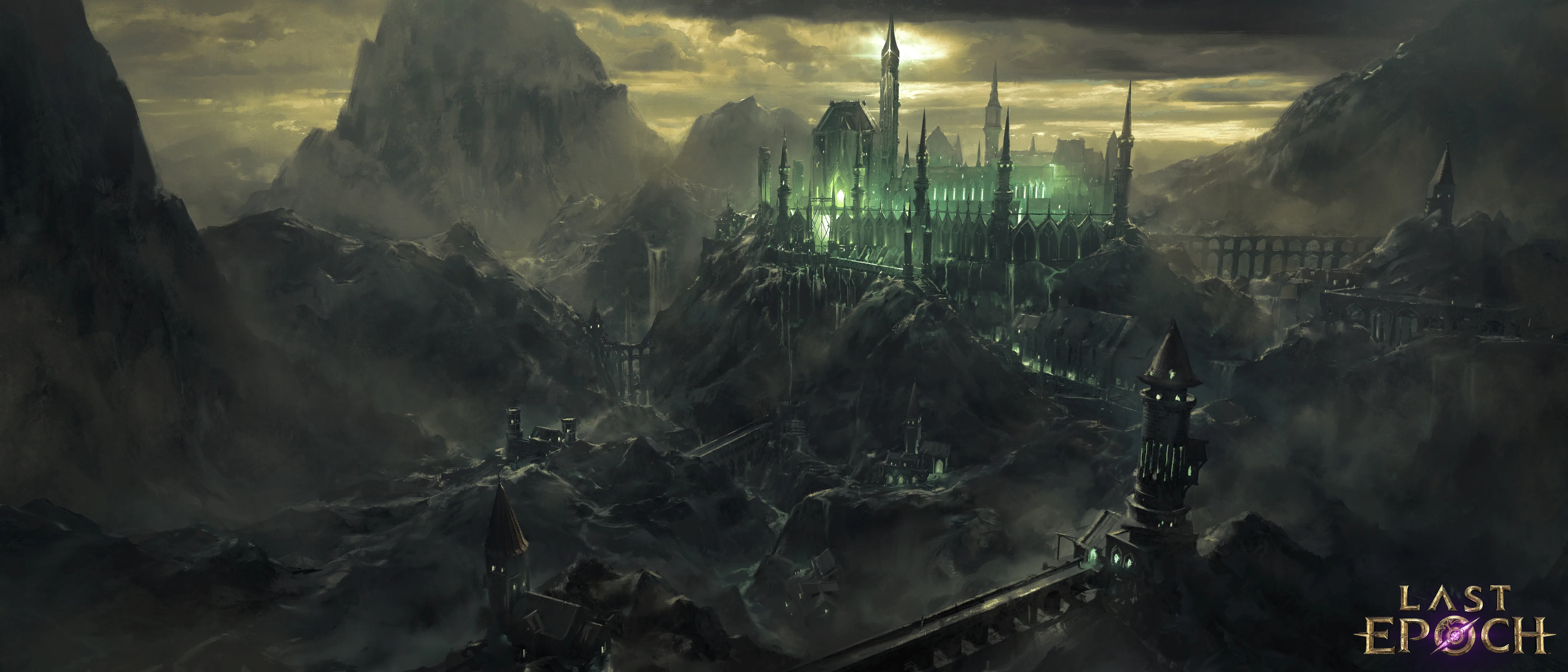
Last Epoch is a loot-focused action RPG about traveling through different eras of Eterra, fighting large groups of enemies, and turning a basic character into a highly specialized build. Its defining ideas are individual skill trees, controllable item crafting, time travel, and an endgame built around repeatable maps, bosses, dungeons, and steadily increasing difficulty.
The immediate rhythm is simple: enter an area, use your skills to clear enemies, collect promising equipment, improve your build, and take on harder content. Beneath that loop is a substantial amount of customization. You choose one of five base classes, develop it into one of 15 masteries, specialize individual abilities, and shape equipment around the damage types and defenses your build needs.
It can be played as a solo PvE game, in online co-op parties of up to four players, or in a fully offline mode. The important restriction is that online and offline characters belong to separate environments and cannot be transferred between them.
Last Epoch at a Glance
| Part of the game | What it means for the player |
|---|---|
| Genre | Top-down action RPG with randomized loot, character builds, and real-time combat |
| Main setting | Eterra across multiple eras, including a future consumed by the Void |
| Character structure | Five base classes and 15 masteries, with separate progression trees for individual skills |
| Main progression | Complete the campaign, refine a build, enter the Monolith of Fate, and pursue harder encounters and better gear |
| Item progression | Find useful bases and unique items, then use crafting to adjust equipment toward your build |
| Play options | Solo online, online co-op for up to four players, or fully offline play |
| Long-term format | Seasonal characters and a permanent character environment, plus optional challenge modes |
The Core Gameplay Loop
Most of your time is spent moving through combat areas and rapidly clearing enemies with a small set of equipped abilities. Enemies drop equipment, crafting materials, and other rewards that may improve your current character or enable a different build. Towns and hubs provide access to storage, vendors, crafting, and progression systems before you return to combat.
The loop becomes more deliberate as your character develops:
- Choose a skill package. Your active abilities need to work together rather than function as five unrelated attacks. One skill might clear ordinary enemies, another might handle bosses, and the remaining slots might provide movement, defense, resources, minions, or buffs.
- Specialize those skills. Each specialized ability has its own tree, allowing it to change damage type, behavior, targeting, utility, or interaction with other abilities.
- Collect compatible equipment. A powerful item is useful only when its affixes, unique effects, or defensive properties support what the build is trying to do.
- Craft targeted improvements. Crafting lets you improve or alter suitable equipment instead of relying entirely on a perfect finished item dropping.
- Raise the difficulty. Stronger builds can tackle more demanding bosses, dungeons, and Monolith content, which in turn provides more opportunities for valuable rewards.
- Refine or rebuild. When progress slows, you inspect whether the problem is damage, defenses, recovery, resource management, or an interaction that the build has not fully supported.
This is not a game where reaching the end of the campaign completes character progression. The campaign introduces the world and major systems; the longer project is improving how your chosen build functions under increasingly difficult conditions.
The Time-Travel Premise and Story
The campaign takes place in Eterra, but it does not stay within a single historical period. A mysterious force sends your character into a ruined future threatened by the Void. From there, the search for a way to prevent that fate carries you between different eras, where familiar places, factions, and conflicts can appear in radically different forms.
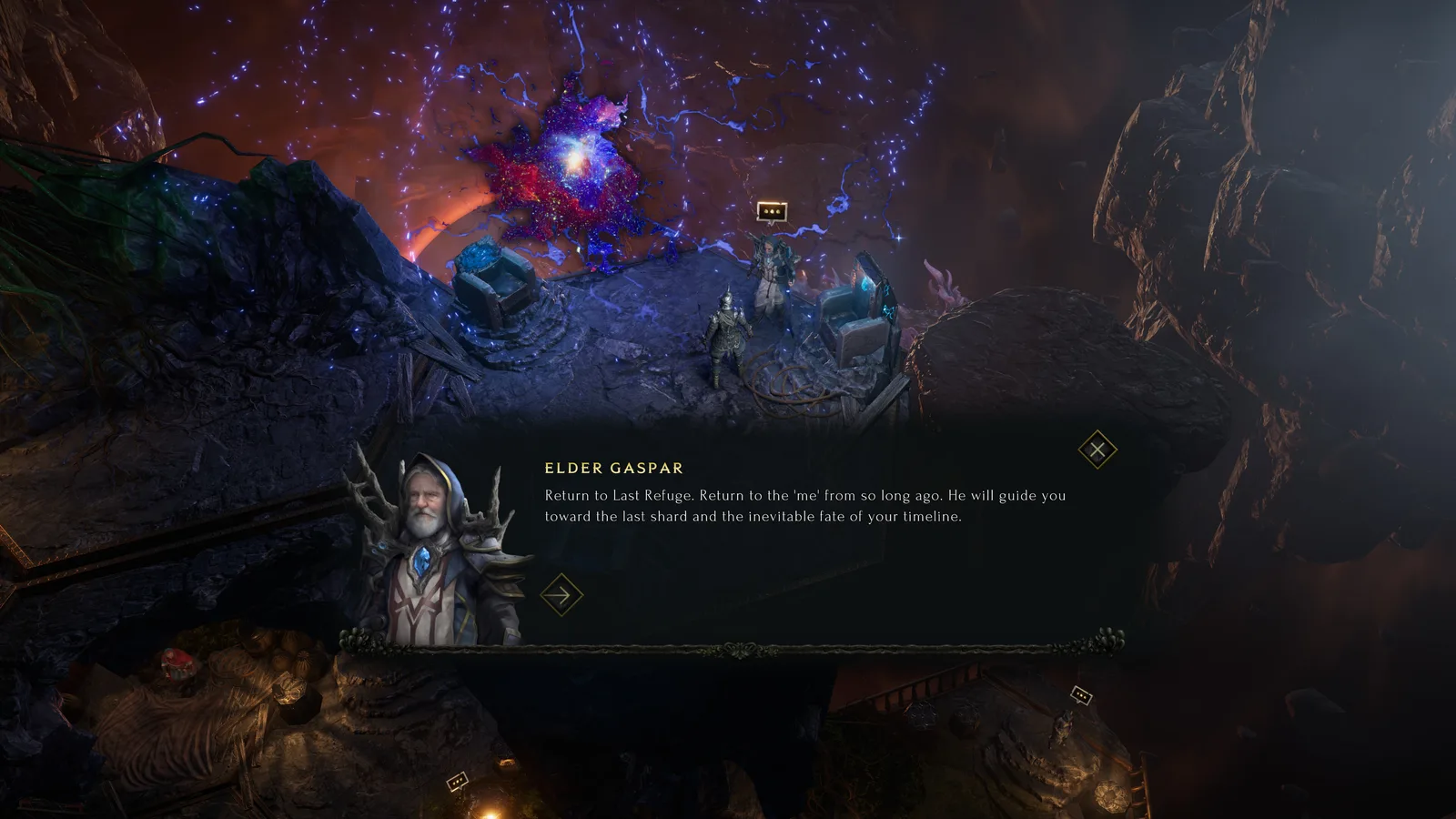
A story scene showing the ruined future and the game's timeline mystery.
That premise affects more than the scenery. Time travel is used to reveal causes and consequences across Eterra's history, placing dark empires, hostile gods, ancient wilderness, and the ruined future within the same larger crisis. Certain locations and dungeons also use movement between eras as part of their identity.
You do not need to memorize the complete chronology to understand the campaign. The spoiler-light version is that Eterra has a catastrophic future, the Void is central to that threat, and your character searches the past for a way to change what happens. The story supplies a reason to cross varied environments and confront very different enemy groups, while character growth and loot remain the main drivers of moment-to-moment play.
Buildcraft Through Skills and Masteries
Character customization begins with five base classes: Sentinel, Rogue, Mage, Primalist, and Acolyte. Each class can develop into one of three masteries, creating 15 specialized directions overall. A mastery is more than a label: it influences which abilities, passive bonuses, and build interactions are available as the character advances.
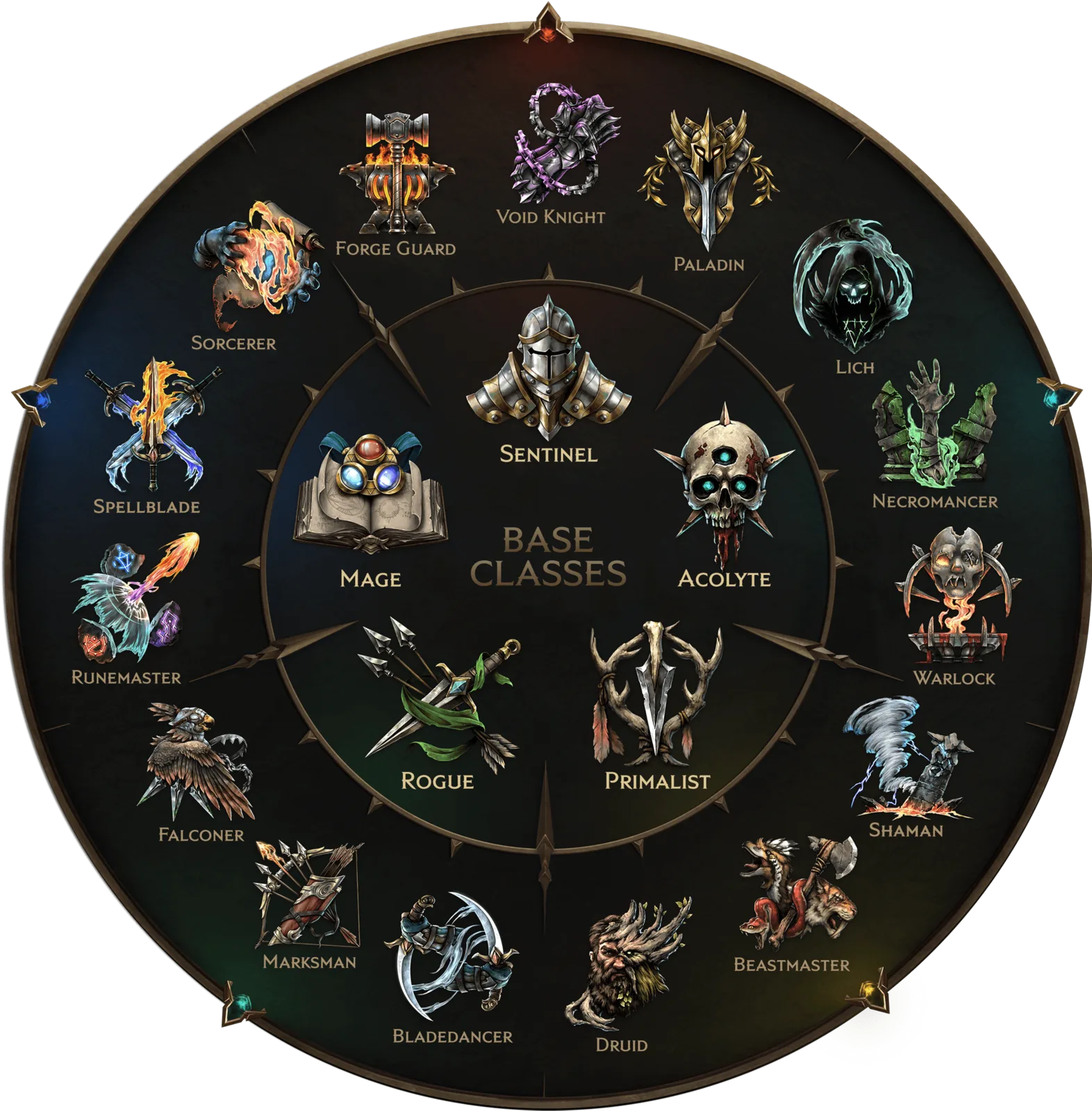
The class wheel connects the five base classes to their mastery choices.
The individual skill trees are the system that most clearly distinguishes Last Epoch's buildcraft. Specializing a skill gives it a separate allocation of points. Nodes can strengthen its existing purpose or transform how it works. An ability may gain a new damage type, trigger another effect, summon something, become more defensive, change its delivery method, or interact with a resource in a new way.
This creates two connected layers of planning:
- The class and mastery passives establish the character's broad direction.
- The specialized skill trees determine how the equipped abilities actually behave.
A successful build therefore depends on interactions rather than isolated numbers. Converting a skill to another damage type matters only if the rest of the character supports that type. A minion upgrade matters only if equipment and passives also invest in minions. A powerful ability that consumes too much mana may require resource generation, reduced costs, or a different casting pattern.
The system encourages experimentation without making every decision frictionless. Skills and skill points can be respecialized, but points above a skill's minimum level must be earned again. Other character choices have their own respecialization rules and may require a Chronomancer. The practical lesson is that you can correct and reshape a build, but a major change may temporarily reduce its power while the new setup develops.
New players do not need a finished endgame plan before choosing a class. A more manageable approach is to pick a fantasy you understand—such as direct melee combat, spellcasting, ranged attacks, or minions—then build around one main damage idea. You can learn the deeper interactions while playing instead of treating character creation as an irreversible exam.
Loot and Crafting Shape Every Upgrade
Combat produces a large amount of randomized equipment, but finding loot is only half of item progression. Last Epoch combines drops with a crafting system intended to give you meaningful control over upgrades. A promising item can be improved by working on its affixes, making the question less about whether a perfect item dropped and more about whether the item is a useful foundation.
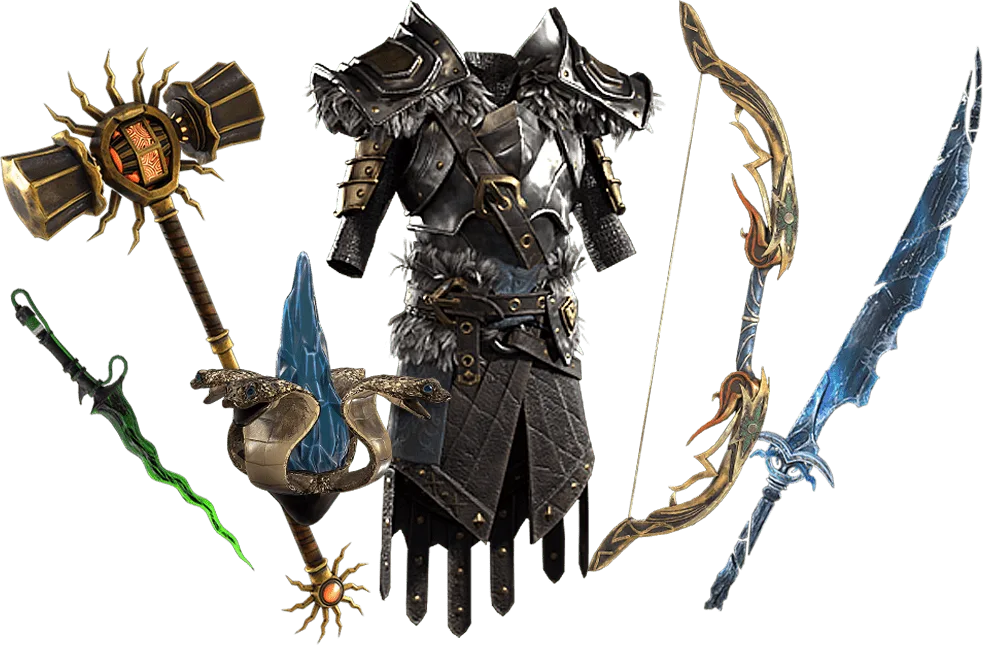
A focused equipment presentation showing the gear players build around.
Items can matter in several different ways. Some provide straightforward offensive or defensive stats. Others support a particular damage type, skill, ailment, minion, or resource pattern. Unique and set items can change build rules more dramatically, creating reasons to reorganize skills and passives around their effects.
The useful decision process is usually:
- Check whether the item type and existing affixes suit the build.
- Compare it with the equipped item rather than judging it in isolation.
- Decide which missing or weak affix would create a real improvement.
- Use crafting only when the result advances the build's current needs.
- Reassess the whole character after a change, especially defenses and resource use.
Because crafting provides control, ordinary-looking drops can remain relevant when they have the right foundation. At the same time, randomized loot still matters: crafting does not remove the hunt for strong bases, rare combinations, or build-changing unique items. The two systems reinforce each other rather than replacing one another.
Loot filters become increasingly important as drops multiply. Their purpose is to emphasize equipment that matches your current goals and hide irrelevant clutter. A filter is most useful when you understand why its rules display or hide an item; blindly importing an aggressive filter can cause you to miss useful crafting bases or upgrades.
Endgame Turns Builds Into Long-Term Projects
After the campaign, the Monolith of Fate becomes the central repeatable endgame. It is organized around timelines containing Echoes: combat areas with objectives, modifiers, and rewards. Completing them advances the timeline and leads toward bosses and additional progression. Corruption provides a route toward harder Monolith content, giving developed characters a way to pursue greater challenge.
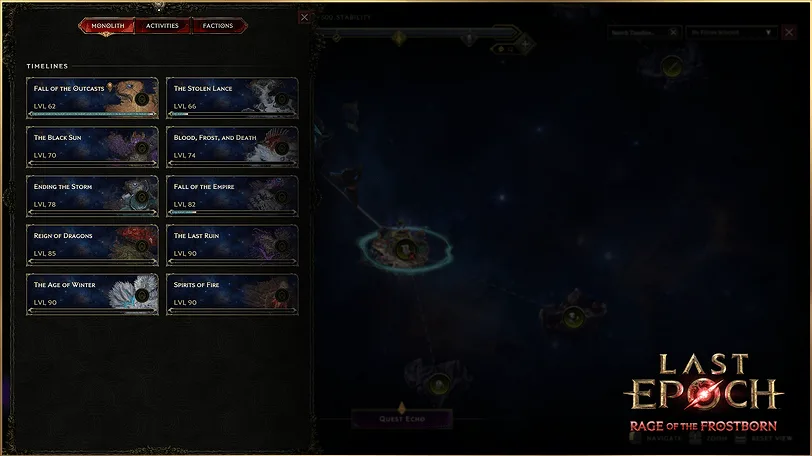
The Nexus interface centralizes timeline navigation and endgame destinations.
The endgame is not one endless corridor. Its main activities include:
- Monolith of Fate: Repeatable Echoes, timeline progression, bosses, and increasing difficulty.
- Dungeons: Separate endgame spaces that test a build and provide their own rewards and mechanics.
- Arena: Combat against continuing waves of enemies, with leaderboard competition available for players interested in that format.
- Seasonal encounters: Additional mechanics and rewards introduced through the active season.
- Pinnacle encounters: High-end boss challenges that give optimized characters demanding targets.
Traveler's Rest serves as a major endgame hub, while the Nexus provides centralized access to timelines and other activities. You can use it to navigate the Monolith and review relevant endgame destinations without losing access to their older entry methods.
A typical endgame goal is not simply to make every number larger. You might pursue a specific unique item, improve a weak defensive layer, complete a better version of an existing item, unlock stronger content, or test whether a build can survive a particular boss. These smaller objectives give direction to repeated runs.
The Monolith is also where weaknesses that felt minor during the campaign become obvious. Fast clearing does not guarantee that a character can withstand a boss hit, recover after taking damage, or sustain mana during a longer fight. Endgame progression repeatedly asks you to balance damage with survival, movement, recovery, and reliable skill uptime.
Online, Offline, Seasonal, and Permanent Play
The first major decision happens before the build begins: choosing the environment in which the character will exist.
Online play supports solo play and parties of up to four players. It is the appropriate environment if you expect to play with friends or participate in online systems. An online character can still adventure alone; choosing online does not require constant grouping.
Offline play supports a self-contained experience without relying on an online character. It is useful when you specifically want independent offline progression. The boundary is permanent: an offline character cannot be moved online, and an online character cannot be converted into an offline one.
You also choose between seasonal and permanent progression. Seasons provide a fresh start with a reset economy and leaderboards, along with original seasonal content. The permanent environment is better suited to continuing established characters without treating each new season as a required restart.
Optional challenge settings further shape the experience. Hardcore introduces the consequences associated with character death, while self-found options focus progression on what your own character or account obtains. These choices are separate from the basic question of which class or build to play.
For a first character, make the online-versus-offline decision based on whether future co-op matters. Do not choose offline as a temporary shortcut if you may later want to join friends, because that character cannot cross the boundary. After that, choose seasonal play if a fresh economy and the active season appeal to you, or permanent play if continuity matters more.
The current seasonal structure adds new systems without changing the game's central identity. You still clear enemies, develop skills, craft equipment, and progress through endgame activities; the season layers additional encounters, rewards, and objectives onto that foundation.
The Kind of Player Last Epoch Suits
Last Epoch is a strong fit if you enjoy building a character as much as controlling one. Combat is immediate, but much of the satisfaction comes from recognizing an interaction, finding the equipment that enables it, and seeing the revised build perform better.
It is especially suited to players who want:
- Fast, top-down PvE combat with frequent enemy groups and item drops.
- More build control than a fixed skill loadout provides.
- Skill trees that can materially change how individual abilities work.
- Crafting that helps convert promising drops into practical upgrades.
- A campaign with varied eras rather than one unchanging setting.
- Repeatable endgame progression with bosses and scalable difficulty.
- The choice between online co-op and a fully offline character environment.
- Seasonal fresh starts without making permanent characters the only option.
It may be less suitable if you want a short, story-only RPG with a definite stopping point after the campaign. The main systems are designed around replaying content, improving equipment, and testing builds. It also asks you to read skill nodes, compare item affixes, and make decisions about defenses and resources; ignoring those layers eventually limits progress.
The game is designed to be approachable enough to begin without an external build plan, while retaining enough interaction between skills, passives, and equipment for extensive optimization. That middle ground is the clearest answer to what Last Epoch is about: accessible action on the surface, supported by a deep character-building game that continues well beyond the story campaign.