This Last Epoch Druid build uses Tornado to trigger Storm Bolts, then enters Werebear Form for burst damage and movement. Choose it if you want a spell-focused shapeshifter with a repeatable boss rotation. You can start the core interaction after unlocking three skill specializations; the later unique-heavy equipment setup is a progression goal.
The route below follows Moorhuhn’s Stormbear Druid guide, labeled patch 1.5.2. The live patch is 1.5.3. This is an explanation of that author’s configuration, without a claim that its damage, boss results, or full equipment setup have been independently tested on 1.5.3.
Build the Storm Bolt interaction first
Tornado supplies the repeated triggers. Gathering Storm’s specialization strengthens the Storm Bolts those tornadoes produce, even though you do not actively cast Gathering Storm. Warcry supplies Maelstrom stacks and critical-strike support; Maelstrom adds utility and further Storm Bolt triggers. Werebear Form adds the transformed part of the damage and movement loop.
| Specialization | Job in this configuration |
|---|---|
| Tornado | Creates the main Storm Bolt triggers |
| Gathering Storm | Scales the triggered bolts through its skill tree |
| Warcry | Generates Maelstrom stacks and supports the burst rotation |
| Maelstrom | Provides utility, Haste, Frenzy, and additional bolt triggers |
| Werebear Form | Adds transformed damage and Ravage movement |
Gathering Storm and Maelstrom remain specialized without occupying the human-form action bar. Fury Leap provides human-form movement without taking a specialization slot. Do not remove a supporting specialization simply because you are not pressing that skill directly.
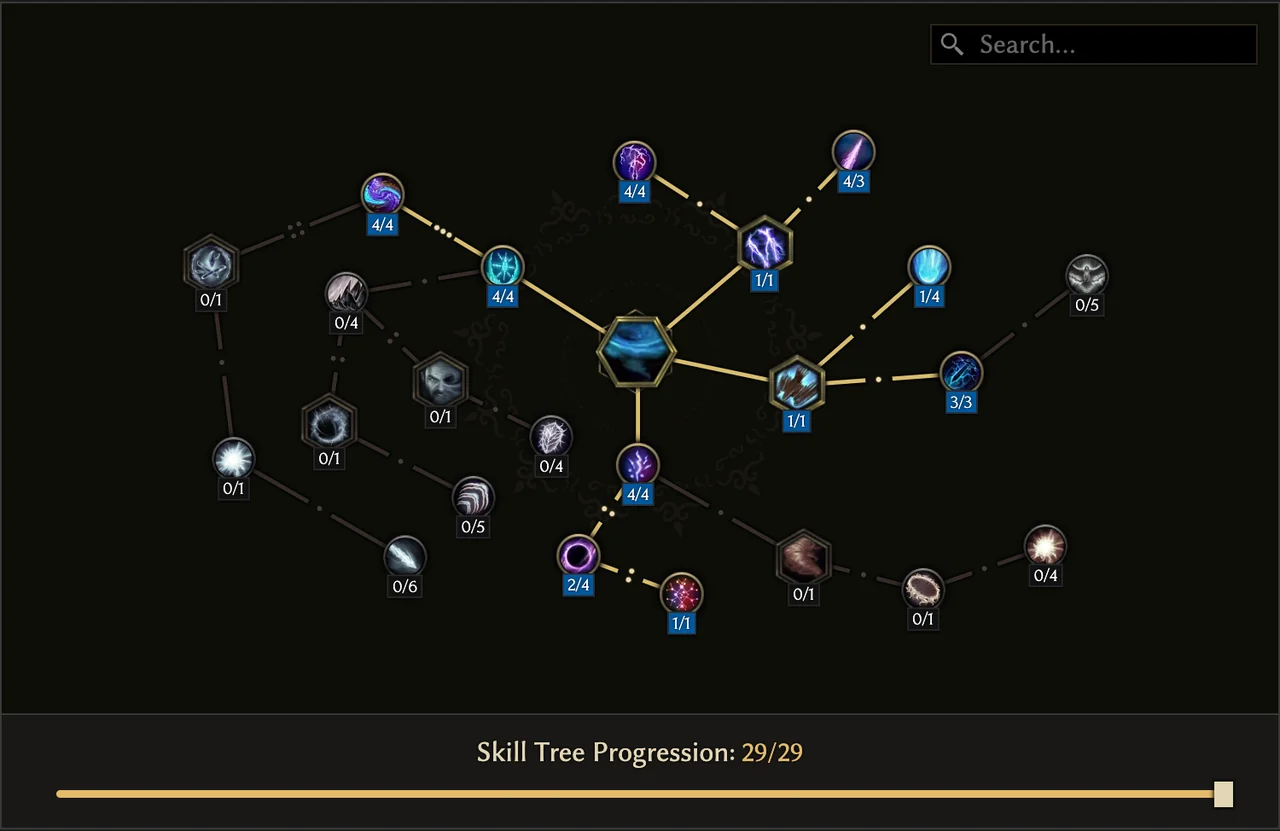
The author’s equipped endgame Tornado tree has 29 points. Use the linked planner for your available skill level; this is not a fresh 20-point allocation.
Start with three specializations, then add the transformations
Keep Druid as the chosen mastery. Moorhuhn’s route spends the first five passive points after mastery unlock in the Shaman tree to access Tornado early. Investing those points is part of this Druid route; it does not mean selecting Shaman as your mastery.
Once the third specialization is available, specialize Gathering Storm, Tornado, and Warcry. The author prioritizes these early nodes:
- Gathering Storm: Concentrated Storm, then Rending Vortex, for the bolt interaction.
- Tornado: Frequent Lightning first, followed by Lasting Storm and Hurricane.
- Warcry: Whirlpool and Shallow Breath, then Bringer of Winter and Ferocity.
Add Maelstrom as the fourth specialization and Werebear Form last in this route. Use the author’s linked planners for the full allocation at your stage rather than treating this short priority list as a complete endgame tree.
Pay attention to mana regeneration before trying to copy a finished character. Returning to human form does not refill mana. The updated overview says you return with the mana you had before transforming, plus the mana regenerated while transformed; other forms of mana recovery do not carry over. Transforming can give regeneration time, but it cannot erase an unsustainable casting pattern.
Use a deliberate boss rotation
For ordinary clearing, cast Tornado and use Warcry when available. Werebear Form and Ravage become more useful for moving through small packs as equipment improves. You can use Evade to redirect Ravage without releasing it, according to the author’s control explanation.
For a boss, the intended sequence is:
- Place tornadoes while the boss is appearing, so the triggers are already active.
- Use Warcry to establish its buffs and Maelstrom stacks.
- Transform into Werebear Form and use Ravage during the burst window.
- Continue using Warcry when available, and repeat the form cycle as cooldowns allow.
Ferocity lets transforming trigger another Warcry independently of its cooldown, which is why the author recommends transforming immediately after a manual Warcry where possible. With Julra’s Stardial equipped, coordinate its movement activation with the burst rather than assuming its benefit is always active.
If damage feels inconsistent, check where the tornadoes are targeting before buying another damage item. The author recommends the Druidic Control node for boss targeting and clearer placement. Against Aberroth, keep tornadoes between the boss and the outside of the arena so bolts are less likely to select the central rod.
Upgrade the equipment without skipping resource checks
The author provides several variations. Treat their item rankings as choices within Stormbear, rather than mandatory equipment for every Druid.
| Priority | What to look for | Why it matters here |
|---|---|---|
| Mana sustain | Mana regeneration on equipment | Transformation no longer supplies a full mana reset |
| Main attribute | Attunement for the damage-focused variation; Strength for a more defensive variation | The preferred balance changes with the chosen setup |
| Rotation uptime | Increased Cooldown Recovery Speed | Moorhuhn recommends at least 50% for the smoother endgame form cycle |
| Armor shred | One source of Chance to Shred Armor on Hit | The author considers a tier-5 affix sufficient for this role |
| Remaining defenses | Health and missing resistances | Idols and ordinary equipment can fill gaps before premium upgrades |
For named-item progression, the guide starts with two Julra’s Stardial rings and works toward Spirit Xylem. It suggests tier-1 Temporal Sanctum for early ring farming. The transitional dual-wield variation uses Mad Alchemist’s Ladle with Tempest Maw, so the staff is not the only equipment route presented.
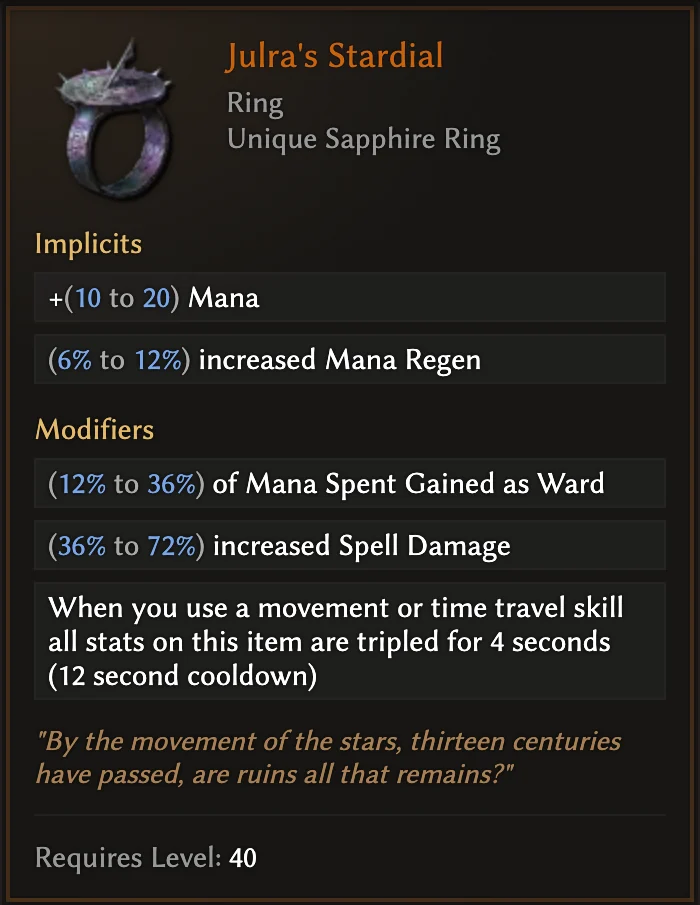
Julra’s Stardial supports the author’s burst setup. The movement or time-travel trigger lasts four seconds and has a 12-second cooldown, as shown in the linked item database.
Eye of Storms is another named upgrade, while Twisted Heart of Uhkeiros and Foot of the Mountain appear later in the author’s farming order. If you use Mantle of the Pale Ox, include the idol affix that summons a Thorn Totem on hit: those summoned minions support the defensive interaction described in the build. Copying the chest without that supporting piece misses part of the setup.
The guide’s loot filter hides non-Primalist equipment. Review that restriction if you also collect gear for another character or for sale. Its item rankings do not establish a universal best Druid build, a guaranteed corruption ceiling, or a fixed farming rate.
Continue with the next equipment decision
- Compare other routes in Last Epoch builds before committing to the spellcaster playstyle.
- Use the build planner guide to compare a transitional setup with the author’s later equipment.
- Follow Legendary Potential and item preparation when you have a usable unique and a suitable donor item.