Choose Grim Dawn if you want a campaign-centered ARPG with exploration, dual-class theorycrafting, a darker world, and a strong solo focus. Choose Last Epoch if you want clearer build experimentation, individual skill trees, accessible item crafting, seasonal updates, and a post-campaign loop built around repeatable Echoes.
Neither game is the universal winner. Grim Dawn gives you broader class pairing and a more traditional world-driven adventure, while Last Epoch makes it easier to understand how a skill changes and how an item can become useful. Your preferred progression loop matters more than which game has the longer feature list.
The short verdict
| Priority | Better fit | Why |
|---|---|---|
| Campaign exploration and atmosphere | Grim Dawn | Its appeal is closely tied to moving through Cairn, revisiting its campaign, and building a character within that world. |
| Easy-to-read build customization | Last Epoch | Up to five specialized skills have individual augment trees, making their build decisions visible in one place. |
| Combining two class identities | Grim Dawn | You select one Mastery and can later add a second, creating a named dual-class combination. |
| Controlled item improvement | Last Epoch | Its forge lets you deliberately work on affixes instead of treating every usable item as a finished drop. |
| Seasonal progression | Last Epoch | It has seasonal and non-seasonal characters and continues to receive season-specific systems and balance updates. |
| Solo-first, self-contained play | Grim Dawn | It suits players who want to explore and develop characters without making an ongoing season the center of the experience. |
| Separate offline and online play | Last Epoch | It provides both modes, though characters cannot move between them. |
| Frequent skill experimentation | Last Epoch | Passive points, skill points, Blessings, and even Mastery choice can be changed, subject to different costs and restrictions. |
The simplest decision rule is this: pick Grim Dawn when the journey through the campaign and the interaction between two Masteries sound like the main attraction. Pick Last Epoch when you want to reach a repeatable endgame, refine gear, and keep changing how a small set of specialized skills works.
How the character systems differ
Both games offer substantial build variety, but they organize that variety differently. Grim Dawn asks you to combine two large class packages. Last Epoch starts with a base class, moves into a Mastery, and then lets you specialize individual skills.
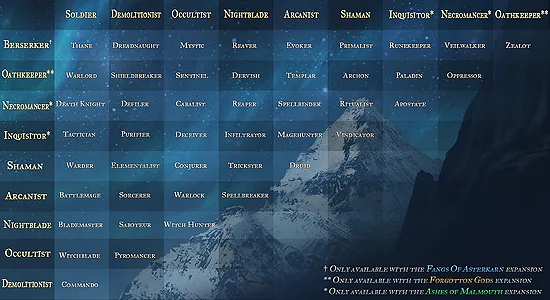
Grim Dawn combines two Masteries to define a character class.
Grim Dawn builds through two Masteries
In Grim Dawn, classes are called Masteries. You choose the first at level 2 and can select a second at level 10. The combination becomes your dual class, so selecting Soldier and selecting Occultist are not isolated choices: their defenses, attacks, support skills, and damage types have to function together.
The available Masteries cover distinct archetypes. Soldier emphasizes durability and conventional weapons. Demolitionist uses firearms, traps, explosives, and destructive magic. Arcanist supplies powerful elemental and Aetherial magic but less innate defense. Nightblade favors rapid weapon attacks, blade magic, and evasive play. Occultist offers curses, poison, acid, entropic magic, and summons. Shaman supports nature magic, beasts, and heavy two-handed combat.
Expansion ownership determines the remaining Masteries. Ashes of Malmouth adds Inquisitor and Necromancer; Forgotten Gods adds Oathkeeper; Fangs of Asterkarn, released July 23, 2026, adds Berserker. Fangs requires the base game plus both Ashes of Malmouth and Forgotten Gods. With all three expansions, the game offers ten Masteries and 45 dual-class combinations.
Inquisitor emphasizes ranged weapons and runes, Necromancer brings skeletal minions and vitality-oriented magic, and Oathkeeper combines shields with celestial powers. Berserker supports shapeshifting, cold-infused attacks, and dual weapons. Check the required expansion before following a build that uses one of these Masteries. Then choose a first Mastery whose core play style already interests you; you do not need to memorize every pairing before starting.
This system rewards players who enjoy finding synergy between two broad kits. A second Mastery can supply defenses, damage support, utility, or an entirely different attack package. The tradeoff is commitment: a Spirit Guide can remove invested skill points for a fee, but points placed in the Mastery bar cannot be removed. You must also remove points from passive modifiers before taking points out of the active skill they modify.
Last Epoch builds through mastery and skill trees
Last Epoch has five base classes—Sentinel, Rogue, Mage, Primalist, and Acolyte—and 15 Masteries. The decisive difference is that active skills also have their own augment trees. A skill is not merely unlocked and leveled; its tree can change its behavior, damage type, delivery method, or interaction with other abilities.
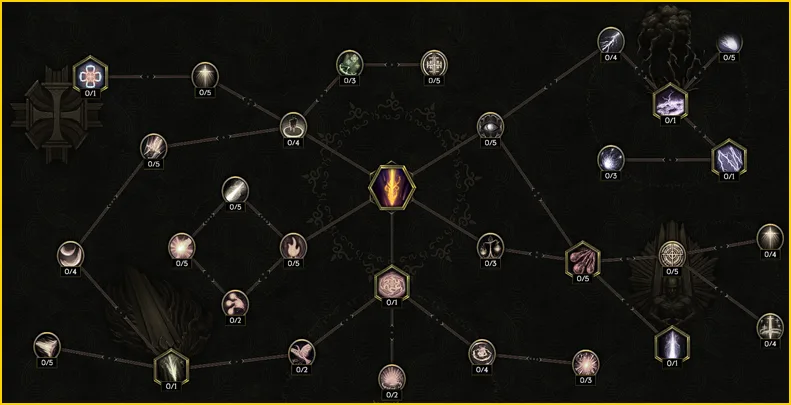
The Smite tree illustrates branching skill modifiers. Use current in-game tooltips for individual node values.
This makes experimentation more legible. Instead of deriving an entire build from two class trees alone, you choose up to five specialized skills and decide what job each one performs. Equipping a skill on the action bar and specializing it are separate decisions. One may become the primary damage skill, another may generate resources or apply a condition, and another may provide movement or defense. The game advertises more than 120 skill trees, so the same base class can support substantially different skill packages.
Last Epoch is also more forgiving when you want to revise a character. Passive points can be changed through Chronomancer Lerinne in towns. Mastery can be changed through the same NPC at the End of Time. Blessings can be swapped with Chronomancer Nyx near the Monolith of Fate gates. Skills can be respecialized from the Skills window, although points above the minimum skill level must be earned again.
That last restriction matters. Respecialization is possible, but rebuilding a skill is not always instant. Test major conversions before reorganizing several specialized skills at once, especially if the character is already tackling difficult content.
Loot and crafting feel
Grim Dawn and Last Epoch both use randomized loot to shape builds, but Last Epoch puts more visible emphasis on modifying promising drops. Its core description treats finding an item and improving that item as connected parts of progression. Magic items can be forged, while unique and set items can change how a build functions.
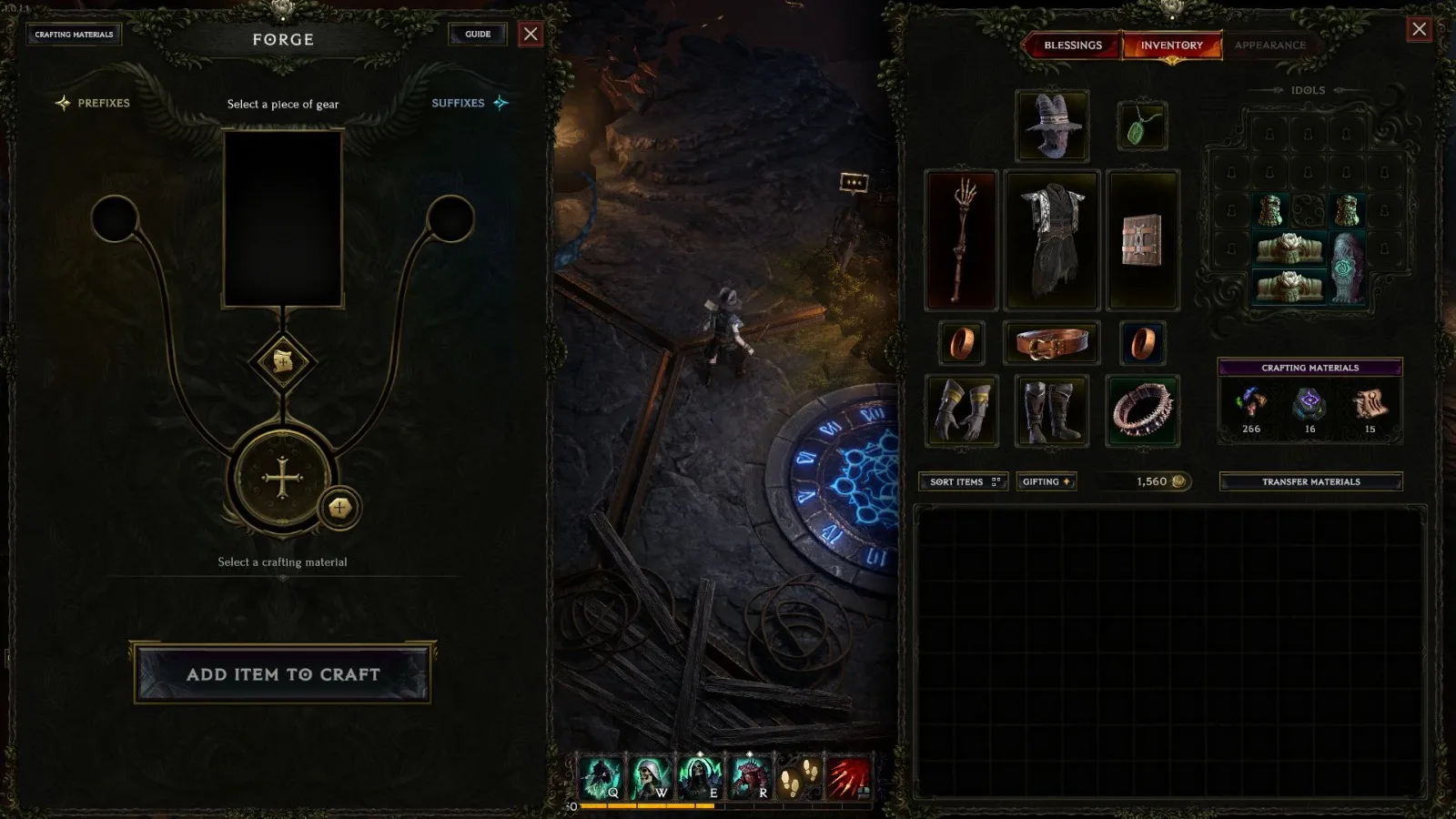
The Forge combines item affixes with crafting materials and controls.
This gives Last Epoch a practical advantage for players who dislike waiting for a perfectly finished item. A drop can be valuable because it has the right base and some useful affixes, even if it still needs work. The forge provides a direct place to make those decisions, and the built-in loot-filter system helps control how much dropped gear remains visible.
Grim Dawn also has crafting, so this is a comparison of how the systems work rather than a choice between crafting and none. Fangs of Asterkarn adds Affix Transmutation for rerolling rare and magic item affixes, alongside potion customization. Those features require the expansion; do not assume a base-game character has the same options. Last Epoch makes repeated affix improvement at its Forge a central part of gearing. Ask which workflow you want to use regularly and include expansion ownership in that decision.
Choose Last Epoch if crafting itself should be a recurring activity. Choose Grim Dawn if you want item hunting to remain closely connected to campaign exploration, bosses, and repeated character runs. In either game, begin with a functional skill and damage plan rather than designing the entire character around an item you do not yet own.
Campaign structure, endgame, and replay loop
Grim Dawn is the stronger fit when the campaign is part of the long-term attraction. Its players frequently value the world layout, side paths, atmosphere, ambushes, and the process of taking additional characters through familiar regions with different Mastery combinations. Its deliberate pace can be a positive if you want to read the battlefield and explore, but it can feel slow if you expect rapid clearing immediately.
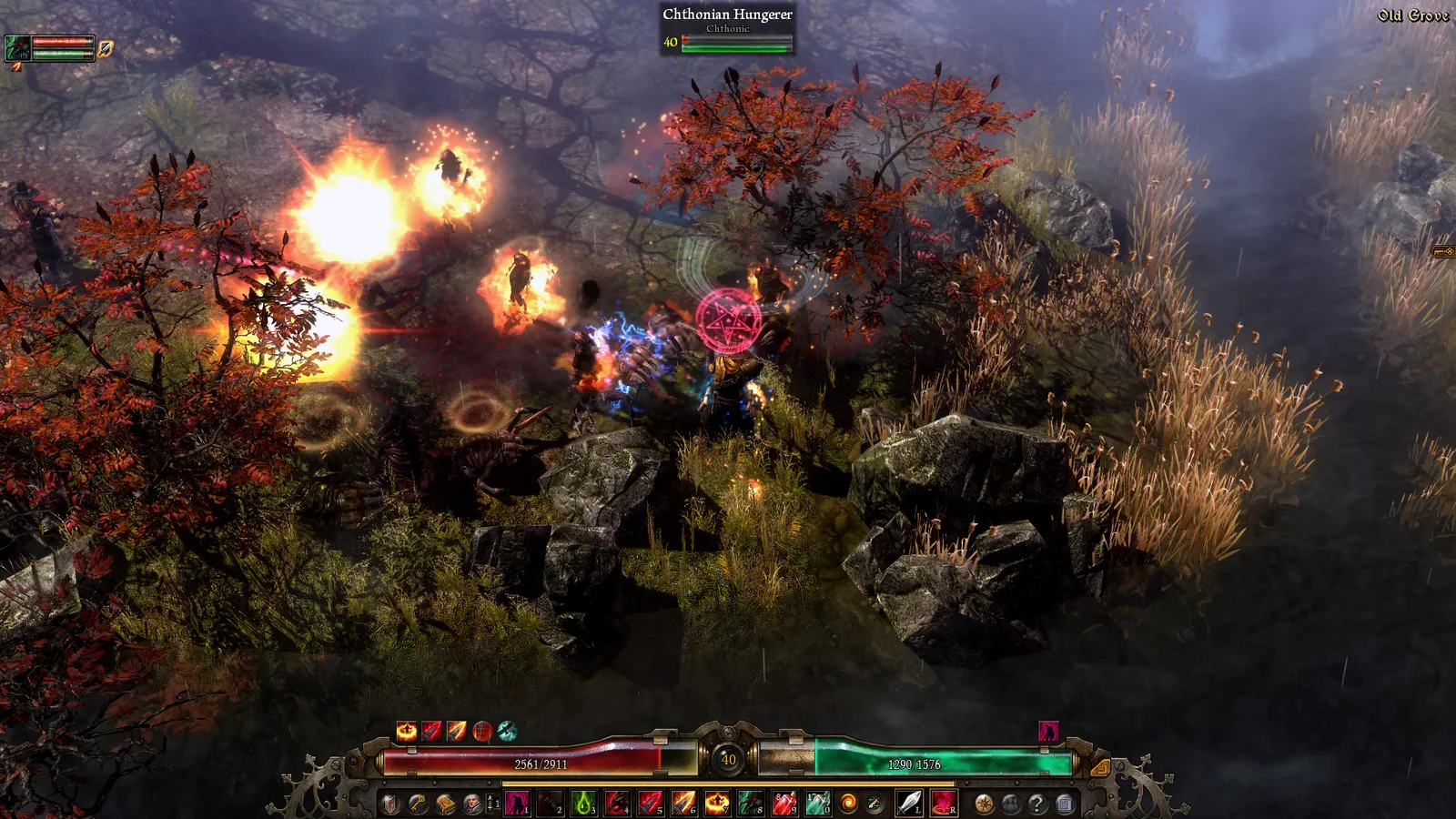
Grim Dawn presents combat within its atmospheric campaign zones.
Last Epoch uses its campaign to establish the character, unlock progression, and lead into the Monolith of Fate. The main post-campaign loop consists of completing Echoes, collecting targeted rewards, raising Corruption, improving equipment, and confronting stronger bosses. Dungeons and other systems sit beside that loop, but Monolith progression is the central repeatable structure.
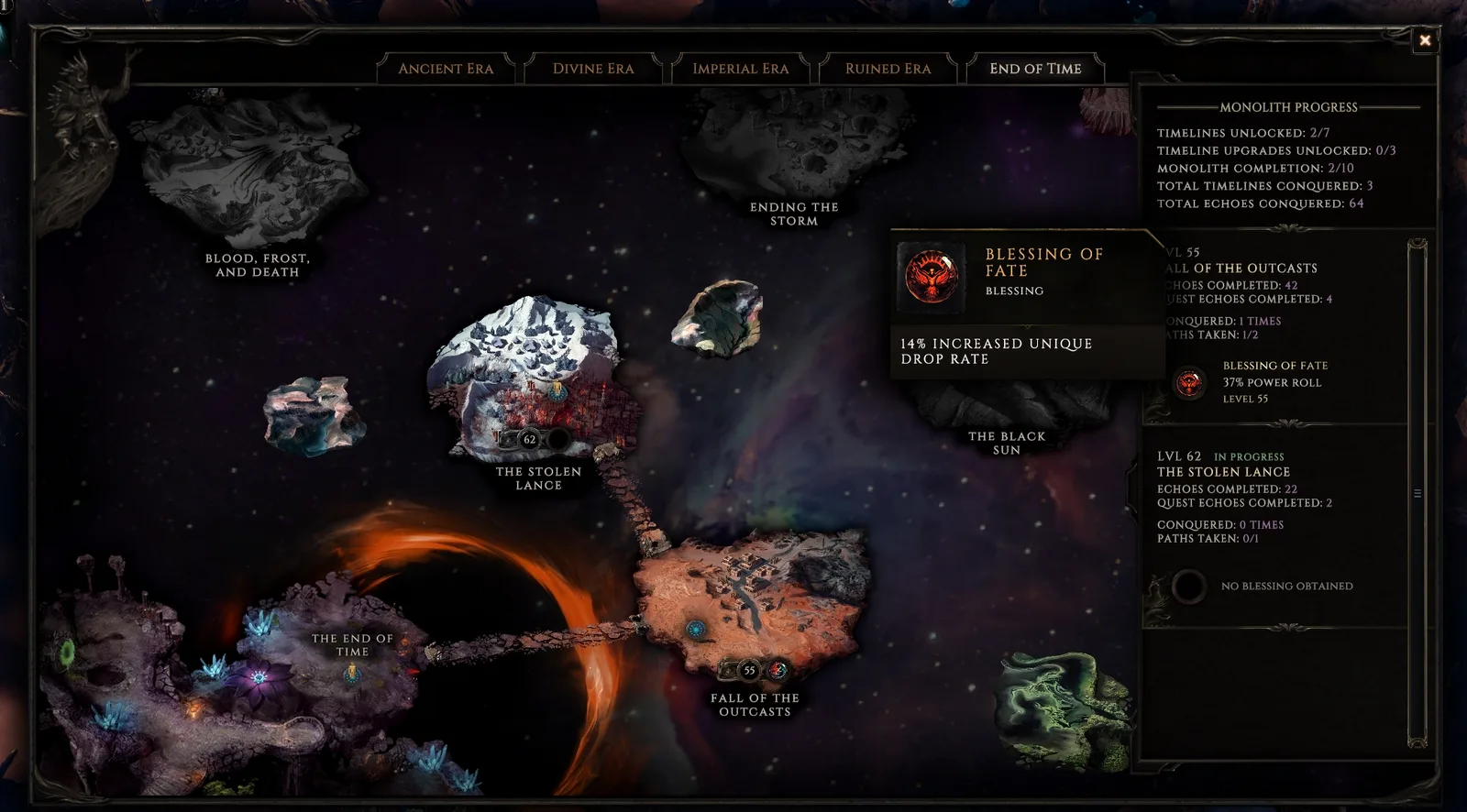
The Monolith of Fate organizes repeatable Echo runs across alternate timelines.
As of version 1.5.2, Last Epoch is in Season 5: Rage of the Frostborn. The game continues to add seasonal mechanics and patch skills, items, interfaces, encounters, and endgame systems. That makes it the more natural choice for players who like returning for a new season, making another character, and reacting to system changes.
The limitation is repetition. Echoes are designed to be repeated, and increasing Corruption does not automatically create an entirely new style of play. Players who need every session to reveal a new area may prefer Grim Dawn’s campaign emphasis. Players who enjoy running compact objectives while refining a build may prefer Last Epoch’s Monolith structure.
Use this test:
- If finishing a campaign makes you want to replay it with another class combination, lean toward Grim Dawn.
- If finishing a campaign makes you want a stable loop for targeted rewards and incremental difficulty, lean toward Last Epoch.
- If you dislike repeating either maps or campaigns, neither game completely removes repetition from the loot-driven ARPG formula.
Online, offline, and seasonal characters
Last Epoch supports single-player PvE, online co-op for groups of up to four, and a full offline mode. Decide between online and offline before investing heavily in a character because the two character pools cannot be transferred into each other.
Choose online play if grouping, the online economy, or playing seasonal characters with other people matters. Choose offline play if independence from the online service matters more. Do not treat offline as a temporary test environment for an online character; progress will remain separate.
Last Epoch also distinguishes seasonal characters from persistent characters. This reinforces its identity as a game you can revisit around new systems and a fresh progression cycle. Grim Dawn is the better fit when you want your personal collection of characters and the campaign itself to remain the center of play rather than organizing your return around a season.
Multiplayer should not be the only deciding factor. Both games can be discussed as co-op ARPGs, but Last Epoch’s explicit separation of online and offline character data creates the more consequential upfront choice. Make that choice before selecting a class or following a build.
Combat pace, presentation, and learning curve
Grim Dawn has an older visual presentation and a more restrained early pace. Some players value its darker, cohesive atmosphere and weightier encounters; others find its colors, navigation, interface, or combat speed dated. The dual-Mastery system also exposes many damage types and interactions, so a new player may need time to understand why two apparently compatible skills do not support the same damage plan.
Last Epoch presents many build decisions more directly. Skill trees state how an ability changes, and the forge makes item improvement an explicit action. That does not make every build simple, but it lowers the barrier to asking useful questions: which skill is my main attack, what type of damage does it deal, and which affixes support it?
Last Epoch is still actively patched, and recent updates include fixes across skills, items, Monoliths, dungeons, encounters, controller behavior, and interfaces. Ongoing development is an advantage if you want new systems, but it also means a build or interface can change and individual bugs can affect current play. Grim Dawn is also receiving updates: Fangs of Asterkarn released in July 2026 and introduced additional campaign and endgame systems. Choose Grim Dawn for its campaign and dual-Mastery structure, or Last Epoch for its seasonal cadence and specialized skill trees, rather than assuming either game guarantees a bug-free or unchanging experience.
Which game matches your priorities
Pick Grim Dawn if most of these statements describe you:
- You want exploration and campaign replay to remain meaningful after the first character.
- Combining two broad classes sounds more interesting than specializing each active skill separately.
- You prefer a dark, older-school atmosphere and do not require a modern presentation.
- You mainly want a solo-first ARPG that feels self-contained.
- You enjoy planning around long-term class synergy and accept that Mastery-bar investment cannot be undone.
- You are interested in making many characters to explore different dual-class combinations.
Pick Last Epoch if most of these statements describe you:
- You want to customize up to five specialized skills through their individual trees.
- You prefer a forge that can deliberately improve useful drops.
- You want a built-in loot filter to control item clutter.
- You enjoy repeatable endgame objectives, targeted rewards, and rising Corruption.
- You want seasonal updates and expect to return for fresh characters or systems.
- You need a clear choice between full offline play and online co-op.
- You want broad respecialization options and accept that respecialized skill levels may need to be re-earned.
If you remain split, use character building as the tiebreaker. Grim Dawn’s defining decision is the relationship between two Masteries. Last Epoch’s defining decision is how a Mastery and several specialized skill trees work together. Pick the system that makes you want to open a planner and create a second character—the better long-term ARPG is the one whose build decisions you are eager to repeat.