Last Epoch uses two separate progression systems that are easy to confuse: class and mastery passive trees shape your character as a whole, while skill specialization trees modify individual skills. Passive points do not level your specialized skills, and changing the skills on your action bar does not automatically change your specializations.
You can eventually specialize in up to five skills, each with its own tree and a natural maximum level of 20. Skill points can be changed from the Skills window, but points above your current Minimum Skill Level must be earned again. Passive points require Chronomancer Lerinne. In version 1.5.2, mastery can also be changed through Lerinne, but only in the End of Time.
Passive trees and skill specialization trees
The two tree types solve different parts of character building. Treating them as one system often leads to wasted points or modifiers that do not support the damage type your chosen skill now uses.
| Tree type | What it changes | How points are changed | Main planning question |
|---|---|---|---|
| Class and mastery passive trees | Character-wide stats, defenses, damage support, and passive-based skill unlocks | Speak to Chronomancer Lerinne in a town | Which global stats and effects support the character’s main skills |
| Skill specialization trees | The behavior, damage type, cost, cooldown, area, ailments, and interactions of one skill | Use the Respec control inside that specialized skill’s tree | What job should this skill perform in the build |
A passive tree usually supports several parts of the character at once. A skill tree can make a much narrower but more dramatic change: converting a skill’s base damage, replacing one ailment with another, adding a cooldown, removing a cooldown, creating a triggered skill, or changing how the skill moves and targets.
These layers must agree. If a specialization node converts a skill from physical damage to fire, passive investment that only improves physical damage will no longer scale that converted base damage. The conversion node’s full wording matters because it can also change the skill’s tags, ailment chances, and resistance-shred effects.
Unlock and specialize a skill
Skills unlock in several ways. Some become available at a particular character level, some require a certain number of passive points in a class tree, and others require a mastery choice. Open the Skills window with the default S key to see the skills your character knows and the requirement for anything still locked.
After a skill is available, there are two separate decisions:
- Equip the skill. Select one of the five action-bar slots and choose the skill you want to place there.
- Specialize in the skill. Use an unlocked specialization slot to give that skill its own level and specialization tree.
A character unlocks specialization slots while leveling, up to a maximum of five. That matches the five skill positions on the action bar, but an equipped skill and a specialized skill are not the same thing. Equipping controls what you can activate from the bar. Specializing allows that skill to gain levels and spend points in its tree.
You may only specialize in a skill your character currently knows. Each specialized skill has a natural maximum level of 20. Reaching that maximum gives you the largest normal point budget for its tree, but it does not mean every node can be taken. The tree still asks you to choose a route and commit points to the effects that serve the skill’s intended role.
Read a specialization tree without wasting points
Start with the skill’s job rather than with the most impressive-looking damage node. A useful reading order is:
- Choose the skill’s role. Decide whether it is your main damage skill, movement tool, defensive button, healing support, ailment applicator, or a setup skill for another attack.
- Find behavior-changing nodes. Look for conversions, triggered skills, additional charges, cooldown changes, targeting changes, and nodes that replace one mechanic with another.
- Read every tradeoff. Strong transformations frequently add mana costs, health costs, cooldowns, reduced speed, shorter duration, or lost utility.
- Confirm the final damage type and tags. Do this before choosing passive bonuses or supporting ailments.
- Check exact activation language. Phrases such as “directly using,” “directly casting,” “while channeling,” “after hitting,” and “when the skill kills” describe different conditions.
- Add numerical scaling last. Increased area, attack speed, penetration, critical bonuses, and more damage are easier to evaluate once the skill’s final behavior is settled.
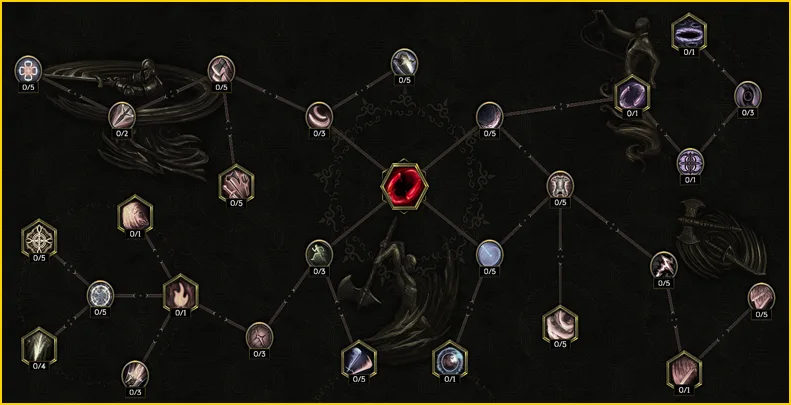
Conversion nodes deserve special attention. Warpath’s Earthscorcher converts its base physical damage to fire, converts Bleed chance from all sources into Ignite chance for Warpath, and replaces its Physical tag with a Fire tag. Apocalypse Whirl instead converts the base physical damage to void, changes Bleed and Ignite chance into Time Rot chance, and replaces the Physical tag with a Void tag.
Those nodes are not simple visual themes. They decide which damage increases apply and which ailments Warpath can inherit from other sources. Once a conversion is selected, reread every planned passive, item modifier, and nearby specialization node using the converted damage type rather than the skill’s original type.
Also watch for mutually incompatible transformations. A node may explicitly state that it has no effect when another conversion has already been taken. Do not assume that two conversions combine merely because the interface allows you to inspect both sides of the tree.
Use node wording to identify real interactions
Skill trees frequently connect one skill to another, but the interaction may carry the second skill’s normal cost or require that skill to be specialized, equipped, or used directly.
For example, Warpath’s Winds of Justice gives Warpath a chance to cast Smite each second while spinning and consumes Smite’s mana cost. Abyssal Tempest similarly casts Abyssal Echoes every five seconds while spinning and consumes that skill’s mana cost. These effects can add another skill to a rotation without another button press, but they also change Warpath’s ongoing mana demands.
Triggered effects should not automatically be treated as direct casts. Smite’s tree repeatedly distinguishes direct casting from other ways of producing Smite. Fissure requires directly casting Smite and consumes additional mana to create a Fissure under the target. Descend also depends on a direct cast, teleports you to the target location, adds a cooldown and mana cost, and makes Smite a Traversal skill. If another effect merely casts Smite for you, do not assume every direct-cast benefit will apply unless the node wording supports it.
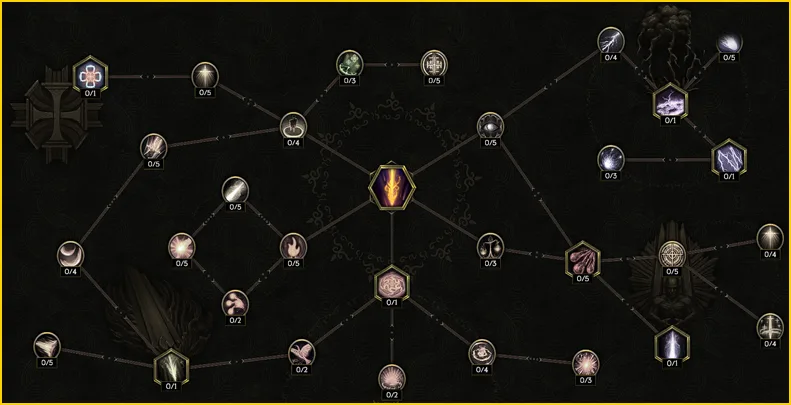
The same care is needed with replacement effects. Smite’s Order of Lagon converts its base fire damage to lightning and converts Ignite chance into Electrify chance. Fallen from Grace converts the base fire damage to void, turns Ignite chance into Time Rot chance, and removes Smite’s healing. The second route therefore changes both offense and utility; selecting it for damage means accepting that Smite no longer fills its original healing role.
When one skill sets up another, verify both ends of the interaction. Void Cleave’s Obliterator makes the next Erasing Strike a guaranteed critical strike after Void Cleave hits at least one enemy. Momentum instead rewards channeling Warpath for at least two seconds before using Void Cleave within one second. These are conditional sequences, not permanent bonuses. A planned rotation must actually satisfy their timing and hit requirements.
Balance power nodes against their costs
Many specialization nodes package a benefit with a limitation. Read the entire node before committing points, especially when it changes cooldowns or resource costs.
Common tradeoff patterns include:
- More power for more mana. Warpath’s Warrior’s Fury increases damage and area while continuously spinning but raises mana cost each second.
- No cooldown for another penalty. Shield Bash’s Flurry of Blows removes its cooldown but greatly increases its mana cost and removes the guaranteed stun or Ignite. Erasing Strike’s Shattered Continuity removes its cooldown but reduces its damage.
- Extra charges with a drawback. Lunge’s Double Strike adds a charge but lengthens the cooldown. Erasing Strike’s Twin Cataclysms adds a charge without the same listed penalty, showing why each node must be read individually.
- Damage in exchange for health. Smite’s Sacrifice grants substantially more damage while consuming a percentage of current health on cast.
- Utility replaced by offense. Abyssal Echoes’ Potent Corruption adds a spell-void hit but removes Abyssal Decay.
- Defense that depends on state. Rebuke’s armor, elemental mitigation, regeneration, and healing options operate while channeling unless another node explicitly makes a benefit persist afterward.
A node that is powerful on paper may make the skill unsustainable or remove the reason it was placed on the bar. Before taking it, check the resulting mana cycle, cooldown, health cost, and lost defensive or healing function.
Respec skill points and change specialized skills
Open the tree for a specialized skill and use the Respec control in the upper-right area of the Skills window. You can change individual skill points or replace the specialized skill, but the system applies a recovery cost through skill levels rather than requiring you to keep the old allocation.
When you specialize in a different skill, the new skill is set to your current Minimum Skill Level. Any levels above that floor must be earned again. A newly specialized skill may receive bonus experience so it can catch up with your other skills. The Skills window shows the current Minimum Skill Level on the Respec control, and an active experience bonus appears above that skill’s experience bar.
This makes experimentation recoverable, but not always instant. If a skill is far above the minimum, removing points or replacing it can temporarily leave the new setup with fewer specialization points. Avoid changing several essential skills at once immediately before difficult content. Change one important skill, rebuild its core route, and let it recover before removing another major part of the character.
Skill respec also cannot repair a passive mismatch by itself. After changing a skill’s damage conversion or ailment, review the class and mastery passives that support it. Conversely, changing passive points does not automatically rewrite the skill tree. The two layers must be checked separately.
Respec passive points and mastery
Passive points are changed through Chronomancer Lerinne, whose map marker uses a purple brain icon. Lerinne can respecialize passive points in towns.
Mastery advice from older guides may be outdated. Under the current 1.5.2 rules, Lerinne can also change your mastery, but mastery respecialization is available only in the End of Time. Traveling to another town and finding Lerinne there is sufficient for ordinary passive changes, not for changing mastery.
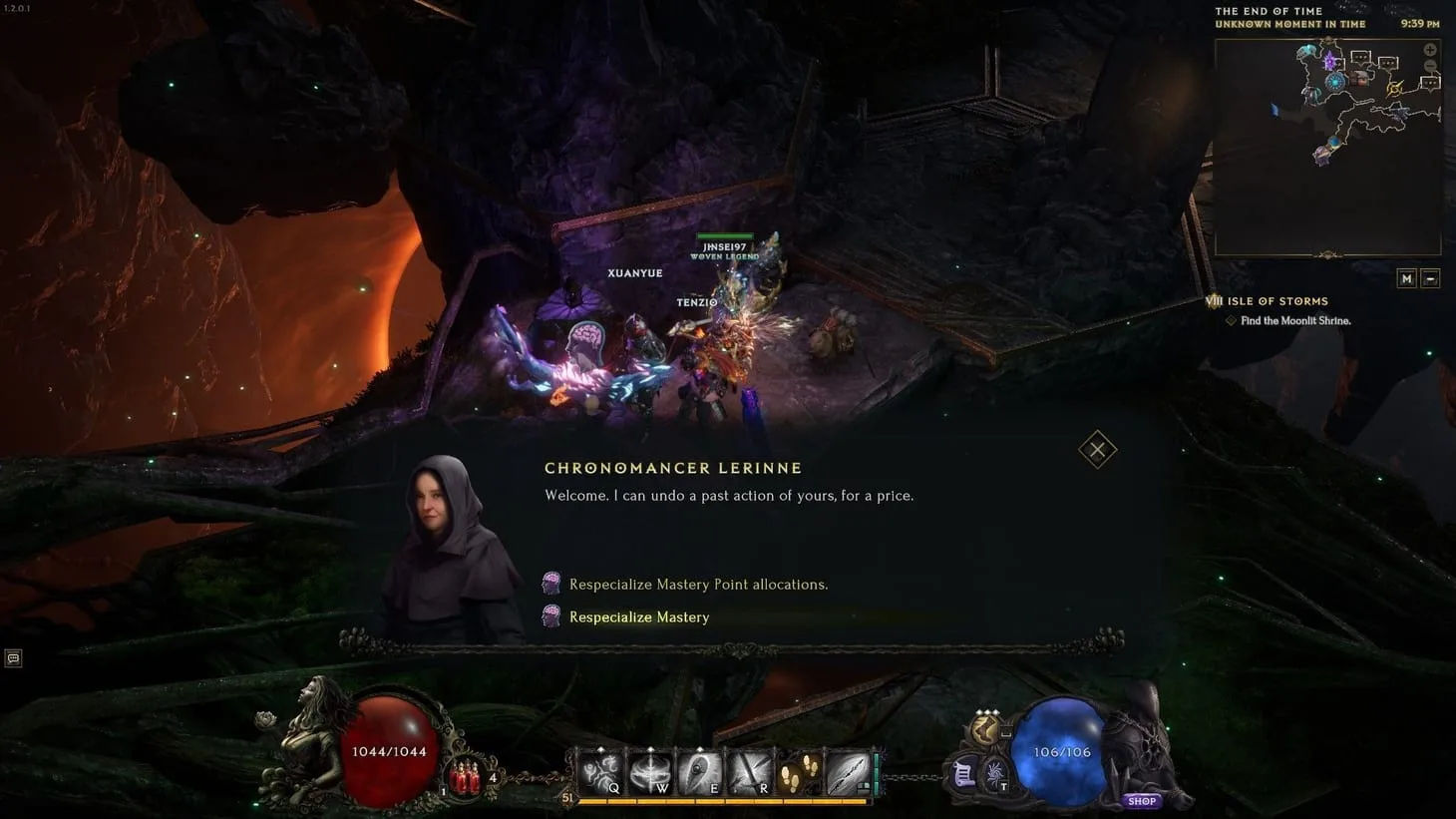
Changing mastery is broader than moving a few passive points. Skills can be unlocked by a mastery choice or by passive investment in a class, so inspect the Skills window after the change. A skill used by the old setup may no longer meet its unlock condition, and a newly available skill still needs to be equipped or specialized deliberately.
Chronomancer Nyx serves a different purpose. Nyx is near the Monolith of Fate gates in the End of Time and allows equipped Blessings to be swapped. Do not confuse that service with skill-point, passive-point, or mastery respecialization.
Common skill tree mistakes
The most frequent errors come from assuming that related mechanics are interchangeable:
- Equipped is not specialized. A skill can occupy the action bar without receiving specialization-tree points.
- Specialized is not necessarily equipped. Check both the action bar and the specialization slots when copying a setup.
- Original damage type is not final damage type. A conversion node can change the base damage, relevant increases, tags, ailments, and resistance shred.
- Triggered is not automatically direct. Respect node text that specifically requires a direct use or direct cast.
- A more-damage node is not free. Look for additional mana, health, cooldown, speed, duration, targeting, or utility costs.
- Respeccing does not preserve every earned skill level. Points above the Minimum Skill Level must be regained.
- Passive respec and skill respec are separate. Fix both layers when the skill’s role or damage type changes.
- Mastery is no longer permanently fixed, but location still matters. The change must be performed with Chronomancer Lerinne in the End of Time.
Before leaving a tree, summarize the finished skill in one sentence: its role, final damage type, main ailment, resource cost, cooldown, and important trigger condition. If that sentence conflicts with your passive bonuses or intended rotation, correct the tree before spending the remaining points on small numerical upgrades.