For a repeatable Last Epoch gold farm, complete Monolith echoes at a difficulty you can clear steadily, then add equipment sales if you belong to Merchant’s Guild. These are different sources of income: direct gold is earned through play, while Bazaar income requires another player to buy an eligible item.
Corruption increases gold with diminishing returns and also increases enemy health and damage. The useful target is therefore the setting that produces reliable completed runs for your character. The official Corruption explanation does not establish a universally fastest timeline or a guaranteed gold-per-hour rate.
Choose the route your faction can actually use
| Situation | Practical route | Main limitation |
|---|---|---|
| Circle of Fortune | Keep farming repeatable content and improving your own equipment | Bazaar selling requires Merchant’s Guild alignment |
| Merchant’s Guild | Combine normal farming with sales of eligible equipment | Listings need Favor and a buyer; asking prices are not completed sales |
| Unstable Monolith clears | Lower the difficulty or improve survival before pushing further | Dying before echo completion loses its guaranteed reward |
| Saving for a purchase or crafting goal | Track net gold after spending | Dungeon rewards and new purchases can consume the balance you just earned |
Do not choose a new faction solely because a guide shows an expensive item. Official Merchant’s Guild rules say Bazaar items can only be traded once. Purchased equipment becomes untradable and bound to Merchant’s Guild, so you cannot equip it as Circle of Fortune after switching. Buying cheaply and relisting the same item is not a valid farming loop.
Build a steady Monolith farming loop
Start from the timeline and corruption level where your character already completes echoes consistently. The following is a practical way to compare your own routes, rather than a claim that one named timeline always wins:
- Set a repeatable difficulty. Choose a level you can sustain without repeated deaths or long boss fights. Increase it only when the extra rewards justify the slower clear.
- Check the active enemy modifiers. Echo modifiers can persist across several echoes, so judge the accumulated difficulty as well as the next reward.
- Finish the objective and collect the completion reward. Avoid abandoning a viable run just to chase a larger corruption number.
- Keep item decisions brief. Inspect the categories you intend to use or sell, then return to clearing rather than filling your inventory with items you have no plan for.
- Measure net results over equal sessions. Record starting and ending gold, time spent, and purchases or other expenses. Compare the result before changing the route.
The official Echo guide confirms that every echo has a guaranteed completion reward, but you cannot collect it if you die before completion. It also explains that enemy modifiers stack across successive echoes. A route that starts comfortably can become unsuitable later in the chain.
Corruption is worth increasing when clear speed and survival remain workable. It is less useful when extra monster health stretches every run or dangerous modifiers produce repeated failures. Because gold scaling has diminishing returns, a higher displayed corruption value does not by itself prove better income.
Keep the comparison simple: change one factor, use the same session length, and count what actually reaches your gold balance. Do not count an unsold item’s asking price as gold already earned.
Turn eligible drops into gold through the Bazaar
Merchant’s Guild becomes available during Chapter 9, with the Bazaar near Maj’elka in the Divine Era. Trading works with other Merchant’s Guild players in the same Season and game mode. It is asynchronous, so you do not need to arrange a face-to-face trade.
Season 5 allows members to buy and sell all equippable item types as soon as they join. Old guides that require a faction rank to unlock a particular gear category are outdated. Favor is still required for transactions, and selling costs less Favor than buying, according to the current official faction article.
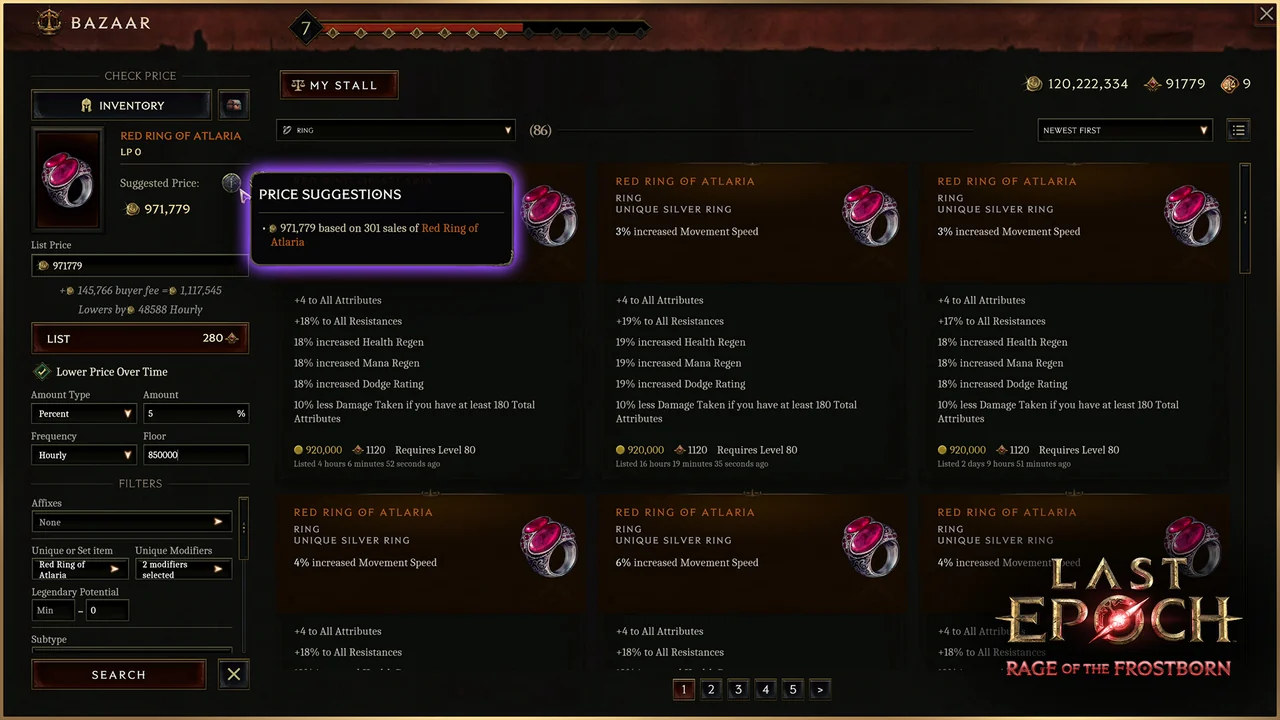
Use the Bazaar’s comparable listings and price suggestion as reference points before setting your own listing price. The example price is not a current market quote.
Before listing a drop, check its trade status and compare equipment with similar bases, affixes, and other relevant properties using the Bazaar filters. The purpose is to decide whether the item deserves listing time; a rare-looking label alone does not prove demand or a sale price.
Keep the two constraints separate. More Favor lets you perform eligible transactions, while actual gold from a sale still depends on a buyer. Items acquired from the Bazaar or marked untradable are not eligible for another sale. Do not plan to transfer a purchased item to a Circle of Fortune setup and assume switching factions removes its binding.
Avoid spending and obsolete farming loops
Lightless Arbor’s Vaults of Uncertain Fate are a place to spend gold for rewards. The official dungeon explanation provides no promise that those rewards return more gold than you spend. Set aside your purchase or crafting budget before treating dungeon spending as part of a farming session.
Patch 1.5.3 also fixes obtaining rewards by repeating the same Woven Echo after its boss has already been defeated. An older video showing that behavior is not a current repeatable income route. This guide covers earning gold inside the game; external gold sellers and real-money transactions are outside the route.
Improve the part slowing your next session
- Use the Corruption guide when the difficulty increase costs more time than it returns.
- Adjust loot filters around the equipment you actually intend to inspect.
- Review Circle of Fortune if self-found equipment progression is your goal instead of Bazaar sales.