Last Epoch corruption is a difficulty and reward value attached to a Monolith timeline. To raise it, explore the echo web, find a Shade of Orobyss echo, and defeat the Shade. Repeating ordinary echoes without completing a corruption-changing encounter does not make the timeline's corruption rise on its own.
Standard timelines begin at zero and stop at 50 corruption. Empowered timelines begin at 100 and have no maximum. For efficient progression, build one timeline to a difficulty you can farm consistently, then use the catch-up bonus when moving into lower-corruption timelines. More corruption improves several rewards, but it also raises monster health and damage; the useful target is the level you can sustain, not the largest number another character has reached.
Read the corruption value before choosing a goal
Corruption increases item rarity, experience gained, monster health, monster damage, and the Timeline Stability granted by echoes. In standard timelines, it also raises area level. In empowered timelines, it increases the rarity of guaranteed echo rewards. It slightly improves the chances of a unique having Legendary Potential or Weaver's Will, but that small benefit should not be confused with a guarantee of a better item.
| Timeline type | Starting corruption | Maximum | Practical implication |
|---|---|---|---|
| Standard | 0 | 50 | Raising corruption here does not turn it into an empowered timeline |
| Empowered | 100 | No maximum | You can keep raising the value, provided you can handle the difficulty |
Check which timeline you are actually entering before troubleshooting a plateau. A standard timeline at its limit is behaving differently from an empowered timeline that simply has not had a Shade completed recently. Treat those as separate problems instead of repeatedly clearing the same content and expecting a different result.
Choose a goal that corresponds to an activity or item. A boss drop can have a minimum corruption requirement; a farming session can instead aim for more stable experience or useful echo rewards. If no specific threshold matters, there is no need to push merely because the next Shade offers a higher number.
Corruption is one layer of difficulty. Active echo modifiers can make a particular run substantially more dangerous, so a death at a given corruption does not automatically prove that every echo at that value is unsuitable. Read the modifiers and compare similar encounters before deciding that your entire build has reached its limit.
Use the Shade loop to raise a timeline
As you progress farther from the timeline's center, Shade of Orobyss echoes begin to appear. Defeating a Shade changes corruption and refreshes the echo web. That refreshed web lets you start exploring again at the new reward and difficulty level rather than continuing indefinitely along the previous path.
A basic push follows this order:
- Select an empowered timeline you can already complete reliably.
- Clear connected echoes and move away from its center.
- Inspect a Shade echo before entering, including the corruption change it offers.
- Check the active modifiers and your readiness for the boss.
- Defeat the Shade, then verify the new corruption value on the timeline.
- Continue through the refreshed web or stop pushing and farm at the new level.
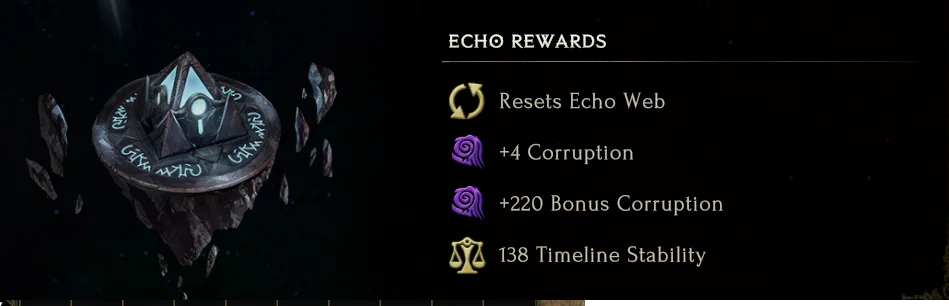
Defeating the Shade does not reset your Timeline Stability or remove your active modifiers. That matters both before and after the fight. You cannot plan around the assumption that completing the Shade clears difficult modifiers, and you do not need to regard existing Stability as automatically lost when the web refreshes.
Read the echo's displayed change rather than assuming every Shade gives the same increase. The boss's position in the web and the timeline's relationship to your highest-corruption timeline can affect the value offered. An earlier convenient Shade and a farther one are not interchangeable just because both contain Orobyss.
After a successful push, run ordinary echoes long enough to evaluate the new difficulty. A single boss kill establishes that you finished that encounter; it does not show that routine farming is efficient or that your defenses are comfortable across multiple modifier combinations. Stop adding corruption when the new value turns ordinary runs into repeated failures.
Focus one timeline before bringing up the others
Corruption belongs to individual timelines. Raising one does not immediately rewrite every other timeline's value. However, defeating a Shade in a timeline that is much lower than your highest-corruption timeline grants bonus corruption, which helps you catch it up more quickly.
The practical sequence is to establish a strong farming timeline first. When you later need a different timeline's rewards, inspect its available Shade echoes and look for the displayed bonus. You do not need to repeat the entire original push from 100 in every timeline, and you should not expect ordinary echo completion alone to apply the catch-up value.
| Situation | Useful next action | What to avoid assuming |
|---|---|---|
| First empowered timeline | Raise it through Shades while checking clear reliability | Every increase improves farming efficiency |
| New lower-corruption timeline | Inspect Shade echoes for a catch-up bonus | All timelines update automatically |
| Different reward target | Change timeline and bring it to an appropriate value | Your highest timeline must remain your only farming location |
| Farm becomes unstable | Pause the push and examine modifiers and defenses | Another corruption increase will solve a damage or survival problem |
Gaze of Orobyss can grant additional corruption when you defeat a Shade. Treat it as another part of the push plan rather than confusing it with the timeline's existing corruption. Check the relevant encounter information before committing; a displayed bonus is more useful than a remembered number from a different version or character.
Confluence of Oblivion is another named route associated with bringing timelines up toward your established corruption progression. Use it when you have access to the relevant Woven Echo and a reason to change timeline. Its availability is a separate question from the ordinary Shade route, so do not make finding one a prerequisite for beginning your first empowered push.
Balance better rewards against completed runs
Higher corruption increases rewards in several ways, but it also increases the time and risk involved in obtaining them. A harder timeline can produce more attractive drops while giving you fewer completed encounters during the same session. The displayed value cannot answer that trade-off on its own.
Measure a few ordinary runs at the current level. Note whether you complete them, whether bosses force long periods without attacking, and whether the useful rewards match your goal. You can make this comparison without treating a handful of drops as a reliable estimate of rare-item probabilities.
For experience and Favor, repeated attempts at the same echo are a poor basis for a Season 5 farming loop. Entering an echo that has already been attempted now provides significantly less experience and Favor, on top of existing reductions to encounters and loot. Progress through fresh echoes rather than building a plan around endlessly restarting one favorable location.
For equipment, consider whether the next increase actually changes eligibility. An item with a minimum corruption requirement creates a clear milestone. Once you satisfy it, further corruption becomes a reward-versus-speed decision. It does not create a promise that the desired unique will drop within a particular number of kills.
If survival is the bottleneck, evaluate the situation in which you die. Repeated deaths during a boss mechanic may call for learning the attack, while consistent trouble with ordinary hits may call for stronger defenses or recovery. Raising the same difficulty value before fixing that cause increases the problem you are trying to solve.
Keep Season 5 encounter difficulty separate
Rage of Morditas introduces its own progression and reward decisions within the campaign and Monolith. Its Anger can increase the difficulty and rewards of Morditas-related challenges, and the Nexus lets you soothe Morditas to reduce Anger. That is not the same control as reducing a timeline's corruption.
If a Morditas challenge is harder than the rest of your farming, inspect that encounter's progression rather than assuming the whole timeline needs to be pushed or reset. Conversely, soothing Morditas does not mean ordinary monsters throughout your empowered timeline have lost the damage and health granted by corruption.
Demigod's Ascendance, the pinnacle Morditas Woven Echo, has a 400-corruption placement requirement. That is a specific access milestone, not a recommended minimum for every build or every reward target. Build toward it only if the pinnacle encounter is your objective and your character can handle the content on the way.
When using a Temporal Keystone as an alternative progression tool, inspect its actual requirements and result before spending it. Keep the ordinary Shade route available while learning the relationship between your highest timeline, catch-up bonuses, and a new destination. A shortcut does not remove the need to complete the harder content at the resulting corruption.
Lower corruption when farming stops working
If you have raised a timeline too far, look for the Sanctuary of Eterra echo connected to its entry point. Completing that echo lets you lower corruption. This is the recovery path when the difficulty value itself has become unsuitable for your character or current goal.
Use the Sanctuary after diagnosing the problem rather than after every isolated death. You may only need a better modifier selection or a gear correction. However, if fresh runs remain consistently slow or unsafe across reasonable conditions, reducing corruption gives you a workable place to continue improving the character.
After reducing the value, verify the timeline display and reassess ordinary echoes. Do not expect the remembered feel of an earlier run to substitute for checking the current setting. The aim is to restore completed runs and usable rewards, then decide whether another push is justified after a meaningful equipment or skill improvement.
A lower value is also reasonable when changing the session's purpose. Learning a boss, testing a resource change, or farming comfortably can call for less difficulty than an ambitious progression attempt. Keep the target tied to the task instead of turning the highest previous corruption into a permanent obligation.
Diagnose corruption that seems stuck
Start with the timeline type. If it is standard and already at 50, you have reached that system's maximum. If it is empowered, check whether you have actually completed a Shade since the last recorded change. Clearing many ordinary echoes may improve Stability and open paths while leaving the corruption value unchanged.
Next, inspect the echo you selected. Read its displayed corruption change, catch-up bonus, and modifiers before entering. Choosing a nearby Shade for convenience can behave differently from the farther echo you meant to farm, and changing timelines can make you compare two different corruption values without noticing.
Finally, distinguish an interface misunderstanding from an encounter failure. A failed Shade attempt is not a successful push. A web refresh after a successful Shade does not mean your Stability disappeared. A lower-corruption second timeline does not mean the progress on your first timeline was lost. Confirm these values separately and choose the next action from the part that is actually incomplete.
Item corruption is a separate crafting system using Rune of Corruption. It permanently alters equipment and generally prevents further modification, with destruction-related exceptions. It does not raise your Monolith corruption, unlock a higher timeline value, or replace a Shade kill. When planning progression, keep the timeline number and an item's Corrupt state as two different decisions.