
The Last Epoch Steam charts snapshot reviewed on October 10, 2026 showed 20,100 players an hour earlier, a 23,261 24-hour peak, and a 258,503 all-time peak. The rolling Last 30 Days row reported 6,971.0 average players and a 42,921 peak, up sharply from September 2026's 878.2 average and 2,036 peak.
That shows a major short-term increase in Steam concurrent activity around Season 5, which launched on October 1 CDT and October 2 in Beijing time. The rolling average is not a total-player count, nor does it prove how many unique people play in a day or month. These are concurrent-player figures: they show how many Steam users have the game running at the same time.
The current picture is therefore more specific than either “the game is dead” or “the game is back to its launch population.” Last Epoch is active, receiving updates, and experiencing another seasonal spike, but its current peak remains far below the record established when version 1.0 launched in February 2024.
Current Last Epoch Steam Charts Snapshot
| Metric | Captured value | What it tells you |
|---|---|---|
| Players an hour earlier | 20,100 | A recent concurrent-player reading, not a daily total |
| 24-hour peak | 23,261 | The highest simultaneous count during the preceding day |
| All-time peak | 258,503 | The game's record concurrent count on Steam |
| Last 30 Days average | 6,971.0 | Average concurrent activity across the rolling period |
| Last 30 Days peak | 42,921 | Highest concurrent count recorded during that rolling period |
| Last 30 Days gain | +6,092.8 | Difference from the preceding comparison period |
| Last 30 Days percentage gain | +693.79% | Relative increase from a very low prior baseline |
| September 2026 average | 878.2 | The final full calendar month before Season 5 launched |
| September 2026 peak | 2,036 | September's highest concurrent count |
The “playing an hour ago” and 24-hour values are the most time-sensitive numbers on the page. They can change whenever players enter or leave the game. The monthly rows are more useful for comparing periods because they reduce the effect of one unusually busy hour.
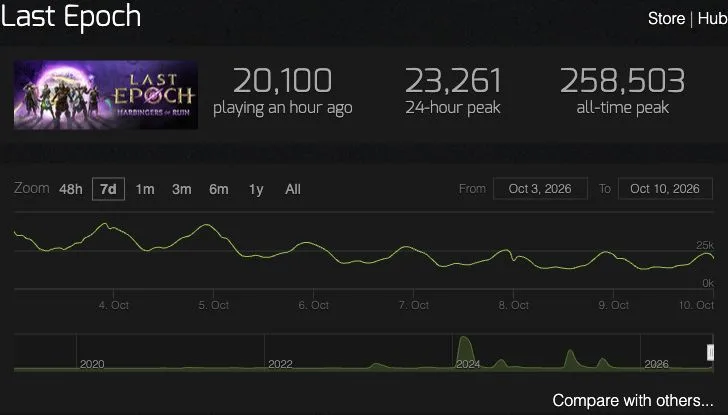
Steam Charts captured October 10, 2026, 01:13 Asia/Shanghai. The latest recorded count is not a live counter; later readings will change.
The all-time peak needs a different interpretation. It is a record from a single high point, not the normal number of people playing Last Epoch. Comparing every ordinary day with 258,503 will make almost any later period look inactive, even when tens of thousands of people are simultaneously playing after an update.
What Changed Around Season 5
Season 5: Rage of the Frostborn went live shortly before this snapshot, while the game was on hotfix 1.5.2.1 at the time of review. The timing matters because the Last 30 Days row mixes quieter pre-season days with the much busier launch period. It is not a clean Season 5 average, and it should not be treated as one.
September 2026 provides the clearest nearby full-month baseline. It averaged 878.2 concurrent players and peaked at 2,036. The rolling Last 30 Days figure then rose to a 6,971.0 average with a 42,921 peak. Both the displayed average and peak are substantially above the September figures.
Three details keep the comparison honest:
- September is a calendar month, while Last 30 Days is a moving window. Their start and end dates do not match.
- The moving window contains days from both sides of the season launch. Its average will continue changing as older pre-season days leave the calculation.
- A launch peak and a sustained average answer different questions. The 42,921 peak captures the largest burst; the 6,971.0 average reflects the entire mixed period.
The snapshot's 23,261 daily peak is also lower than the 42,921 rolling-period peak. That does not erase the launch surge. It shows that the largest burst had already passed by the captured day. Later daily concurrency can show whether aggregate activity stayed higher, but player retention requires cohort data rather than a public concurrency row.
Last Epoch Player Count History
Last Epoch's chart is highly cyclical. Major bursts are followed by quieter stretches, and later releases bring players back. The selected rows below compare historical averages and peaks without assigning a cause to every change.
| Period | Average players | Peak players | Supported context |
|---|---|---|---|
| May 2019 | 382.4 | 1,548 | Early Access began on April 30, 2019 |
| March 2023 | 12,396.7 | 40,504 | Large pre-release activity spike |
| January 2024 | 3,031.0 | 7,769 | Final full month before version 1.0 |
| February 2024 | 54,475.9 | 258,503 | Version 1.0 released on February 21 |
| March 2024 | 81,154.6 | 226,133 | Highest monthly average in this table |
| July 2024 | 16,873.3 | 71,086 | Later return spike |
| April 2025 | 36,199.9 | 150,214 | Largest 2025 peak in this table |
| August 2025 | 14,160.1 | 80,180 | Another major return period |
| March 2026 | 5,933.9 | 43,709 | Large 2026 spike before Season 5 |
| September 2026 | 878.2 | 2,036 | Final full month before Season 5 |
| Last 30 Days | 6,971.0 | 42,921 | Rolling window containing the Season 5 launch |
February 2024 holds the all-time concurrent record, but March 2024 has the higher monthly average: 81,154.6 compared with 54,475.9. There is no contradiction. Last Epoch launched late in February, so that month's average includes many quieter pre-release days. March was the first complete month after launch, allowing its average to remain high even though its 226,133 peak did not exceed February's 258,503 record.
The later data shows repeated increases in concurrent activity rather than a smooth line. It does not identify whether the same people returned. April 2025 reached a 150,214 peak after March had peaked at 4,730. August 2025 then reached 80,180 after July peaked at 4,912. In 2026, March reached 43,709, activity declined through the middle of the year, and the current Last 30 Days window reached 42,921 around Season 5.
These increases do not establish whether earlier players returned or how long each cohort stayed, why every player returned, or whether one future season will behave like another. The table shows repeated large changes in Steam concurrency; release timing provides context but does not establish the cause of each change.
How to Read Average and Peak Players
The average players column is the better starting point when you want to understand the normal level of simultaneous activity across a month. A higher monthly average means higher mean concurrency over that interval. Different daily patterns can produce the same average, so it cannot show how many days activity stayed high or how many individual players kept playing.
The peak players column answers a different question: how many users were running Last Epoch simultaneously at the busiest recorded point in that period. It is useful for measuring the maximum size of a launch surge, but it cannot show how quickly that surge faded.
The gain column compares one period's average with the preceding period. A positive number means the average increased; a negative number means it declined. Percentage gain needs extra care because a small baseline can produce an enormous percentage. The current +693.79% looks dramatic because the preceding population was unusually low. The absolute gain of 6,092.8 average concurrent players gives the percentage necessary scale.
Use all three fields together:
- Start with average players to judge the period's overall level.
- Check peak players to see the size of the busiest burst.
- Read absolute gain before percentage gain so a low baseline does not distort your impression.
- Compare equivalent time windows whenever possible.
- Add release timing before attributing a movement to player sentiment or game quality.
What the Steam Charts Do Not Measure
The numbers cover Steam activity, not every possible definition of the Last Epoch community. They do not provide a total-owner count, unique daily users, unique monthly users, copies sold, or the number of people who intend to return later.
They also do not separate the game's supported modes. Last Epoch includes online play, full offline play, solo play, and online co-op for up to four players. A Steam concurrency total does not tell you how many of those users are matchmaking, trading, playing alone online, or using offline characters. Online and offline characters cannot be transferred between modes, but that character boundary is not visible in a public concurrency row.
A chart cannot directly answer these questions:
- How fast a particular region, activity, or difficulty finds a group
- How active the player-driven market is at a particular hour
- How many players completed the campaign or reached endgame
- How many users returned specifically for one Season 5 feature
- Whether a decline reflects dissatisfaction, normal season completion, or another release
- Whether current server problems exist
- Whether an individual player will enjoy the game
Server status is especially important to separate from population. A high player count does not prove that every service is functioning, and a low count does not prove that servers are down. Use current service information for connection problems rather than diagnosing them from the chart.
Whether Last Epoch Is a Dead Game
The October 10 concurrency figures and current game updates do not support calling Last Epoch inactive. The game had tens of thousands of concurrent Steam players around the snapshot, Season 5 had just launched, and hotfix 1.5.2.1 had been released. The chart also records several substantial returns after earlier low periods.
That conclusion should remain narrow. “Not dead” does not mean “near its all-time record,” and it does not guarantee that every online activity will feel equally populated. The recent 42,921 peak was only about one-sixth of the 258,503 all-time peak. At the same time, it was more than twenty times September 2026's 2,036 monthly peak. Which comparison matters depends on the question you are trying to answer.
An old discussion calling the game dead is weak evidence for the current state. That discussion began in July 2021, years before the February 2024 full release and before the current multiplayer, seasonal, and version context. It is useful mainly as an example of how the same chart can be cherry-picked: one person can compare a post-update decline, while another selects a longer period and argues that the baseline grew. Neither approach should replace a clearly dated, like-for-like comparison.
A Better Way to Compare Last Epoch Activity
Use a fixed comparison method instead of choosing the largest or smallest number available.
- Record the capture date. Live and rolling values become stale quickly. This page's current snapshot is dated October 10, 2026.
- Choose one metric. Compare monthly average with monthly average, or monthly peak with monthly peak. Do not compare a live count directly with a monthly average.
- Match the windows. A complete calendar month is not equivalent to a partial season or moving 30-day window.
- Mark major releases. February 2024 contains the version 1.0 launch, while the current rolling period contains the Season 5 launch.
- Include both a peak and a baseline. The peak shows the busiest recorded moment; the average summarizes concurrent activity across the interval. Neither measures unique reach or player retention.
- Avoid unsupported causes. A simultaneous chart movement and update date can show timing, but the chart alone cannot prove why each individual returned or left.
- Wait for complete data before judging retention. The first days of a season measure launch interest better than long-term population.
For a practical Season 5 comparison, preserve September 2026 as the pre-launch baseline, record the Last 30 Days row with its exact capture date, and then compare both against the first complete post-launch calendar month when it becomes available. That sequence lets you compare the launch window with later aggregate concurrency. Measuring retention of individual players would require cohort data that these public charts do not provide.
Reading the October 2026 figures
Last Epoch's Steam charts show a strong Season 5 rebound from a quiet September, not a return to the game's 2024 launch record. The current snapshot contains three different scales: 20,100 concurrent players at the captured reading, a 42,921 Last 30 Days peak, and a 258,503 all-time peak. Each is valid, but each answers a different question.
If you want the most useful single reading, use the 6,971.0 rolling average to describe activity across the mixed launch window and the 42,921 peak to describe its largest surge. Keep the 878.2 September average beside them as the pre-season baseline. Then revisit the figures after a complete post-launch month rather than treating one launch-day peak—or one old forum argument—as the permanent state of the game.