This Last Epoch Dreamslash build follows Cursedboy's full-life Echo Blaster Bladedancer, using the author's saved configuration and played build walkthrough. Dreamslash supplies a repeatable attack and shadow interaction; Shadow Daggers, triggered Bladestorm and Shadow Cascade deliver the selected damage package. The author describes a comfortable starter and explicitly does not call it an S-tier build.
This is one configuration with an earlier Umbral Blades transition. The direct Shadow Cascade, cold conversion, low-life and full Doppelganger variants discussed in the video are separate options. Their strongest-looking pieces do not all belong in the selected full-life setup.
Reproduce the actual engine
| Configuration | Selected choice |
|---|---|
| Base class / mastery | Rogue → Bladedancer |
| Primary loop | Synchronized Strike creates shadows; Dreamslash spends them and triggers specialized throwing attacks through Somnambulism |
| Five specialized skills | Dreamslash, Synchronized Strike, Smoke Bomb, Bladestorm, Shadow Cascade |
| Damage identity | Physical Shadow Daggers plus the supported melee/throwing shadow package |
| Resource gate | Zero-cost direct Dreamslash; Sapping Strikes; enough reduced throwing mana cost for the triggered skills |
| Defense | Full health with shadow-related recovery, health on melee hit where available, and ordinary resistance/crit mitigation |
| Evidence boundary | Author-played configuration; no independent in-game test by this wiki |
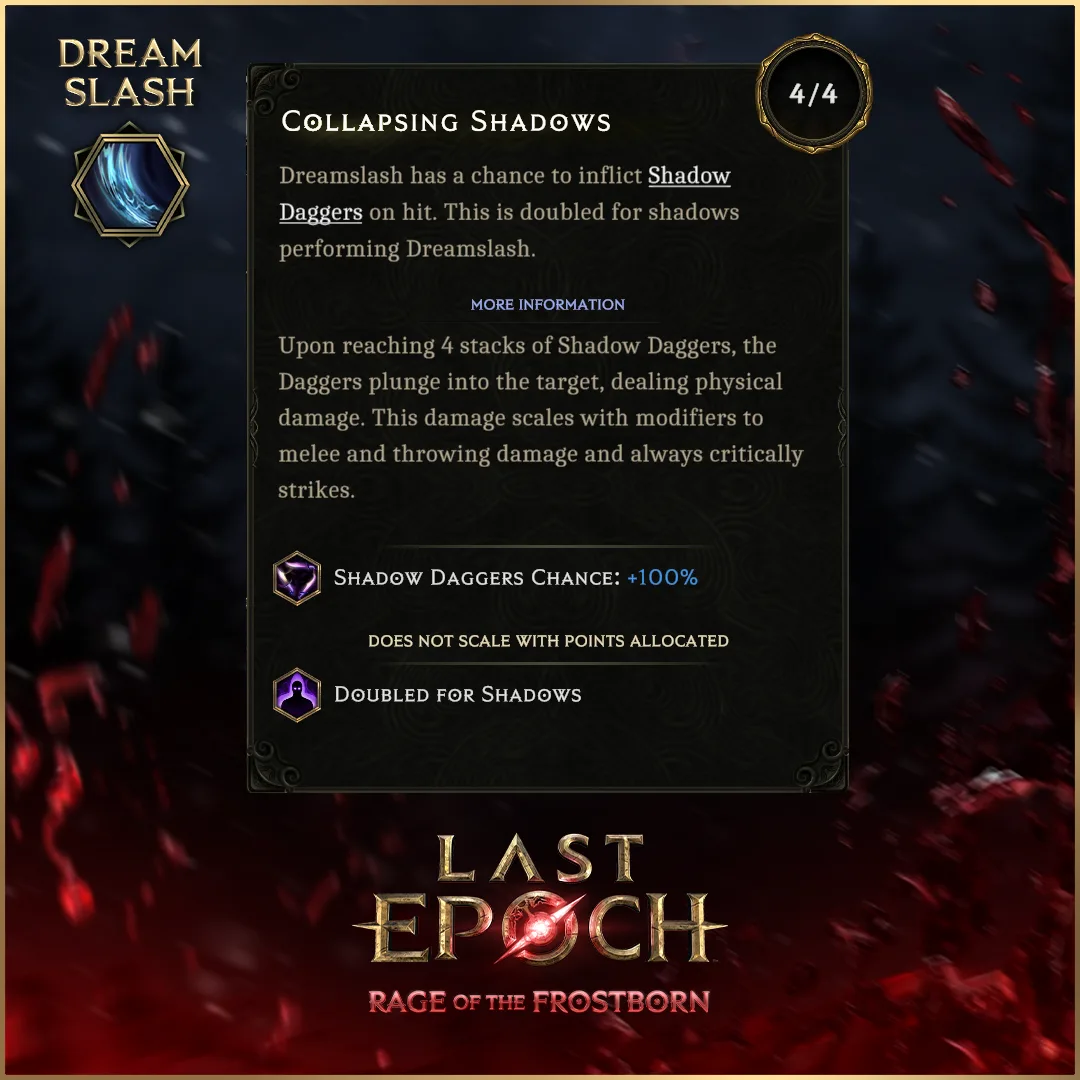
Shadow Daggers' damage proc always crits; ordinary Dreamslash does not automatically always crit. The distinction changes gearing. Physical damage, compatible melee/throwing flat damage and critical multiplier support the proc, while ordinary attacks and other triggered damage can still have their own crit conditions. Buying only increased Dreamslash critical chance is not a replacement for the proc engine. Author's mechanics explanation at 2:21.
The official skill unlock is 10 Bladedancer passive points, with a melee weapon required. Shadows must be within 12 meters of the target to be consumed. The dash and slash cannot both hit the same enemy from a single use, so do not double-count those two animations as boss damage. Official Dreamslash mechanics.
Campaign, Normal Monolith and endgame gates
| Stage | What to use | Do not switch until |
|---|---|---|
| Early Rogue / Bladedancer | Keep a functional Rogue leveling route; Dreamslash can be unlocked before the full five-skill package | Your melee attack, defenses and current support skills sustain ordinary encounters |
| Before expensive throwing-cost rings | The author uses Umbral Blades before the Shadow Cascade transition | Dreamslash's free direct hit restores mana and shadow creation remains repeatable |
| Normal Monolith shadow engine | Add the selected Synchronized Strike / Dreamslash loop and Bladestorm; preserve working health and resistances | You have the relevant mastery unlocks and can pay the triggered skill costs against a durable target |
| Shadow Cascade transition | Specialize Dagger Dance, keep Careful Assault 2/4, and use reduced throwing-cost rings | The author gives T7 + T5 as the lower cost-affix example and recommends two T7s for players unfamiliar with the mana interaction |
| Endgame refinement | Better physical penetration, shadow damage, health, recovery, gear-granted levels and the selected glove variant | The complete loop already works; offensive upgrades do not remove resistance or crit coverage |
The ring tiers are Cursedboy's recommendation, not an assertion that every Dreamslash variant requires two exalted rings. His Shadow Cascade route changes the triggered cost burden. A different tree or item roll can have a different budget, so verify the actual cost before spending crafting resources. Transition explanation at 5:30.
Synchronized Strike is a later Bladedancer skill in Season 5, requiring 35 points in the mastery tree. Unlocking Dreamslash at ten points therefore does not unlock the finished shadow-generation package. Keep the earlier setup until the mastery and skill specializations are ready.
Skill nodes with confirmed point counts
| Skill | Selected nodes / points | Why they matter |
|---|---|---|
| Dreamslash | Distortion Blade 3/3 for the zero-cost base attack; Somnambulism, Collapsing Shadows, Umbral Recollection, Wounds in Reality | Reduce the base three-mana cost, deliver Shadow Daggers, trigger throwing skills and create/resummon shadows |
| Dreamslash coverage | Shared Memories, Inception, Night Terror refraction package in the walkthrough | The author prefers the repeated attack coverage and Dream-stack generation for packs and durable targets |
| Shadow Cascade | Dagger Dance; Careful Assault 2/4 | Dagger Dance adds the throwing identity used by the cost-reduction affixes; two shadows are the author's preferred trigger threshold |
| Bladestorm | Alloy Animation and the selected Shadow Daggers route | The selected configuration allows two storms that can contribute to the same target; follow its actual tree rather than a physical leveling storm tree |
| Synchronized Strike | Shadow-creation and full-life recovery branches shown in the saved planner | Creates the shadows needed by Somnambulism and supports the selected health-recovery loop |
| Smoke Bomb | Shadow generation, Smoke Blades and Dusk Shroud support | Adds available shadows, conditional damage and a fighting/repositioning tool |
Distortion Blade's 3/3 follows directly from the official three-mana base cost and one-cost reduction per point; it is necessary to reproduce the author's free-hit Sapping Strikes engine. Careful Assault 2/4 is explicitly stated in the video. The video does not speak every connecting point or remainder allocation. Those values remain in A21Xa3O4, and this page does not fabricate a complete point map. Official node effects, author's node discussion.
Avoid Dreamshift in this shadow-copy engine: the official node makes shadows stop performing Dreamslash. Gathering Darkness imposes a minimum one-mana cost, changing the zero-cost recovery plan. Neither is a harmless extra damage node for the selected configuration.
Nightmare Steel is an optional movement change discussed by the author: it makes the direct skill send a wave while you remain in place. It is still a melee attack. Test the aiming pattern after the hotfix before choosing it simply to remove the dash animation.
Mana: a free attack is not a free trigger chain
The essential passive allocation stated in the video is Sapping Strikes, three points as soon as possible. It supplies mana from the zero-cost direct attack. The author also uses four points in a Bladedancer throwing-cost passive and a Falconer dodge-related mana option; the exact names and connecting allocations are not fully audible in the reviewed automatic captions, so use the saved planner rather than guessing their identities.
Somnambulism consumes mana equal to the selected throwing skill's cost. Dagger Dance makes Shadow Cascade eligible for the throwing-cost reduction affixes, which is why the ring transition matters. Bladestorm has its own cost reductions in the same author's configuration. Check both skills' actual costs after changing equipment.
Recurring Dreams can spend five mana per affected shadow, and Synchronized Strike has its own cost. Their expense does not disappear because the Dreamslash icon says zero. If resource sustain fails, check these costs before increasing attack speed. Author's mana section at 6:51, official Somnambulism and Recurring Dreams descriptions.
Do not count triggered Shadow Cascade as a direct-cast mana-restoration button. A passive or skill node requiring direct use must meet that requirement. The selected engine is free-hit recovery plus cost reduction, not an assumed refund from every triggered animation.
Gear: function first, luxury second
| Gear / affix | Selected role | Requirement boundary |
|---|---|---|
| Reduced throwing mana cost on rings | Allows the chosen Shadow Cascade / Bladestorm trigger package to sustain | Affix-gated transition; use the author's earlier Umbral Blades stage before the cost package is ready |
| Withstand the Elements, physical-resistance attack-speed modifier | Converts the relevant resistance investment into the selected attack-speed benefit | Check the actual variant; the cold minion-spell modifier used by Tide Shaman is a different effect |
| Weapons | Compatible physical/melee/throwing damage and the author's supported weapon effects; health on melee hit is a useful recovery affix | Do not require a perfect legendary slam to begin the earlier engine |
| Helmet / body | Damage with shadows, compatible physical penetration and health | Defensive rare affixes remain important; the creator's spoken example uses health and hybrid health |
| Belt | Health, physical damage, mana regeneration and potion cleanse | Recovery and cleanse have jobs independent of tooltip damage |
| Omnis | The author wants better resistance coverage with a critical-multiplier legendary roll | A luxury goal; he explicitly says his live Omnis crafts failed. Keep a functional defensive amulet meanwhile |
| Incisive Rage variant | The author wants the Deadly Strikes interaction as a later damage upgrade | It was absent from his shown live setup; it is not a starter requirement |
| Full Doppelganger set | Optional traversal-created shadows discussed in the video | Separate full-set option; do not assume one piece grants the three-piece behavior |
The weapon, amulet and idol rolls shown in the saved planner are targets, not guaranteed drops. The author's live character and saved configuration differ, especially in resistance coverage and expensive legendary results. Gear explanation at 13:27.
A useful upgrade improves the complete loop. If a new ring removes throwing-cost reduction, recalculate the triggered mana burden. If an offensive glove or weapon removes life or resistance, repair that loss before increasing difficulty. Physical resistance overcap for the glove effect is an offensive interaction, not an increase to the normal resistance damage-reduction cap.
Blessings, idols and full-life recovery
The author uses blessings to cover missing resistances while his desired Omnis is absent. The current saved planner shows 75 fire, 69 cold, 79 lightning, 197 physical, 84 necrotic, 69 poison and 59 void resistance with its displayed conditions. Those numbers are the copied configuration's visible sheet, not seven capped resistances or an ideal survival target. Check your actual defenses instead of treating the planner's physical overcap as protection from every element.
For this route, resistance repair comes before a luxury damage blessing. The exact completed blessing set is not clearly named in the reviewed video; do not borrow Warpath's or another Bladedancer's five-blessing list and present it as Cursedboy's. His specific discussion of a physical-resistance blessing supports the glove goal, with the remaining choices affected by his amulet and other missing rolls. Blessing and resistance discussion at 11:54, visible saved sheet.
Idol priorities discussed in the video are health, damage with shadows and critical multiplier, plus temporarily useful mana efficiency if costs remain unresolved. The author calls his own live idols unfinished. An altar's stronger prefix effect can improve the relevant idol affixes, but only if you have those affixes in the layout.
The selected character is a life build. Synchronized Strike's chosen recovery branch rewards shadow creation, including later resummons during its window. Wounds in Reality uses bleeds to generate additional shadows; this does not turn the entire character into a bleed-damage build. Health on melee hit can help a fast direct-attack loop, but it requires contact with the enemy. Movement, blind, dodge and Dusk Shroud complement recovery; they do not replace resistance coverage and consistent crit protection. Recovery section at 10:05.
Clearing and boss rhythm
- Create shadows with Synchronized Strike.
- Repeat Dreamslash toward the pack or boss, letting Somnambulism deliver the selected throwing package.
- Recreate shadows when the loop needs them; place Smoke Bomb where its support and movement help the next safe attack window.
- Use deliberate movement when an attack would carry you into a hazard. Shift can be an unspecialized bar option, but is not one of the selected five specializations.
- In a longer boss fight, observe mana, shadow count and health recovery together. Fast pack clear can hide a cost problem that appears when on-kill effects stop.
The creator prefers Careful Assault at two shadows because his three- and four-shadow tests were less comfortable. Copy that threshold before deciding the same setup is unreliable. The full Doppelganger and low-life Shift experiments have different support assumptions and are outside this configuration.
Failure diagnosis
| Symptom | Inspect | Correct before adding damage |
|---|---|---|
| Mana collapses after adding Shadow Cascade | Dagger Dance, ring cost affixes, zero-cost Dreamslash and Sapping Strikes | Restore the earlier Umbral Blades stage or acquire the selected cost package |
| Dreamslash shows a cost despite Distortion Blade | Gathering Darkness or another cost-changing branch | Reproduce the author's free-hit path; do not assume the extra cost preserves recovery |
| Many animations but weak damage | Shadow Daggers delivery, Somnambulism eligibility and matching physical scaling | Check the selected damage package rather than stacking ordinary Dreamslash crit chance |
| Shadow Cascade seldom triggers | Careful Assault allocation and available shadows | Use the author's 2/4 threshold and maintain shadow creation |
| Shadows do not participate | Target range, shadow position or Dreamshift allocation | Keep shadows within the required range and remove incompatible behavior |
| Life recovery fails on a boss | Direct hits and the shadow-creation recovery window | Preserve the full-life support path; do not expect a low-life Shift bonus to be active |
| A fast upgrade causes deaths | Lost resistance, health, crit protection or unsafe dashes | Repair the missing defensive layer and attack from a safe position |
Patch review and evidence
Reviewed October 11, 2026 against official 1.5.2.1. Triggered Dreamslash from Portentous Rage no longer moves the player and instead creates an independent maximum-range slash. With Nightmare Steel, targeting no longer prioritizes nearby enemies when the cursor is not directly hovering over one. The same hotfix fixes lost modifiers on corrupted Unsated Rage, Frostbound Solitude and Withstand the Elements variants. Official hotfix.
These are behavior and item fixes. They do not validate a new damage ceiling or prove that the author's earlier gameplay was repeated on this exact hotfix. The guide is partially verified: sources and configuration were checked, but the wiki has not played the build. No author-provided loot-filter XML was verified; avoid a strict endgame filter that hides the early cost and defensive affixes.
Evidence and references
- Cursedboy's played build walkthrough: configuration, transition, mana, recovery and actual gear limitations. Automated English captions were reviewed.
- Cursedboy's saved level-100 planner: the single allocation reference used here; target gear differs from the live showcase.
- Official Season 5 nodes: Dreamslash requirements, costs and incompatible conversion branches.
- Season 5 build explorer and physical Bladestorm Bladedancer: compare the two different Rogue configurations before committing gear.