Omen, Heretical, and corrupted do not describe the same thing. An Omen Idol is a specific idol type with fixed size rules, a defined drop source, stronger affix potential, and a default equip limit. A Heretical Idol is an enchanted version of a class-specific idol, with extra modifiers that grow through Weaver’s Touch. It is not another name for an Omen Idol. Corrupted describes an item state: an idol may be created or changed with that state, and a corrupted item becomes unmodifiable.
The most important overlap is that every Omen Idol is always corrupted, but that does not make every corrupted idol an Omen Idol. To identify an idol correctly, read its type, dimensions, affixes, corrupted status, and any equip restriction as separate properties. Do not identify it from border color or one unusual modifier alone.
The Differences at a Glance
| Term | What it tells you | Confirmed identifying rules | What it does not tell you |
|---|---|---|---|
| Omen Idol | The idol's specific type | It is 3x1 or 1x3, comes from Omen Windows or Roaming Omens, is always corrupted, and normally has a one-Omen-Idol equip limit | It does not mean that every corrupted idol is an Omen Idol |
| Heretical Idol | An enchanted class-specific idol | The Woven Enchanter adds enchanted modifiers and Weaver’s Touch; equipped kills can develop those modifiers | It does not inherit Omen size, drop source or equip limit |
| Corrupted idol | The idol's item state | Corruption is final: the item cannot be modified afterward | Corrupted is not a complete idol type and does not automatically mean Omen or Heretical |
| Idol Altar | An item equipped above the Idol Grid | It changes the grid's shape and properties and may create Refracted Slots or alter the Omen Idol limit | It is not an idol placed inside the grid and is not another word for an Omen Window |
| Omen Window | A combat encounter | It appears in the Campaign and Monolith of Fate and can reward corrupted items, Runes of Corruption, Idol Altars, and other loot | It is not an inventory slot, idol type, or altar |
This separation matters because each term answers a different question. “Omen” identifies a special family. “Corrupted” tells you whether the item has entered an irreversible state. “Heretical” must be evaluated as its own label rather than borrowing Omen rules. An Idol Altar changes the environment in which your idols are equipped, while an Omen Window is one place where the related rewards originate.
Start With the Normal Idol Rules
A normal idol is equipment placed in the dedicated Idol Grid beside the inventory. Quest completion unlocks more room in that grid, up to 20 slots. Idols occupy physical space rather than a conventional equipment slot, so both their modifiers and their dimensions matter when you plan a layout.
Regular idol sizes range from 1x1 through 2x2, 1x4, and 4x1. Larger idols generally provide more of each stat, and some stats are limited to particular dimensions. Most idols are restricted to a base class, with class-specific idols drawing from their own possible affixes.
Standard idols drop with one prefix and one suffix. They cannot be adjusted through ordinary crafting, so an idol's existing combination must already suit your build and available grid space. That baseline helps expose what is unusual about an Omen Idol: it occupies a new 3x1 or 1x3 footprint while drawing power and modifier possibilities associated with larger conventional idols.
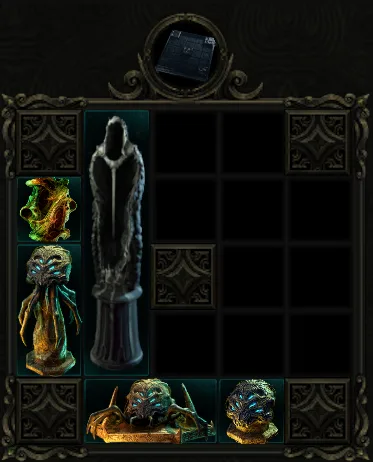
The normal Idol Grid shows how idol dimensions use available slots.
Omen Idols Are a Specific Idol Type
An Omen Idol is either 3x1 or 1x3. Its orientation therefore matters: the same number of occupied cells can be easy or impossible to fit depending on the current shape of your Idol Grid and the positions of other idols.
Omen Idols are more powerful than standard idols of the same dimensions. Their prefixes and suffixes have the same power as those found on 1x4 or 4x1 idols. They can also roll modifiers that would otherwise be limited to 1x4, 4x1, or 2x2 idols. This is affix potential, not a promise that every Omen Idol will produce the exact modifier or roll your build needs.
They drop from Omen Window encounters and, since patch 1.4.2, from Roaming Omens as well. Both Omen Idols and Idol Altars can appear in Roaming Omens loot. Omen Idols are always corrupted. That final point creates the common naming confusion: “Omen” identifies the item type, while “corrupted” is also one of its states. The two labels are simultaneously true, but they are not interchangeable.
By default, you may equip only one Omen Idol. Some Idol Altars can increase that limit substantially, so the limit belongs to the Omen Idol system and can be modified by the equipped altar. Finding a second strong Omen Idol is therefore not enough by itself; you also need an altar whose actual modifiers permit the intended layout.
When comparing an Omen Idol with another idol, check all of the following rather than looking only at raw affix values:
- Whether its 3x1 or 1x3 orientation fits the current grid.
- Whether the prefix and suffix contribute to the build's real needs.
- Whether another Omen Idol is already equipped.
- Whether the equipped Idol Altar changes the Omen limit.
- Whether the idol crosses any Refracted Slots created by the altar.
- Whether moving it forces you to remove multiple smaller idols with a better combined result.
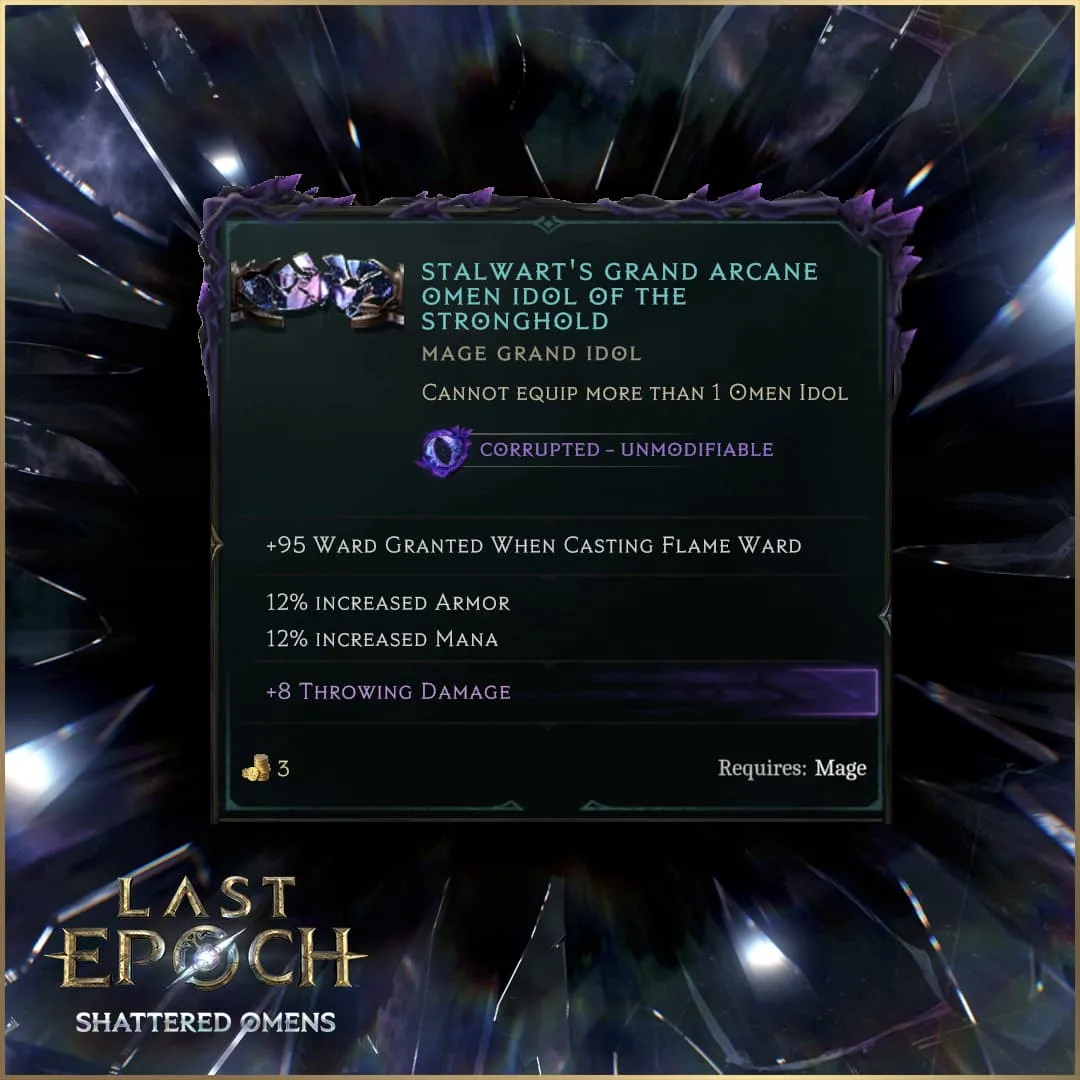
An Omen Idol is a specific idol type, separate from whether the item is corrupted.
Heretical Idols Grow Through Weaver’s Touch
The Woven Enchanter turns a class-specific idol into a Heretical version of the same subtype. Eligible subtypes are Adorned, Grand, Huge, Large and Ornate Idols. This enchantment preserves the idol’s ordinary affixes and adds an enchanted modifier plus Weaver’s Touch. Its shape still matters: the enchanted idol must fit the cells available in your grid.
Equip the idol and kill enemies to develop it. A kill has a chance to consume Weaver’s Touch and improve an enchanted modifier or add the second enchanted modifier. This is progression through use, rather than a normal Forge operation that lets you select any affix you want.
| Property | Heretical rule |
|---|---|
| Original modifiers | Two ordinary idol affixes, which do not have tiers |
| Extra modifiers | Up to two enchanted affixes |
| Enchanted modifier limit | Tier 7 |
| Initial enchanted tier | Up to Tier 4 |
| Growth resource | Weaver’s Touch, consumed through equipped kills |
| Re-enchantment | Spend Memory Amber at the Woven Enchanter to replace the enchanted result |
When Weaver’s Touch is depleted, further kills do not keep raising the enchanted modifiers. Judge the developed item by the modifiers it actually gained and whether those modifiers help your character. A higher tier is useful only if the effect fits your damage, defenses or resource plan.
Re-enchantment removes the old enchanted modifiers and remaining Weaver’s Touch before assigning a new enchantment. It does not mean that the Enchanter lets you keep the best enchanted line and reroll only the unwanted one. Preserve a working idol if the replacement result could leave your build worse off, and check the displayed Memory Amber cost before confirming.
Heretical and corrupted are separate properties. An enchanted class idol does not acquire the Omen Idol’s fixed dimensions, encounter source or default equip limit. Check whether the item is already corrupted before assuming you can enchant or change it: corruption’s finality still matters even when the item also has another special label.
The Season 5 unique idol Frostborn Solitude interacts with the number of Heretical Idols you equip. That is a specific build interaction, not a reason to replace every ordinary idol regardless of its affixes. Evaluate the unique’s actual benefits and penalties together with the Heretical items you would add.
Corrupted Describes an Irreversible Item State
Corruption is a risk-and-reward item system. A Rune of Corruption is used in the Forge: place the eligible item in the Forge, select the rune, and accept the confirmation prompt. The result can improve or damage the item, and the final outcome is displayed in the Forge window.
Possible outcomes include adding effects or stats, maximizing some or all existing roll values, adding affixes, reducing affix tiers, changing rarity, converting attributes, minimizing rolls, or turning the target into a random magic item. A sufficiently bad result can ruin the item and make it unequippable. These are possible outcomes, not a guaranteed sequence and not a selectable menu of results.
After corruption, the item becomes unmodifiable. This is the practical meaning of the corrupted state when deciding whether to risk an idol: you are not beginning another normal crafting phase. You are accepting a final result that may be better, worse, or unusable.
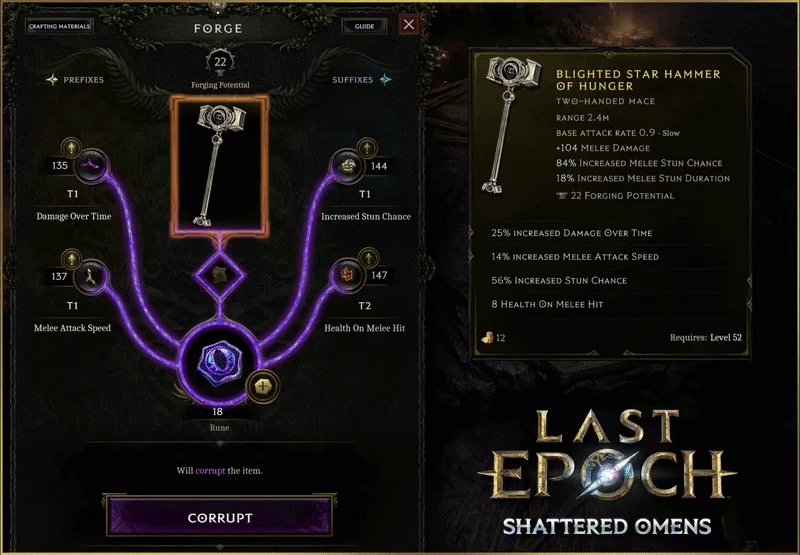
The Forge interface shows the irreversible corruption action.
Corruption does not erase every underlying identity rule. A class-specific item remains class-specific, although corruption may change its level requirement or subtype. Corrupted items that would normally allow shattering can still be shattered, but corruption-exclusive affixes cannot be recovered as affix shards.
For ordinary equipment, finish the useful conventional crafting before applying the Rune of Corruption. For idols, remember that their normal prefixes and suffixes cannot be tuned through standard crafting in the first place. Judge whether the starting idol is worth risking, then assume the corruption result will be final.
Omen Idols are the important exception to the acquisition sequence because they drop already corrupted. You do not need a Rune of Corruption to make an Omen Idol count as corrupted, and its always-corrupted state does not remove its identity as an Omen Idol.
Idol Altars Change the Grid, Not the Idol's Identity
An Idol Altar is equipped in the dedicated slot above the Idol Grid. Equipping one can immediately change the grid's shape and properties. It does not turn a normal idol into an Omen Idol or rename a Heretical Idol; it changes the rules and spaces around the idols you equip.
Altar modifiers may affect the entire grid, only idols placed in Refracted Slots, or other specified targets. Refracted Slots are visually marked with a purple glow. An idol placed across one or more of those slots may have amplified affixes or receive additional bonuses, depending on the exact modifiers of the equipped altar.
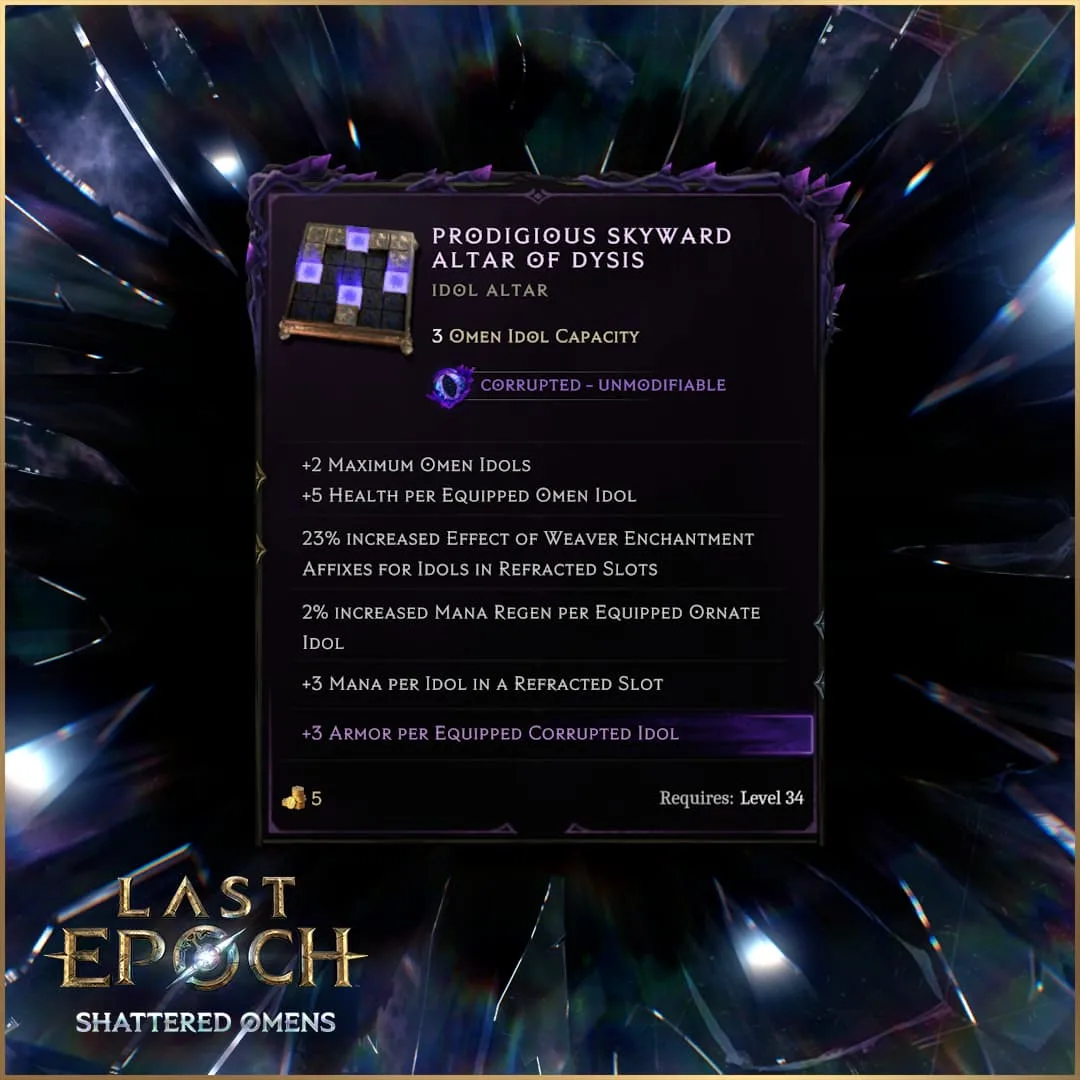
The Idol Altar modifies the grid and adds Refracted Slots without changing the idol's type.
The altar must therefore be included in any meaningful comparison. An idol that looks weaker in isolation may become the better choice when it crosses the correct Refracted Slots. Conversely, a powerful 3x1 Omen Idol can become awkward if its orientation prevents it from reaching the relevant slots or forces several valuable idols out of the grid.
Evaluate an altar in this order:
- Compare the old and new grid shapes.
- Identify every Refracted Slot.
- Read which altar effects apply globally and which require Refracted placement.
- Check whether it changes the number of Omen Idols you may equip.
- Rebuild the complete grid rather than swapping one idol in isolation.
- Compare the combined effects of all removed and added idols.
The altar is also a possible reward from completing Omen Windows. That shared acquisition source is why Omen Idols, Idol Altars, corrupted items, and Runes of Corruption are often discussed together, even though they are different objects or systems.
How the Omen Window Reward Path Fits Together
Omen Windows appear as random encounters in both the Campaign and the Monolith of Fate. Entering the encounter circle shatters the window and summons an Omen. During the first phase, the Omen is invulnerable while Fractured enemies enter the battle. Defeating those enemies fills the encounter's progress bar and expands the ring.
Leaving a normal encounter ring for more than 10 seconds causes the Omen to escape and ends the encounter. In a party, only one player must remain inside to prevent that countdown. Once the progress bar fills, the Omen absorbs the remaining Fractured enemies, becomes vulnerable, and begins its second phase.
Defeating the Omen can produce several related but distinct rewards, including corrupted items, Runes of Corruption, Idol Altars, Timeglass Fragments, and Omen Idols. The presence of all these rewards in one activity does not collapse them into a single item category.
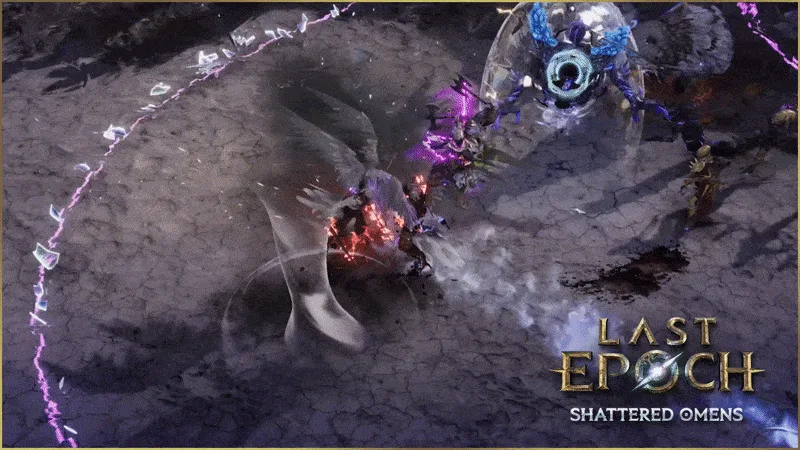
An Omen Window encounter provides the context for the Omen reward path.
Timeglass Fragments provide another route to Runes of Corruption: they can be exchanged with Apophis in the Monolith of Fate. This gives the overall system a clear sequence without implying a guaranteed idol outcome:
- Find and complete an Omen Window.
- Defeat its Fractured enemies, then kill the vulnerable Omen.
- Inspect each reward by its actual item type.
- Treat an Omen Idol as already corrupted.
- Equip an Idol Altar above the grid if its layout and modifiers improve the build.
- Use a Rune of Corruption only when you accept an irreversible and unpredictable result.
Higher-tier Omen Windows contain tougher and more numerous Fractured enemies and provide more loot. That affects the encounter's risk and reward, but it does not guarantee a particular Omen Idol roll, altar modifier, or corruption result.
A Reliable Identification and Comparison Method
When an unfamiliar idol drops, classify it before deciding whether it is an upgrade.
First, read its explicit type. If it says Omen Idol, apply the confirmed Omen rules: 3x1 or 1x3, always corrupted, stronger affix potential, and the default equip limit of one. If it says Heretical, keep it in that separate category and do not copy Omen-only rules onto it.
Second, inspect the corrupted state independently. A corrupted label tells you that further modification is unavailable. It does not by itself reveal the idol's family, dimensions, class restriction, or equip cap.
Third, compare usable effects rather than category prestige. One large special idol is not automatically better than the smaller idols it displaces. Add together the lost prefixes, suffixes, and any altar interactions before deciding.
Fourth, test the physical layout. A 3x1 Omen Idol and a 1x3 Omen Idol use the same number of cells but fit very differently. An altar can change the grid shape, so a layout that works under one altar may fail immediately after you replace it.
Fifth, account for Refracted Slots. Check whether the idol merely touches a glowing slot or occupies the cells required by the altar's wording. Apply only the effect actually described by that altar.
Finally, stop before corruption and evaluate the downside. A Rune can improve the item, weaken its rolls, reduce tiers, change rarity, or ruin it. There is no supported basis for assuming a favorable result merely because the target is already rare, valuable, or important to the build.
Common Mix-Ups to Avoid
- “Omen” and “corrupted” are synonyms. They are not. Omen is an idol type; corrupted is an item state. Omen Idols happen to possess both properties.
- Every corrupted idol is an Omen Idol. False. The corrupted state alone does not establish the Omen type.
- Heretical means Omen. Do not transfer the Omen Idol's size, source, affix strength, or equip limit to a Heretical Idol.
- An Idol Altar occupies the Idol Grid. It uses its own slot above the grid and changes the grid's layout or behavior.
- An Omen Window is the same thing as an Idol Altar. One is a combat encounter; the other is an equippable item that changes the Idol Grid.
- A Rune of Corruption is a normal upgrade. Its result can be beneficial or destructive, and the corrupted item becomes unmodifiable.
- A stronger affix pool guarantees a perfect Omen Idol. It does not. Omen Idols have stronger potential, but their useful modifiers and values still need to match the build.
- A second Omen Idol can always be equipped. The default limit is one. An appropriate Idol Altar must change that limit before additional Omen Idols become usable.
The shortest accurate rule is: identify the idol family first, inspect corruption as a separate state, and calculate the full Idol Altar layout before equipping anything. That keeps Omen-specific mechanics attached to Omen Idols, prevents unsupported assumptions about Heretical Idols, and makes the irreversible corruption decision explicit.