
Converted damage counts for global increased physical damage only when that damage is physical after conversion. Last Epoch resolves the conversion first and then applies damage-type modifiers. If a skill’s physical base damage is fully converted to fire, lightning, cold, void, or another type, global increased physical damage no longer scales that converted component. If another skill is converted into physical, global increased physical damage can scale the newly physical base damage.
The important limitation is that conversion does not necessarily change every component delivered by the skill. Untyped added damage normally adapts to the skill’s converted base type, while explicitly typed added damage keeps its stated type unless the conversion says otherwise. Ailments and secondary effects also remain separate unless the conversion explicitly includes them.
The short rule for converted damage
Use the final damage type, not the type the skill had before you allocated the conversion.
- Physical damage that remains physical benefits from increased physical damage.
- Physical base damage converted completely to another type does not benefit from increased physical damage.
- Base damage converted into physical can benefit from increased physical damage.
- Untyped added damage follows the applicable base damage type and therefore usually follows its conversion.
- Added damage that already names a type, such as melee physical damage or melee fire damage, is not automatically converted with the base damage.
- Ailments and other applied or triggered effects are not automatically converted with the skill.
- Generic increased damage is broader than increased physical damage, but neither should be assumed to affect minions unless the modifier includes the required minion wording.
This is why a physical modifier can appear useless after a conversion while still scaling a small physical portion from a separate, explicitly typed source.
How conversion changes the damage packet
A skill’s final hit can contain several components. Treat each component separately instead of treating the skill name as one indivisible damage type.
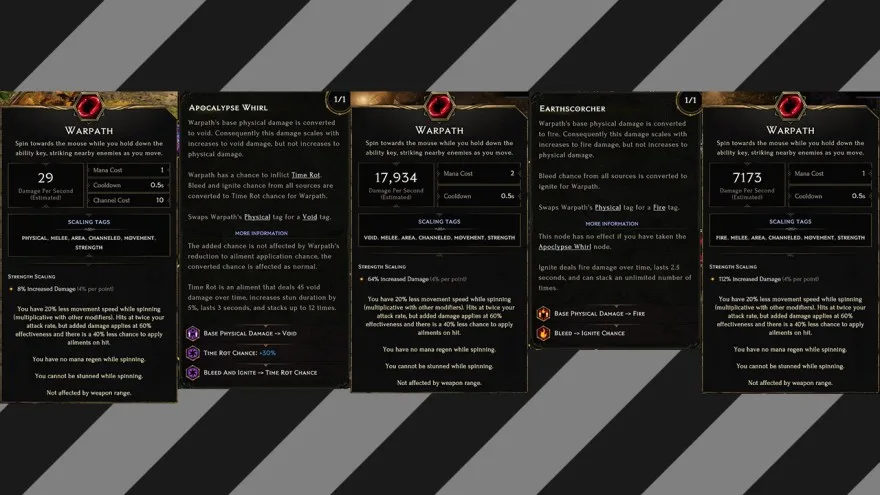
Warpath’s conversion nodes replace its physical scaling tag with void or fire scaling.
Base damage
Base damage is the damage inherent to the skill. Conversion changes this component from the original type to the destination type. A physical skill converted to fire has fire base damage after the conversion, so increased fire damage applies to that component and increased physical damage does not.
Untyped adaptive added damage
A modifier such as added melee damage, without a damage type written into the modifier, is adaptive. It becomes a type that follows the skill’s base damage. Added melee damage contributes physical damage to a physical melee attack, but it contributes fire damage to a fire melee attack.
When the skill’s base damage is converted, this adaptive component follows the converted type. That makes untyped added damage useful for builds that change a skill’s element or damage type.
Explicitly typed added damage
A modifier such as added melee physical damage already has a damage type. Base damage conversion does not automatically turn that physical contribution into fire, lightning, or another type. Likewise, added melee fire damage does not automatically become physical merely because the skill’s base damage is converted to physical.
A converted skill can therefore deliver more than one damage type in the same hit. The converted base and adaptive damage may be fire, while a separate source still contributes physical damage. Increased physical damage scales only that remaining physical component.
Ailments and secondary effects
A damage conversion does not automatically convert ailments or other effects applied or triggered by the skill. A node that changes the hit from physical to fire should not be treated as proof that every ailment, triggered skill, or secondary effect also became fire damage. Follow the wording attached to that effect and only include it in the conversion when the description explicitly says it is converted.
Conversion happens before increased damage is applied
The clean way to evaluate a modifier is to resolve the damage packet in order:
- Identify the skill’s base damage type before conversion.
- Apply the conversion to the base damage.
- Let untyped adaptive added damage follow the applicable base type.
- Keep explicitly typed added damage in its stated type unless a rule explicitly converts it.
- Apply relevant increased damage modifiers to each resulting component.
- Apply relevant more-damage modifiers according to the component and skill conditions they specify.
- Evaluate ailments and triggered effects separately rather than folding them into the converted hit.
Added damage is also affected by the skill’s added damage effectiveness before it joins the base damage for later increased and more modifiers. That does not change the conversion rule: each resulting component still checks its final type when determining whether increased physical damage applies.
A modifier can match the skill in more than one way. For example, a physical melee component can benefit from applicable melee damage and physical damage modifiers. “Melee” describes how the damage is delivered, while “physical” describes the damage type. Converting the component to fire can remove its physical match without removing its melee match.
Worked examples with simplified damage packets
The following examples use hypothetical values only to expose the order of operations. They omit defenses, critical strikes, skill-specific more modifiers, and other combat variables.
A physical skill converted completely to fire
Assume a physical melee skill has 10 base damage and receives 5 untyped added melee damage. A conversion changes its base damage completely to fire.
The 10 base damage becomes fire. The 5 untyped melee damage adapts to the converted base type and also becomes fire. The resulting 15-point component is fire before increased modifiers are applied.
Global increased physical damage does not scale this component because none of it is physical after conversion. Applicable increased fire damage and increased melee damage can scale it because its final properties are fire and melee.
A converted skill with separate typed physical damage
Use the same converted fire skill, then add a modifier that explicitly grants 5 melee physical damage. Base damage conversion does not automatically convert that typed addition.
The skill now has a fire component from its converted base and adaptive damage, plus a separate physical component from the explicitly typed modifier. Increased fire damage affects the fire portion. Increased physical damage affects the physical portion. Increased melee damage can affect both because both portions are delivered as melee damage.
This is the main exception behind apparently conflicting answers. Saying “increased physical damage does nothing after full conversion” is correct only when the evaluated damage packet has no separate physical component left.
A non-physical skill converted into physical
Assume a skill’s base damage starts as another type and a conversion changes it completely to physical. Its base component is now physical before increased modifiers are evaluated. Untyped adaptive added damage also follows that physical base type.
Global increased physical damage can scale those newly physical components. Increased damage for the original type does not scale them merely because the skill used to have that type. Once again, the original type is not retained as a second scaling route after conversion.
An explicitly typed addition matching the original type remains separate unless the conversion includes it. That separate component can still use modifiers for its own final type.
A skill that retains multiple damage components
Some skills can deal multiple types because their base damage, conversion choices, or added damage sources leave more than one component active. Do not choose a single increased-damage modifier based only on the skill’s most prominent tag.
Sort the packet by final damage type. Increased physical damage applies to the physical slice, increased fire damage to the fire slice, and a broader delivery modifier such as increased melee damage can apply across slices that remain melee. This approach prevents a small physical component from being mistaken for proof that the entire converted hit still scales with physical damage.
Separate adaptive and typed added damage
The fastest equipment check is to read every flat added-damage line literally.
| Modifier wording | Behavior after base conversion | Physical increased damage applies when |
|---|---|---|
| Added melee damage | Adapts to the skill’s applicable base type | The adaptive damage becomes physical |
| Added spell damage | Adapts to the spell’s applicable base type | The adaptive damage becomes physical |
| Added melee physical damage | Remains explicitly physical unless another rule converts it | The skill can use that added melee damage |
| Added melee fire damage | Remains explicitly fire unless another rule converts it | It does not; the component is fire |
| Increased physical damage | Scales physical components regardless of their earlier type | A component is physical after conversion |
| Increased melee damage | Scales qualifying melee components across damage types | The component is melee |
| Increased damage | Broadly scales qualifying damage dealt by the character | The modifier’s scope includes that source |
Adaptive flat damage is usually easier to reuse when switching a skill between damage types. Typed flat damage is narrower: it can remain useful as a secondary component, but it may not receive the main increased-damage investment of the converted build.
This distinction is particularly important when comparing weapons. A weapon can have a strong base or useful properties while also carrying increased physical damage that no longer scales the converted portion of your main skill. Evaluate the useful and dead lines separately instead of declaring the whole item functional or useless based on one modifier.
Global does not mean every damage type
In “global increased physical damage,” the two words describe different restrictions.
“Global” means the modifier is not confined to one named skill or one local skill-tree effect. “Physical” still restricts it to physical damage. Global physical damage can apply across multiple qualifying skills, but it does not become generic increased damage and does not remember that a converted fire component originated as physical.
Generic increased damage is broader because it is not limited to one damage type. It can affect different player damage types when the other conditions are satisfied. That does not automatically make it a minion modifier. Player damage and minion damage must be evaluated separately, and a minion build should look for wording that actually applies to minions.
The same separation applies to delivery tags. Physical is a damage type; melee, spell, and throwing describe methods of dealing damage. A spell can deal physical damage, and a melee attack can deal fire damage. Match modifiers against both the final type and the delivery method.
Audit a converted build in six steps
Use this process whenever you allocate a conversion node or equip an item that changes a skill’s base type.
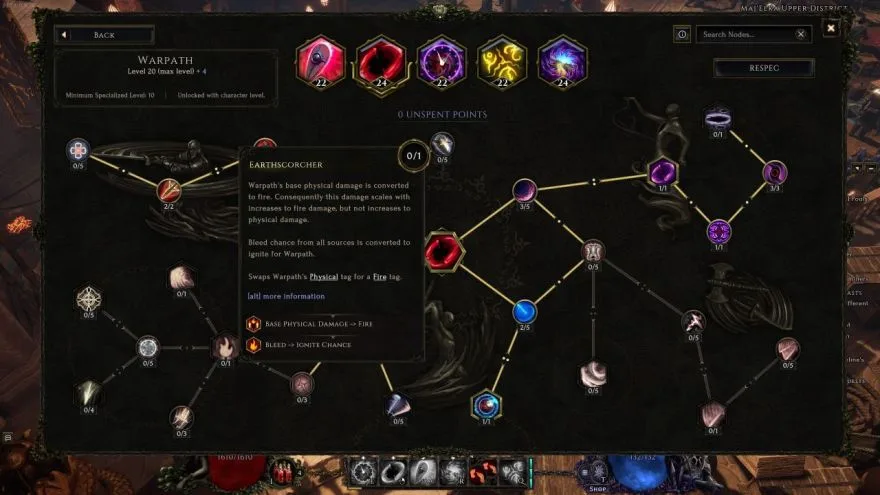
The skill tree tooltip states how Earthscorcher converts Warpath’s damage and changes its tag.
- Read the full conversion text. Confirm the starting type, destination type, and whether the wording mentions only base damage or explicitly includes another effect.
- Inspect the skill’s active tags. Use the in-game skill information to confirm the active damage and delivery tags after allocating the conversion. Do not rely on memory from the unconverted skill.
- List every flat added-damage source. Separate untyped adaptive additions from modifiers that explicitly name physical, fire, cold, lightning, void, poison, necrotic, or another type.
- Group increased modifiers by scope. Keep damage-type modifiers, delivery modifiers, generic damage, minion modifiers, and skill-specific modifiers in separate groups. A line belongs in the calculation only when its wording matches the resulting component.
- Move ailments and triggered effects into separate rows. Do not assume the main hit’s conversion changes them. Check their own wording, type, and scaling rules.
- Reassess every item after conversion. Physical increased damage may become weak or dead for the main component, while adaptive added damage or a delivery modifier can remain fully useful.
When the displayed tooltip seems inconsistent, simplify the comparison. Change one modifier at a time, keep the conversion fixed, and compare like with like. Minion and cooldown-skill tooltip values can be unreliable indicators of the full interaction, so modifier wording and final damage tags should lead the audit.
Common conversion mistakes
Scaling the original type after full conversion
The original damage type is not an extra scaling tag retained for the converted component. If physical base damage becomes fire, increased physical damage is not applied first and carried through the conversion. The conversion occurs first.
Assuming every flat damage line converts
Untyped added damage adapts, but explicitly typed added damage does not automatically follow. A build can therefore contain both the converted type and leftover typed damage from gear, passives, or another source.
Treating global physical damage as generic damage
Global describes where the modifier can apply, not which types it can scale. The physical restriction still controls the result.
Treating physical and melee as alternatives
They describe different attributes. A component can be both physical and melee, fire and melee, or physical and spell. Conversion can change the damage type while leaving the delivery method intact.
Converting the hit and assuming ailments follow
Ailments and triggered effects do not automatically inherit the conversion. Include them only when their own wording or the conversion explicitly supports the interaction.
Trusting one tooltip number without checking components
A single total can hide mixed damage types and separate modifiers. Break the skill into converted base damage, adaptive additions, typed additions, ailments, and triggered effects before deciding whether a physical affix is useful.
Gear decisions after converting a skill
For a fully converted main hit, prioritize modifiers that match the destination type, the skill’s delivery method, or a valid generic scope. Untyped adaptive added damage is valuable because it follows the converted base type. Explicitly typed added damage is most efficient when it matches the destination type or forms a deliberately supported secondary component.
Do not automatically discard an item because it contains increased physical damage after a conversion. First determine whether the item also supplies a useful base, adaptive added damage, critical properties, or another relevant modifier. At the same time, do not count the physical line toward the converted component when no physical damage remains.
A concise build check is:
- What type is the base damage after conversion?
- Which added damage is adaptive?
- Which added damage has an explicit type?
- Which components are still physical?
- Which increases match the final type?
- Which delivery modifiers still apply?
- Are any ailments, minions, or triggered effects being incorrectly bundled into the main hit?
If the only physical part of the packet was converted away, global increased physical damage is a dead modifier for that packet. If conversion creates physical damage or a separate typed physical component remains, the modifier applies only to those physical components.