Last Epoch Season 4, Shattered Omens, launched on March 26, 2026. It introduced Omen Windows, Echo Chains, corrupted items, Idol Altars, two Rogue skills, a new pinnacle encounter, and a reorganized Monolith progression path. It also expanded loot filters and revised several everyday interfaces.
Season 4 is no longer the current season. As of October 10, 2026, Last Epoch is in Season 5: Rage of the Frostborn, and the released version is 1.5.2.1. Use this page to understand what Shattered Omens added, identify mechanics or items that originated there, and judge whether a Season 4 guide is still useful. Do not assume old balance advice, reward sources, or progression routes remain unchanged in Season 5.
Season 4 at a glance
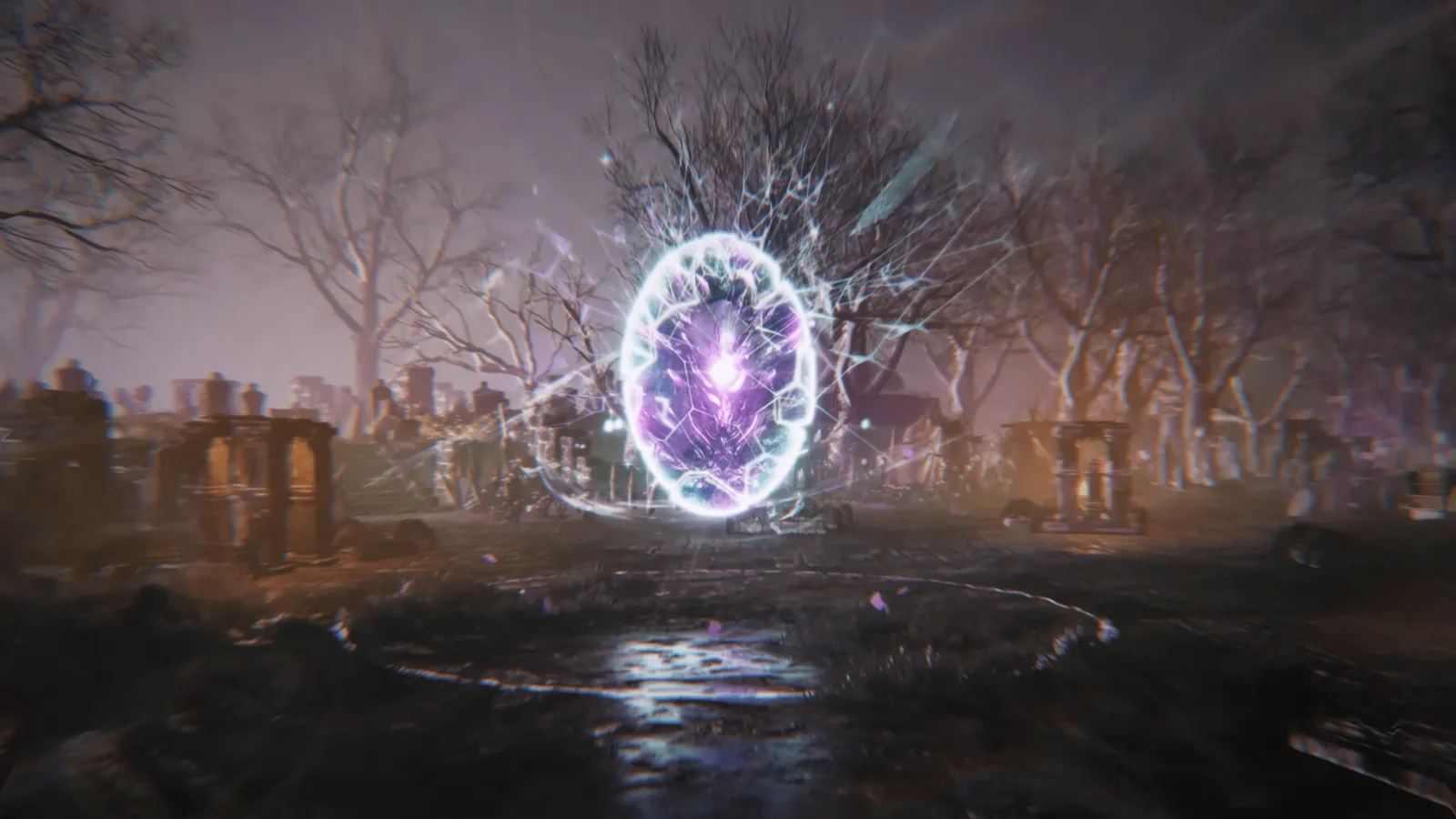
Season 4 is titled Shattered Omens.
Shattered Omens combined a seasonal encounter with several permanent-looking changes to equipment and endgame progression. The important distinction is that these systems did not all serve the same purpose.
| Season 4 addition | What it changed at launch | Why players cared |
|---|---|---|
| Omen Windows | Added enclosed horde encounters in the Campaign and Monolith | Created a repeatable source of seasonal rewards |
| Echo Chains | Connected several Echoes around a defined challenge or reward type | Made Monolith routes more deliberate |
| Rune of Corruption | Added an irreversible final gamble for finished equipment | Extended item progression beyond ordinary crafting |
| Idol Altars and Omen Idols | Changed Idol Grid layouts and introduced special Idol options | Added another layer of build-specific grid planning |
| Bladestorm and Shadow Rend | Added two Rogue skills with their own specialization trees | Opened new sustained-area and Shadow-based playstyles |
| Knowledge of Orobyss | Reworked access to higher-level Monolith timelines | Let players choose more of their route toward Empowered content |
| Vision of the Observer | Added a pinnacle encounter tied to Greater Omen Windows | Gave high-Corruption characters another endgame target |
| Loot-filter expansion | Raised the supported rule count and added more controls | Made detailed endgame filters easier to maintain |
For a returning player, the practical value of this list is diagnostic. A guide built around Omen Windows, Timeglass Fragments, or Season 4 balance assumptions is historical. A guide explaining a general interface improvement may still resemble the current game, but its exact instructions should be checked against the live client.
Omen Windows were the seasonal activity

The marked ring defines the Omen Window combat area.
Omen Windows appeared throughout Eterra during Season 4, including in the Campaign and the Monolith. Third-party launch documentation placed their first possible appearance as early as Chapter 2. Entering a Window began a horde-style encounter centered on a marked ring.
The launch flow was straightforward:
- Enter the Omen Window to start the encounter.
- Remain inside the marked area while defeating Fractured enemies empowered by the Omen.
- If you leave the ring, return before the failure countdown expires.
- Survive the enemy phase until the Omen becomes vulnerable.
- Defeat the Omen and collect the resulting seasonal rewards.
The reward pool described at launch included Timeglass Fragments, Runes of Corruption, already-corrupted equipment, Omen Idols, and Idol Altars. Higher-tier Windows increased the challenge and reward potential. These encounters therefore connected almost every major Season 4 system: fighting Omens supplied the materials and equipment used by the new item and Idol mechanics.
Greater Omen Windows were the Monolith escalation of the same idea. They used harder opening enemies and brought two Omens into the later phase. Completing one could create a Timeglass Core. At launch, that Core could start another Echo Chain or be shattered for additional fragments. Timeglass Fragments could then be spent with Apophis in the Monolith hub for items, crafting materials, and Woven Echoes.
This is the first place an old guide can become misleading. As of October 10, 2026, Season 5's Morditas ritual is the active seasonal activity. A Season 4 instruction telling you to farm Omen Windows for your present-season progression should therefore be treated as a historical route, not a confirmed Season 5 farming method.
Echo Chains gave Monolith runs a route
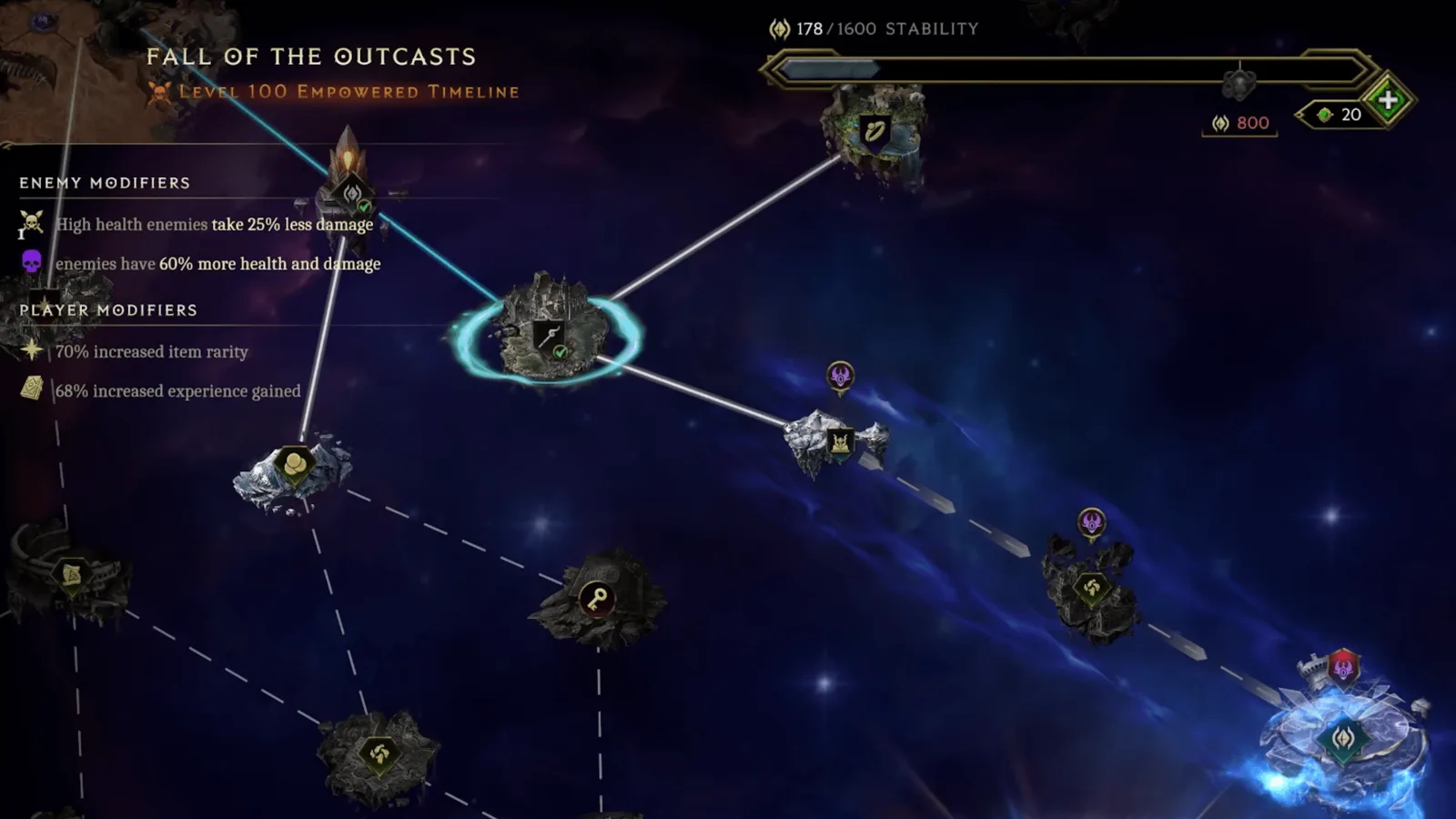
Echo Chains connect successive Monolith Echoes into a route.
Echo Chains linked several Echoes into a short sequence with a recognizable objective. Instead of selecting every Echo as an isolated map, a player could follow the chain and use the portal that appeared after completing each stage. That structure made it easier to pursue a particular encounter type or progression benefit.
Five chain categories were documented for the Season 4 launch:
- High Stability Chains awarded substantially more timeline stability than ordinary Echoes.
- Nemesis Chains guaranteed a Nemesis encounter in each Echo and ended in a Conquered Tower.
- Rift Beast Chains required a Rift Beast kill in each stage and ended in Primeval Cascade with several Rift Beasts.
- Omen Window Chains placed an Omen Window in every Echo, then ended with a Greater Omen Window and roaming Omens carried over from earlier stages.
- Pinnacle of Chaos Chains combined Omen activity with Champion enemies and ended in a dedicated Pinnacle of Chaos area.
Weaver Tree nodes could influence how these chains appeared or behaved. That made the system more than a linear set of bonus maps: it connected Monolith routing with a player's broader endgame choices.
When reading an archived build or farming guide, separate its route from its build logic. A resistance target, skill interaction, or defensive principle might remain understandable, while instructions such as “force this Echo Chain” or “spend the resulting Timeglass Core” belong specifically to the Season 4 environment unless newer material confirms otherwise.
Corrupted items added a final, irreversible gamble
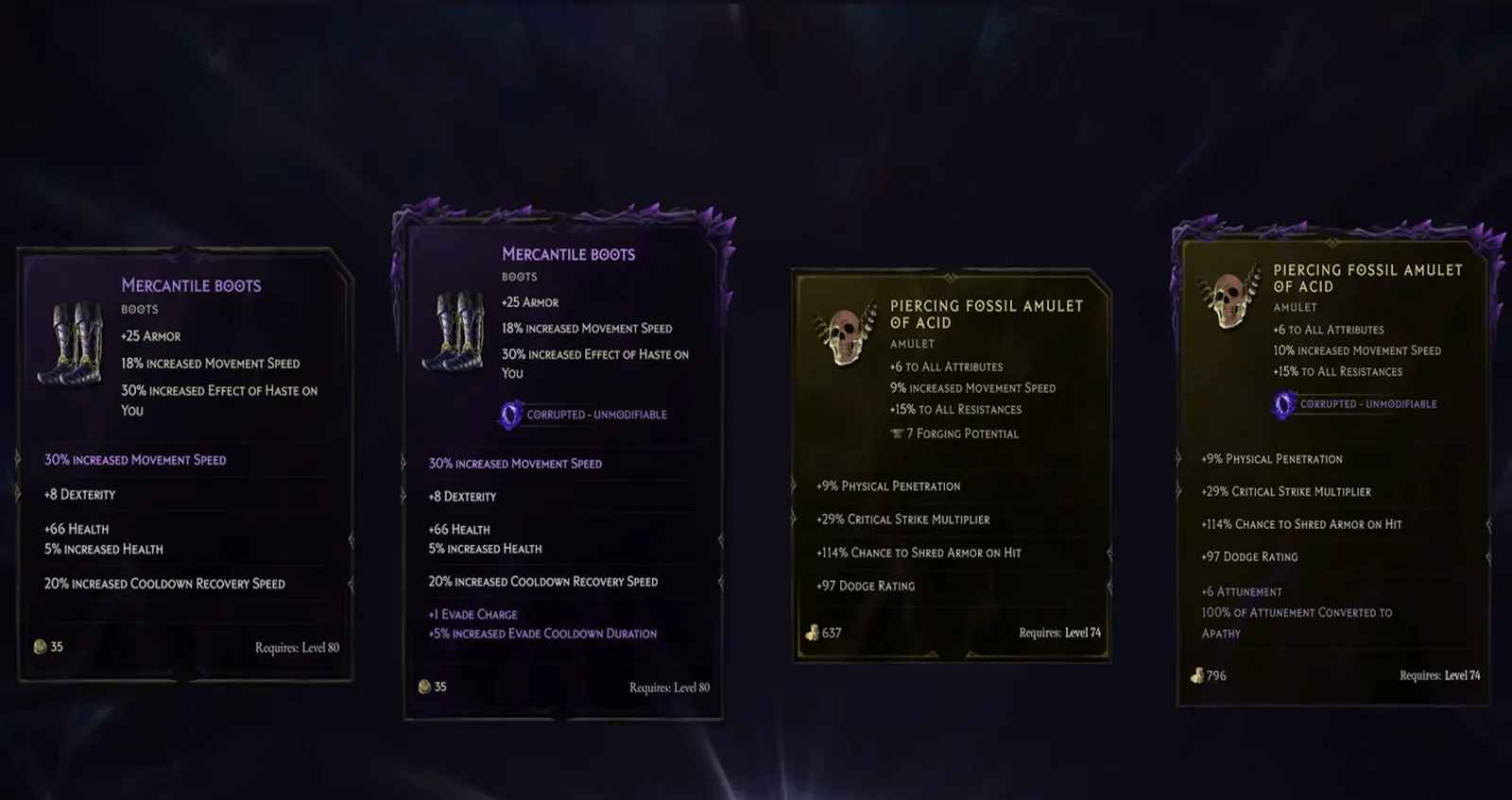
Rune of Corruption creates a permanent corrupted-item result.
The Rune of Corruption was designed for equipment that had already received its normal crafting work. At Season 4 launch, using the Rune could add or remove stats, change existing affix tiers, or convert base attributes into special corrupted attributes. The outcome could improve an item or damage its value.
The central rule was permanence: after corruption, the item could not be modified further through ordinary crafting. The safe Season 4 order was therefore:
- Decide whether the item was worth risking at all.
- Complete every ordinary craft you still needed.
- Confirm that you were willing to keep a bad corruption result.
- Use the Rune of Corruption only as the final operation.
- Recheck the complete item rather than evaluating only the new modifier.
This sequence still matters as historical context because it explains why old guides call corruption an end-of-crafting decision. It should not be confused with Monolith Corruption, which is an endgame difficulty and reward-scaling system rather than an item state.
Corrupted equipment remains a relevant system in Season 5. Check the current season’s acquisition rules, result pools, and balance values before using a Season 4 farming plan. For present-day crafting, preserve the irreversible-operation rule and verify the exact live tooltip before committing a valuable item.
Idol Altars changed grid planning
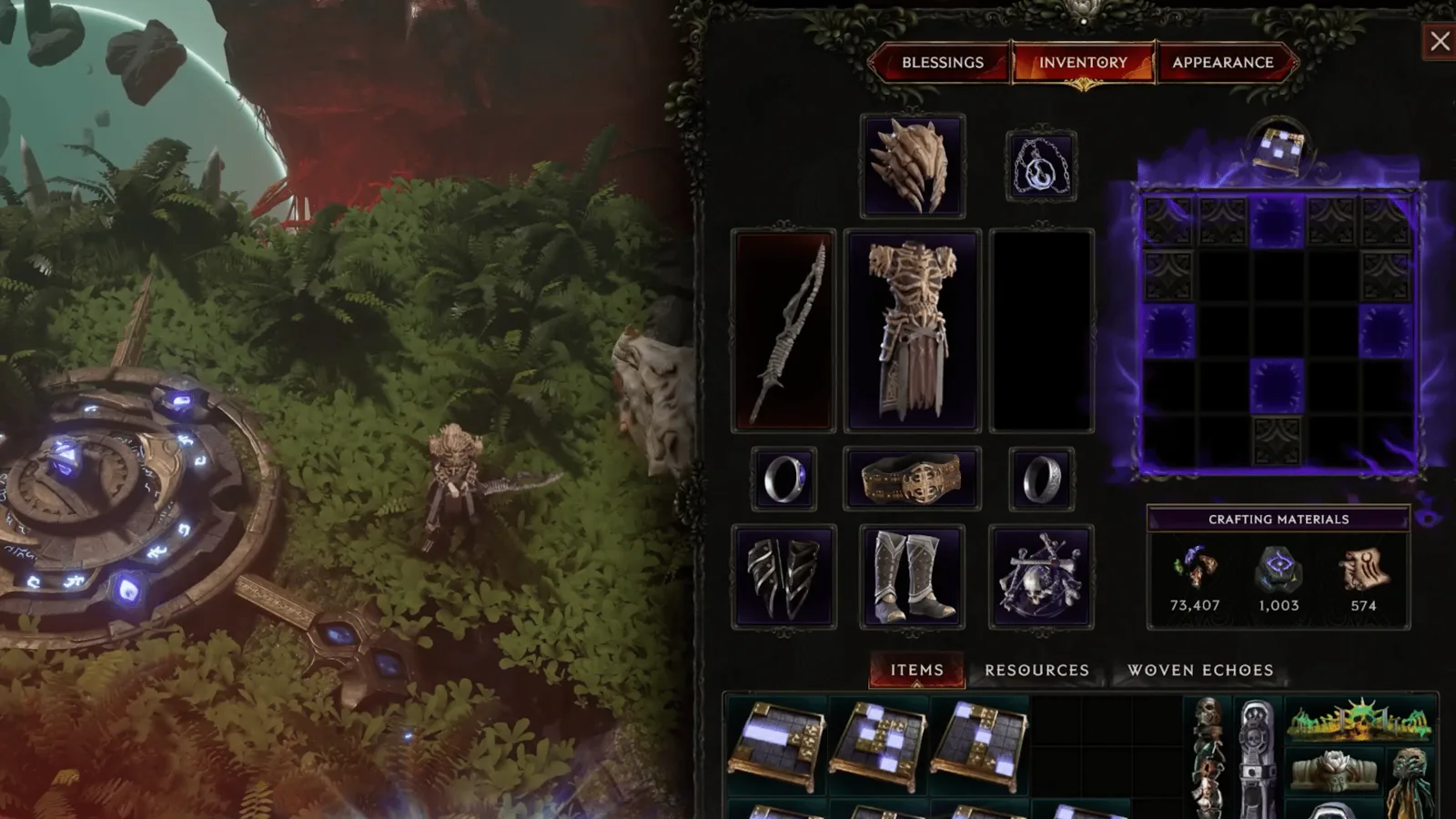
Idol Altars reshape the grid and add new placement options.
Idol Altars occupied a position above the Idol Grid and changed the grid's layout. Launch documentation described thirteen possible layouts and highlighted Refracted Slots, which applied additional benefits to Idols touching those spaces. This turned Idol planning into a shape-and-position problem rather than a simple exercise in filling a fixed rectangle.
Season 4 also introduced Omen Idols. These were described as 3-by-1 or 1-by-3 Idols carrying pre-corrupted affixes normally associated with larger Idol sizes. A character could equip one Omen Idol by default, while some Idol Altars could raise that limit.
The decision process was consequently more involved than choosing the Idol with the largest isolated modifier:
- Check how the Altar reshapes the usable grid.
- Identify which spaces are Refracted Slots.
- Place important Idols where they can benefit from those spaces.
- Confirm that the layout still accommodates the Idol sizes required by the build.
- Compare the benefit of another Omen Idol with the ordinary Idols displaced by the new arrangement.
An old planner screenshot may therefore fail even if every listed Idol still exists. If its grid shape came from a particular Season 4 Altar, copying only the individual Idols will not reproduce the setup.
Bladestorm and Shadow Rend expanded the Rogue toolkit
Season 4 added Bladestorm and Shadow Rend as full Rogue skills with their own specialization trees. These were additions to the class, not universal recommendations that made every older Rogue build obsolete.
Bladestorm created spinning blades at a chosen location and repeatedly damaged enemies in the area. Launch descriptions allowed as many as three storms to exist at once, while preventing one enemy from being hit by several storms simultaneously. Its tree supported changes to area, duration, damage types, movement, Shuriken interactions, and explosive behavior. Its basic identity was sustained control of an area rather than a single immediate strike.
Shadow Rend paired an initial forward attack with a Shadow that repeated a stronger attack after a delay. The lingering Shadow could interact with other Rogue actions, and specialization options changed critical, ailment, mobility, or Shadow-consumption behavior. Its identity was a two-stage burst pattern that rewarded planning around Shadow timing.
These summaries explain what the skills were meant to do at launch; they are not Season 5 build prescriptions. Later balance changes can alter nodes, damage, triggers, and required equipment. A current build should specify its applicable patch and provide a present-day specialization tree instead of relying on a Season 4 showcase.
Monolith progression was reorganized
Season 4 introduced the Knowledge of Orobyss quest as the route to level-90-and-higher timelines. At launch, the Monolith began from a more central hub: early timelines were available to the sides, while higher-level paths to the north remained locked until the quest reached five points.
Points came from completing Chapters IX and X and from selected timelines. Some timelines were documented as granting two points rather than one. The result was a choice between more easier objectives and fewer harder ones. Progress was also shared across characters, reducing how much of the same unlock route had to be repeated.
The Monolith interface received supporting changes. Timeline quests appeared as buttons, information panels exposed details such as area level, Corruption, and Harbinger status, and warnings clarified when death or leaving an Echo had reduced its rewards. The former reward rock and chest were combined into a central chest. Bonus stability during an Echo filled three markers, with greater progress improving the resulting chest.
These changes explain why Monolith footage from before and after Season 4 can look different even when both videos discuss the same timeline. For current navigation, follow the interface shown by version 1.5.2.1 rather than assuming every Season 4 unlock requirement remains authoritative.
Vision of the Observer was the new pinnacle target
The Season 4 pinnacle route began with a special Woven Echo called Omen's Veil. Its documented objective involved activating three Greater Omen Windows together. Completing that challenge awarded the Fractured Prison Echo, which contained Vision of the Observer.
The Fractured Prison required at least 400 Corruption at launch. The encounter was positioned between Aberroth and Uber Aberroth in expected difficulty, so it was not intended as a character's first Monolith boss. The route demanded both access to the required Woven content and a build capable of handling several Greater Omens before the final encounter even became available.
For a returning player, this boss route is best read as a record of Season 4's endgame ladder. Do not assume that its entrance item, Corruption requirement, or relative difficulty remains unchanged without confirmation from the current client.
Quality-of-life changes affected everyday play
Shattered Omens expanded loot filters from 75 to 200 rules and added filtering controls for corruption, crafting statistics, runes, glyphs, and shards. Item beams, map icons, and sounds could be configured separately, allowing a filter to communicate importance through more than text color.
The update also revised crafting presentation, stash sorting and search, controller feedback, character-sheet visibility, and several animations. Crafting results were shown more clearly before confirmation, while the combined Monolith reward chest reduced unnecessary movement between Echoes.
The rule-count increase was particularly important for advanced filters. It allowed one filter to cover more item bases, affix combinations, crafting stages, and character needs. However, a 200-rule filter is not automatically safer. Rules still need to be ordered and reviewed so that a broad hiding condition does not suppress valuable equipment.
Reading Season 4 guides in Season 5
Use three checks before following any Season 4 page today:
- Identify the mechanic boundary. Omen Windows, Timeglass Cores, and Shattered Omens reward loops describe Season 4. Season 5's active loop is the Morditas ritual.
- Identify the patch boundary. The current released hotfix is 1.5.2.1. A skill tree, item interaction, or boss strategy written for 1.4 may have been changed since publication.
- Separate concepts from values. Irreversible crafting order, grid-shape planning, and route comparison can remain useful concepts even when exact drops, node values, and unlock requirements have changed.
Shattered Omens matters because it added a connected endgame package: Omen Windows generated resources, Echo Chains organized their pursuit, corruption extended item progression, Idol Altars changed build planning, and Vision of the Observer supplied a high-end destination. Its overview remains useful history. Its exact farming and build instructions should be treated as version-bound until the current game confirms them.