No. You cannot use a corrupted item to create a Legendary item in the Eternity Cache. This applies whether the corrupted item is the Unique you want to upgrade or the Exalted item supplying the affixes. Once an item is corrupted, it cannot be crafted or improved further, and its Legendary Potential, Forging Potential, Weaver’s Will, and Touch are removed.
If you want to both slam and corrupt an item, the safe order is:
- Finish crafting the Exalted donor.
- Slam the eligible Unique and Exalted items in the Eternity Cache.
- Inspect the completed Legendary.
- Corrupt that Legendary only if you accept the risk of permanently changing or ruining it.
Corruption is the final operation, not a preparation step. If you corrupted the Unique or Exalted donor too early, there is no supported way to reverse the corruption and make that item eligible for a slam again.
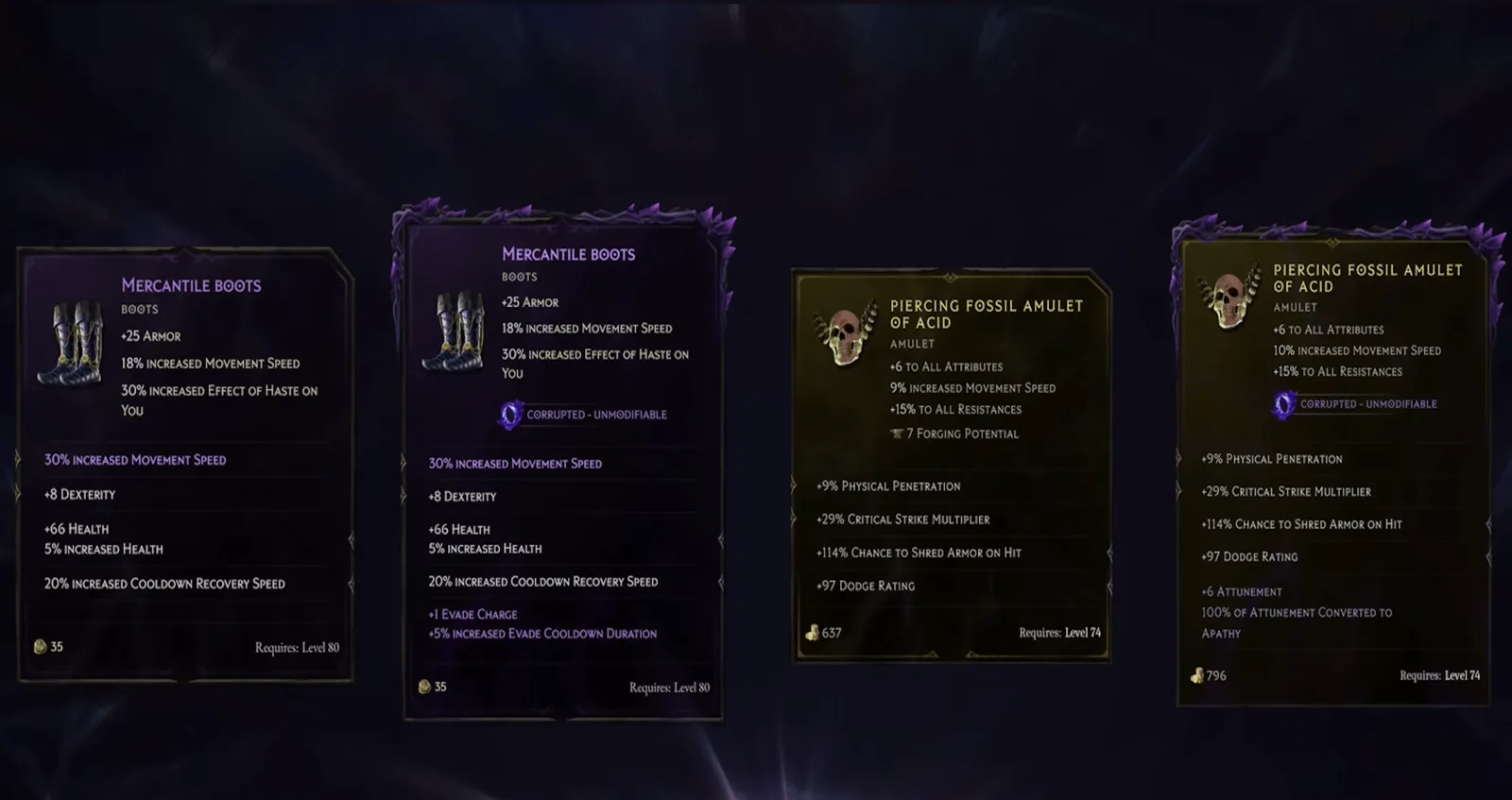
Corrupted item tooltip example. Check the corruption state before preparing an Eternity Cache attempt.
What players mean by slamming an item
“Slamming” is the community term for creating a Legendary item in the Eternity Cache. The operation combines two inputs:
- A Unique item with at least 1 Legendary Potential.
- An Exalted item of the matching item type with exactly four unsealed affixes.
The resulting Legendary keeps the identity and unique modifiers of the Unique item. It also receives a number of affixes from the Exalted donor equal to the Unique item’s Legendary Potential. At Tier 2 or higher Temporal Sanctum, you can choose one affix to guarantee its transfer. If more affixes must be transferred, the remaining selections are random.
For example, a Unique helmet with 2 Legendary Potential needs an eligible Exalted helmet. The completed Legendary receives two of the donor’s four unsealed affixes. At a qualifying dungeon tier, one can be selected as the guaranteed affix and the other is chosen randomly.
Corruption does not expand this recipe. It creates a separate, permanent item state that disqualifies the item from Legendary creation.
Why the Eternity Cache rejects a corrupted item
A corrupted item is locked against further modification. Corruption may change affix tiers or values, add or remove affixes, alter rarity, replace the item subtype, convert attributes on an amulet, or even make the item unequippable. Because those outcomes are permanent, the item is no longer accepted as a crafting input for the Eternity Cache.
The lock applies to both sides of the slam:
| Item you try to use | Accepted for a slam | Reason |
|---|---|---|
| Uncorrupted Unique with at least 1 Legendary Potential | Potentially yes | It can qualify if the other recipe requirements are met |
| Corrupted Unique | No | Corruption removes Legendary Potential and prevents further crafting |
| Eligible uncorrupted Exalted item | Potentially yes | It must match the Unique’s item type and have exactly four unsealed affixes |
| Corrupted Exalted item | No | A corrupted item cannot be modified or used to create a Legendary |
| Completed uncorrupted Legendary | Not an input | It is already the result of a slam |
| Completed corrupted Legendary | Not an input | It is both a finished Legendary and permanently corrupted |
A corrupted item can still be destroyed with a Rune of Shattering if that item would normally be eligible for shattering. It can also be destroyed at a Sacrificial Altar. Those are destructive exceptions, not ways to resume crafting, recover Legendary Potential, or perform a slam.
Eligibility checklist before the slam
Use this checklist before entering the Eternity Cache room or committing either item:
- The Unique is not corrupted. If its tooltip shows that it is corrupted, stop. It cannot be used.
- The Unique has at least 1 Legendary Potential. A Unique without Legendary Potential cannot receive donor affixes through the Cache.
- The donor is Exalted and not corrupted. A Rare item is not a substitute, even if it has four desirable affixes.
- The two items have the same equipment type. A Unique helmet needs an Exalted helmet, a Unique shield needs an Exalted shield, and so on.
- The Exalted donor has exactly four unsealed affixes. A sealed affix may also be present, but it is ignored during Legendary creation and cannot transfer.
- The donor affixes are finished. Upgrade, replace, seal, or otherwise craft the donor before the slam. The Exalted item is consumed by the operation, so there is no later chance to improve it.
- The dungeon tier accepts the Unique. Higher-level Uniques require an appropriate Temporal Sanctum tier.
- Your guaranteed affix is selected deliberately. At Tier 2 or higher, select the affix you cannot afford to miss before completing the operation.
Forging Potential on the Exalted donor does not determine whether its affixes can transfer. An eligible Exalted item with 0 Forging Potential can still be used. That makes it sensible to finish every useful donor affix before the slam, even if the final crafting operation consumes the remaining Forging Potential.
Do not confuse four total visible affixes with four unsealed affixes. A donor with three unsealed affixes and one sealed affix does not meet the requirement. The sealed affix is extra; it does not fill one of the four required donor slots.
The safe crafting order
Following a fixed order prevents the most common irreversible mistake.
1. Protect the irreplaceable Unique
Keep the target Unique uncorrupted while you prepare the donor. If the item has rare rolls or unusually high Legendary Potential, leave it in your stash until the Exalted item is ready. Corrupting it “for one more modifier” first will remove the property required for the slam.
A backup copy is especially valuable if you eventually plan to corrupt the completed Legendary. The slam consumes both ingredients, and the later corruption can make the result worse or unequippable. Your currently equipped, build-enabling item should not be the only copy exposed to that risk.
2. Finish the Exalted donor
Craft the donor before it enters the Cache. Confirm that it has the desired four unsealed affixes and that the most important affix is at the best tier you can safely produce. Do not leave a planned upgrade for later: the donor disappears during the slam, and the resulting Legendary cannot be edited as though it were still an Exalted item.
If the donor has a sealed affix, remember that it will be ignored. Judge the item by the four unsealed affixes that are actually eligible to transfer.
3. Perform the slam while both items are uncorrupted
Place the qualifying Unique and Exalted items into the Eternity Cache. At Tier 2 or higher, choose the affix that must transfer. Complete the combination and collect the Legendary result.
Check the new item immediately. Verify which affixes transferred, its resulting level requirement, and whether your character can still equip it. A class-specific transferred affix can make the Legendary class-specific, so eligibility for the Cache does not guarantee that every character can use the result.
4. Decide whether the finished Legendary is worth corrupting
Only now should you consider a Rune of Corruption. The rune can improve the item, leave you with an awkward tradeoff, or damage the item’s usefulness. Possible outcome categories include changed affix tiers or values, added or removed affixes, changed rarity or subtype, and an unequippable result.
There is no follow-up crafting phase after this step. Corruption locks the Legendary in its resulting state. Treat the rune as a wager on an already completed item, not as another normal forge operation.
What to do when an item was corrupted too early
The correct response depends on which ingredient was corrupted.
The target Unique is already corrupted
Do not spend a Temporal Sanctum key expecting the Cache to repair or accept it. The Unique has lost its Legendary Potential and cannot be used to create a Legendary. Keep it only if its corrupted outcome is useful as equipped gear, or use an allowed destructive option if you no longer want it.
To continue the original slam plan, obtain another uncorrupted copy with Legendary Potential. Recheck its rolls before investing in a new donor, because the replacement may not have the same base modifiers or Legendary Potential as the item you lost.
The Exalted donor is already corrupted
That donor is also ineligible. Its four affixes may look perfect, but corruption prevents the Cache from using it. You need another matching Exalted item with four unsealed affixes.
Do not corrupt a donor in the hope that a favorable fifth modifier will somehow transfer. Legendary creation selects from the four eligible unsealed affixes on a valid Exalted input; a corrupted item is rejected before that selection matters.
The Legendary result is already corrupted
The slam has already happened, so there is no second slam to perform on that item. Evaluate the corrupted Legendary as a finished piece of equipment. It cannot be reopened, recrafted, or combined with another Exalted item to replace an unwanted transferred affix.
A Season 4 community strategy used corrupted Legendaries as sacrificial items in a Woven Offering to reroll another Unique’s inherent modifier values. That is a separate sacrificial use, not permission to place a corrupted item into the Eternity Cache. It also does not turn the sacrificed item back into a valid slam ingredient.
Common reasons an attempted slam fails
If the Cache refuses your items, check these causes in order:
- One item is corrupted. This is the immediate answer for a tooltip-marked corrupted Unique or donor.
- The Unique has no Legendary Potential. A normal Unique without at least 1 LP cannot be slammed.
- The donor is not Exalted. Rare, Magic, Set, and other item states do not replace the required Exalted donor.
- The equipment types do not match. Matching slot names matter; broadly similar equipment is not enough.
- The donor lacks four unsealed affixes. A sealed affix is ignored and does not count toward the four.
- The selected Temporal Sanctum tier is too low for the Unique. Use a dungeon tier that permits the Unique’s level requirement.
- A class restriction makes the pairing unusable. Recheck class-specific affixes and the class eligibility of the intended result.
Corrupted items may also appear invalid in ordinary Forge and stash interactions because the current interface no longer highlights them as valid crafting candidates. That behavior is consistent with their locked state; it is not evidence that the item needs more Forging Potential or a different rune.
When corruption is worth considering
Corruption makes the most sense after the item is already complete and replaceable. Consider it when all of the following are true:
- The Legendary already works for your build.
- No normal crafting step remains unfinished.
- You have a backup item that keeps the build functional.
- You understand that a positive-looking result may still introduce a harmful tradeoff.
- You can accept losing the item’s current usefulness.
Avoid corruption when the item is your only build-enabling piece, when you still need to slam it, or when the current Legendary already solves the problem you crafted it for. The chance of extra power does not remove the possibility of reduced affixes, an undesirable subtype, or an unequippable result.
The practical rule is simple: craft first, slam second, corrupt last. A corrupted item cannot go into the Eternity Cache, but a completed Legendary can be corrupted afterward if you knowingly accept that the result is permanent.